
TEO RTS-EX Confocal Micro-Raman Spectrometer
| Brand | TEO |
|---|---|
| Origin | Beijing, China |
| Manufacturer Type | Authorized Distributor |
| Product Category | Domestic |
| Model | RTS-EX |
| Instrument Type | Confocal Micro-Raman Spectrometer |
| Spectral Range | 200–1100 nm |
| Spectral Resolution | <0.8 cm⁻¹ |
| Spatial Resolution | Lateral <1 µm, Axial <2 µm |
| Minimum Wavenumber | 0 cm⁻¹ |
| Spectral Reproducibility | ±0.2 cm⁻¹ |
Overview
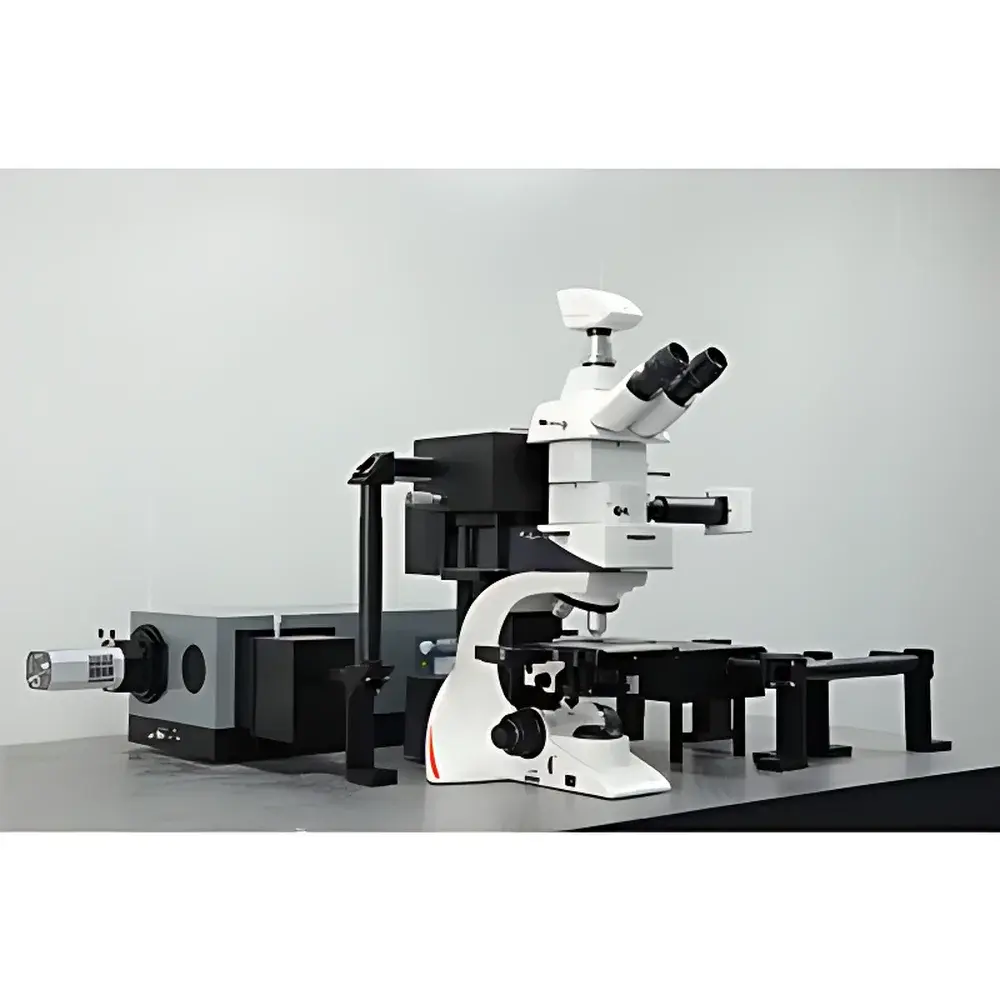
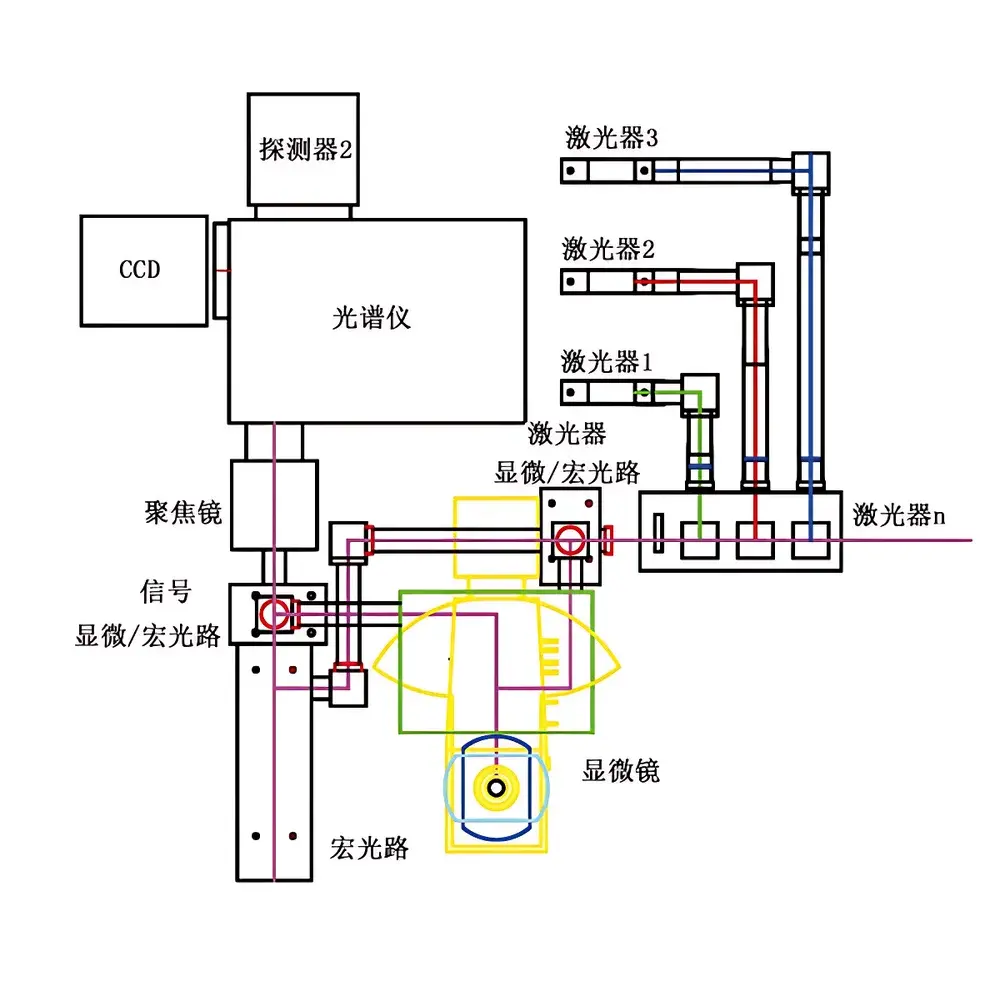
The TEO RTS-EX Confocal Micro-Raman Spectrometer is a research-grade, modular optical spectroscopy platform engineered for high-fidelity Raman microspectroscopy in academic, industrial, and metrology laboratories. It operates on the principle of inelastic light scattering (Raman effect), where monochromatic excitation—typically from visible or near-UV lasers—is focused onto a microscopic sample volume via an integrated high-numerical-aperture microscope. Scattered photons are collected through the same objective, spectrally dispersed by a high-efficiency Czerny–Turner monochromator equipped with selectable holographic gratings (150–1800 grooves/mm), and detected by a deep-cooled, back-illuminated scientific CCD optimized for quantum efficiency in the 200–1100 nm range. The confocal architecture employs pinhole-based spatial filtering to reject out-of-focus signal, enabling depth-resolved spectral acquisition with sub-micron lateral and axial resolution. This design supports quantitative mapping, layer-specific analysis of thin films, and non-destructive chemical identification at diffraction-limited spatial scales.
Key Features
- Confocal optical architecture with motorized XYZ stage and software-controlled pinhole alignment for optimal depth sectioning
- Deep-cooled, low-noise back-illuminated CCD detector with >90% peak quantum efficiency and thermoelectric cooling to –70 °C
- High-throughput optical path: total system throughput >80% across visible–NIR range, minimizing integration time without sacrificing SNR
- Stable, horizontal beam path design eliminates thermal drift-induced spectral shift; no daily wavelength recalibration required
- Modular laser coupling: standard 532 nm DPSS laser; optional UV (266/325 nm), visible (488/532/633 nm), and NIR (785/1064 nm) sources with automatic wavelength registration
- Interchangeable grating turret supporting simultaneous optimization of resolution (<0.8 cm⁻¹), throughput, and spectral coverage (60–5000 cm⁻¹)
- Automated alignment routines and real-time spectral preview enable rapid method development and operator independence
Sample Compatibility & Compliance
The RTS-EX accommodates diverse sample geometries—from bulk crystals and polished wafers to biological tissue sections, polymer blends, and 2D materials—via interchangeable microscope objectives (10×–100×, NA 0.25–0.95) and dual-path illumination (micro- and macro-mode). Sample environments include ambient air, inert gas purge, vacuum-compatible stages, and optional cryostats (4–300 K), high-temperature furnaces (up to 1000 °C), and electromagnet cells (±2 T). All hardware and firmware comply with CE marking requirements. Data acquisition and processing workflows support audit trails, electronic signatures, and metadata tagging aligned with GLP and ISO/IEC 17025 documentation standards. Optional FDA 21 CFR Part 11-compliant software modules are available for regulated QC/QA environments.
Software & Data Management
Control and analysis are performed using TEO SpectraSuite™ v5.x—a Windows-based platform featuring intuitive graphical workflow builders, batch processing pipelines, multivariate analysis (PCA, cluster analysis), and spectral library matching (NIST, RRUFF, commercial material databases). Raw spectra are stored in vendor-neutral HDF5 format with embedded calibration, instrument configuration, and environmental metadata. Export options include ASCII, CSV, JCAMP-DX, and MATLAB-compatible .mat files. Remote monitoring, scheduled acquisitions, and API-driven automation (Python/LabVIEW SDKs) facilitate integration into automated lab networks and high-throughput screening setups.
Applications
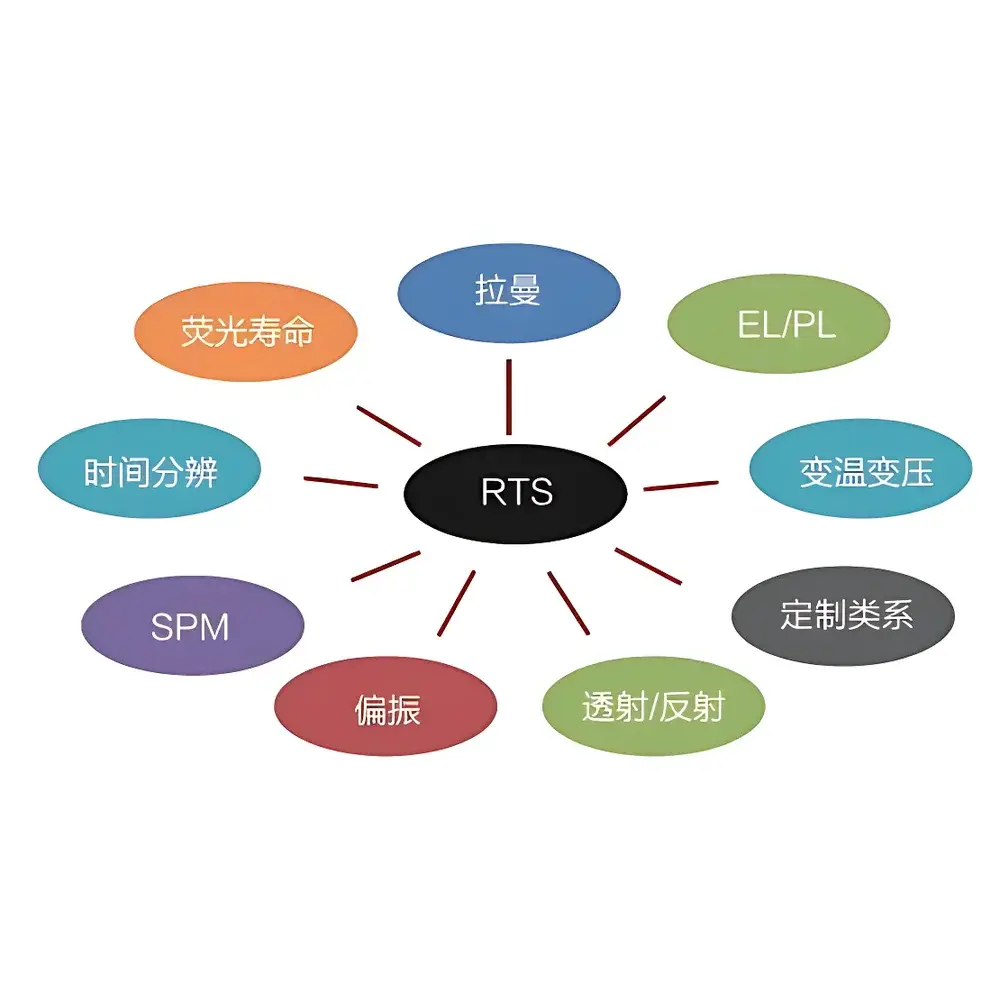
- Identification and stress/strain mapping of graphene, transition metal dichalcogenides (TMDs), and other 2D heterostructures
- Phase distribution analysis in pharmaceutical polymorphs and amorphous/crystalline domain characterization
- In situ electrochemical Raman monitoring of battery electrode interfaces under potentiostatic control
- Microplastic identification and polymer degradation assessment in environmental samples
- Non-invasive histopathological analysis of fixed tissue sections using label-free Raman contrast
- Correlative Raman–AFM (TERS-ready) for nanoscale chemical–topographical co-localization
- Time-resolved studies via TCSPC-compatible extensions for fluorescence lifetime–Raman hybrid measurements
FAQ
What laser wavelengths are supported natively, and how are multiple excitations managed?
The RTS-EX ships with a 532 nm laser as standard. Additional wavelengths—including 266, 325, 488, 633, 785, and 1064 nm—are integrated via fiber-coupled ports with automated shutter and filter wheel control. Each laser source is registered in software with its own calibration map and power normalization profile.
Can the system perform true confocal Raman imaging with Z-stacking and 3D reconstruction?
Yes. Motorized piezo Z-stage (100 µm range, 1 nm step size) enables precise optical sectioning. Depth profiling and volumetric reconstruction are supported through native 3D spectral cube acquisition and post-processing tools for intensity, peak position, and FWHM mapping.
Is spectral calibration traceable to NIST standards?
All systems undergo factory calibration using neon and argon emission lines, with optional on-site recalibration using NIST-traceable Raman standards (e.g., silicon, cyclohexane, sulfur). Calibration certificates include uncertainty budgets per ISO/IEC 17025 guidelines.
What data security and compliance features are included for regulated industries?
Optional SpectraSuite™ GxP Edition provides role-based access control, full electronic audit trail, 21 CFR Part 11-compliant e-signatures, and encrypted database storage—validated for use in pharmaceutical, medical device, and contract research organizations adhering to GMP/GLP frameworks.
Related Products






