
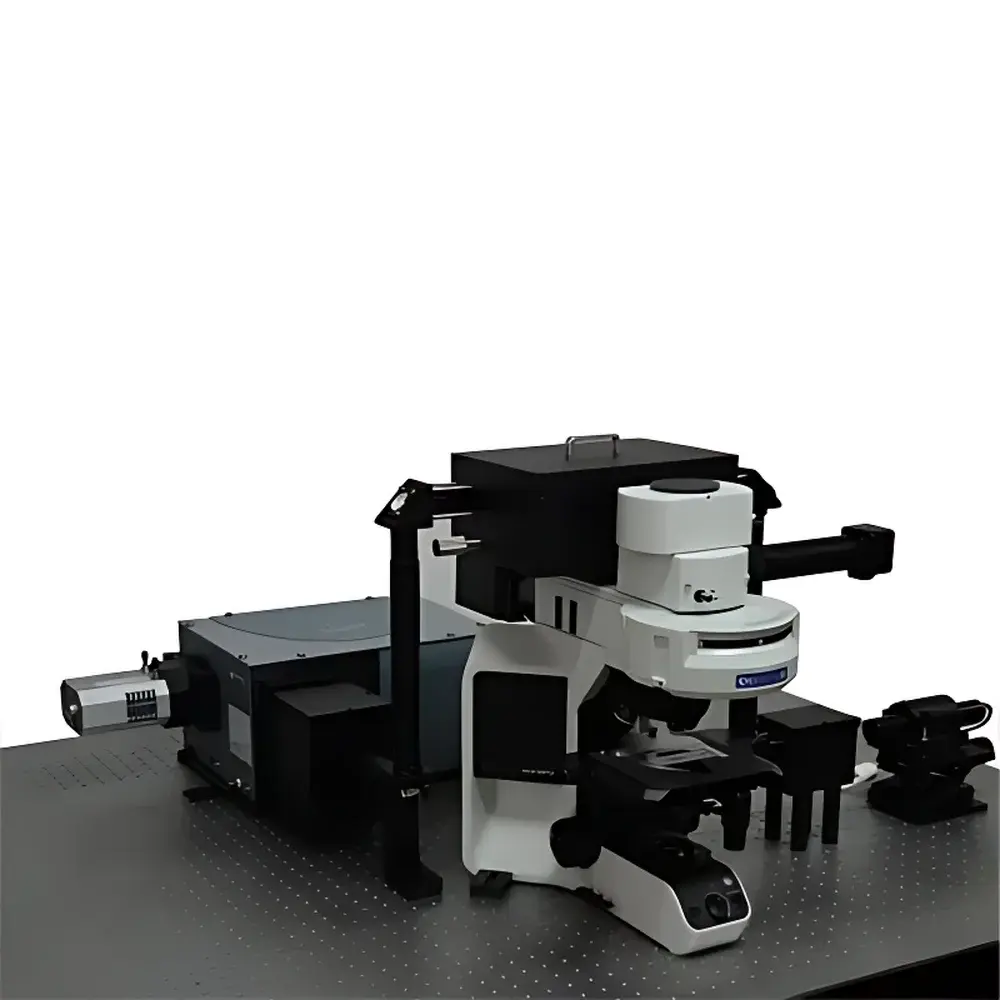
TEO RTS-B Micro-Raman Spectrometer with Confocal Microscopy
| Brand | TEO |
|---|---|
| Origin | Beijing, China |
| Manufacturer Type | Authorized Distributor |
| Origin Category | Domestic (China) |
| Model | RTS-B |
| Price | USD 70,000 (approx.) |
| Instrument Type | Confocal Micro-Raman Spectrometer |
| Spectral Range | 60–5000 cm⁻¹ |
| Spectral Resolution | <1 cm⁻¹ |
| Spatial Resolution | Lateral <1 µm, Axial <2 µm |
| Minimum Wavenumber | 0 cm⁻¹ |
| Spectral Reproducibility | ±0.2 cm⁻¹ |
| Excitation Lasers | Standard 532 nm |
| Microscope | Olympus BX53 or Leica DM2700 upright research-grade microscope |
| Gratings | 150, 600, 1800 grooves/mm (blaze wavelength selectable) |
| Detector | Deep-cooled, infrared-enhanced, low-noise scientific CCD |
| Confocal Mode | Slit-CCD coupled high-throughput confocal architecture |
| Optical Path | Horizontal, rigid monolithic design |
Overview
The TEO RTS-B is a high-performance confocal micro-Raman spectrometer engineered for precision molecular fingerprinting at diffraction-limited spatial resolution. Based on the principle of inelastic light scattering—where incident monochromatic laser photons interact with vibrational modes of chemical bonds—the system delivers quantitative, non-destructive, and label-free spectral identification across solid, liquid, and thin-film samples. Its optical architecture integrates a stabilized horizontal beam path, rigid optomechanical mounting, and a slit-coupled CCD confocal detection scheme to minimize thermal drift and mechanical hysteresis. Unlike conventional dispersive Raman systems, the RTS-B employs a true confocal pinhole-less design using spectral filtering and precise focus control, enabling depth-resolved analysis without sacrificing throughput. Designed for laboratory environments requiring long-term stability and regulatory-compliant operation, the instrument maintains spectral calibration without daily recalibration—a critical advantage for GLP/GMP-aligned quality control labs and academic core facilities.
Key Features
- High optical throughput: >50% system transmission efficiency across the 200–1100 nm spectral window, optimized for both visible and NIR excitation
- Deep-cooled scientific CCD detector: Thermoelectrically cooled to –70 °C, with infrared enhancement and read noise <3 e⁻ RMS, ensuring high signal-to-noise ratio even for weak Raman scatterers
- Sub-micron spatial resolution: Lateral resolution <1 µm (at 532 nm), axial resolution <2 µm—enabling mapping of heterogeneous materials, grain boundaries, and thin-film interfaces
- Rigid horizontal optical layout: Minimizes sensitivity to vibration and thermal expansion; eliminates need for routine wavelength recalibration per ASTM E1840 and ISO/IEC 17025 guidelines
- Modular excitation platform: Standard 532 nm diode-pumped solid-state (DPSS) laser; optional upgrade paths to 325 nm (HeCd), 405 nm (diode), 633 nm (HeNe), 785 nm, or pulsed UV/NIR sources
- Interchangeable grating turret: Supports 150, 600, and 1800 grooves/mm gratings with selectable blaze wavelengths—balancing resolution, dispersion, and throughput per application requirement
Sample Compatibility & Compliance
The RTS-B accommodates diverse sample geometries via dual-path optical configuration: a high-magnification confocal micro-mode (using Olympus BX53 or Leica DM2700 upright microscopes) and a macro-mode for bulk or irregularly shaped specimens. It supports ambient, inert-gas, vacuum, and temperature-controlled stages (–190 °C to +600 °C, optional). All hardware and software comply with IEC 61000-6-3 (EMC) and IEC 61010-1 (safety). Data acquisition and storage adhere to ALCOA+ principles (Attributable, Legible, Contemporaneous, Original, Accurate, Complete, Consistent, Enduring, Available); audit trails, electronic signatures, and user-role permissions are configurable to meet FDA 21 CFR Part 11 and EU Annex 11 requirements when paired with validated software modules.
Software & Data Management
The system runs on TEO SpectraSuite v5.x—a Windows-based platform supporting real-time spectral acquisition, multi-point mapping, automated focus tracking, and batch processing. It includes embedded algorithms for cosmic ray removal, fluorescence background subtraction (polynomial and iterative morphological), peak fitting (Voigt/Lorentzian/Gaussian), and multivariate analysis (PCA, cluster analysis). Raw data is saved in HDF5 format (ISO/IEC 11581 compliant), ensuring long-term readability and interoperability with MATLAB, Python (via h5py), and commercial chemometrics packages. All processing steps—including baseline correction, normalization, and spectral alignment—are logged with timestamps and operator IDs for full traceability.
Applications
- Pharmaceutical polymorph screening and API crystallinity assessment per USP and ICH Q5A
- Carbon nanomaterial characterization (graphene layer count, defect density via D/G ratio)
- Microplastic identification in environmental samples (FTIR cross-validation supported)
- Strain and doping profiling in semiconductor wafers and 2D materials
- In situ electrochemical Raman monitoring of battery electrode interfaces
- Biomedical tissue diagnostics—e.g., distinguishing cancerous vs. normal epithelial cells based on nucleic acid/protein band ratios
FAQ
What laser safety class does the RTS-B operate under?
The standard 532 nm configuration operates as Class IV laser product per IEC 60825-1; integrated interlocks, beam shutters, and key-controlled access ensure compliance with OSHA 29 CFR 1926.102 and ANSI Z136.1.
Can the system be upgraded to time-resolved or PL spectroscopy?
Yes—the modular optical bench supports seamless integration of TCSPC electronics, pulsed laser drivers, and gated ICCD detectors for fluorescence lifetime and photoluminescence quantum yield measurements.
Is spectral calibration traceable to NIST standards?
Factory calibration uses NIST-traceable neon and argon emission lines; users may perform verification with provided Si (520.7 cm⁻¹) and cyclohexane reference standards.
What maintenance is required for long-term spectral stability?
No routine optical alignment is needed; annual verification of grating position accuracy and CCD dark current performance is recommended per ISO/IEC 17025 clause 6.4.3.





