
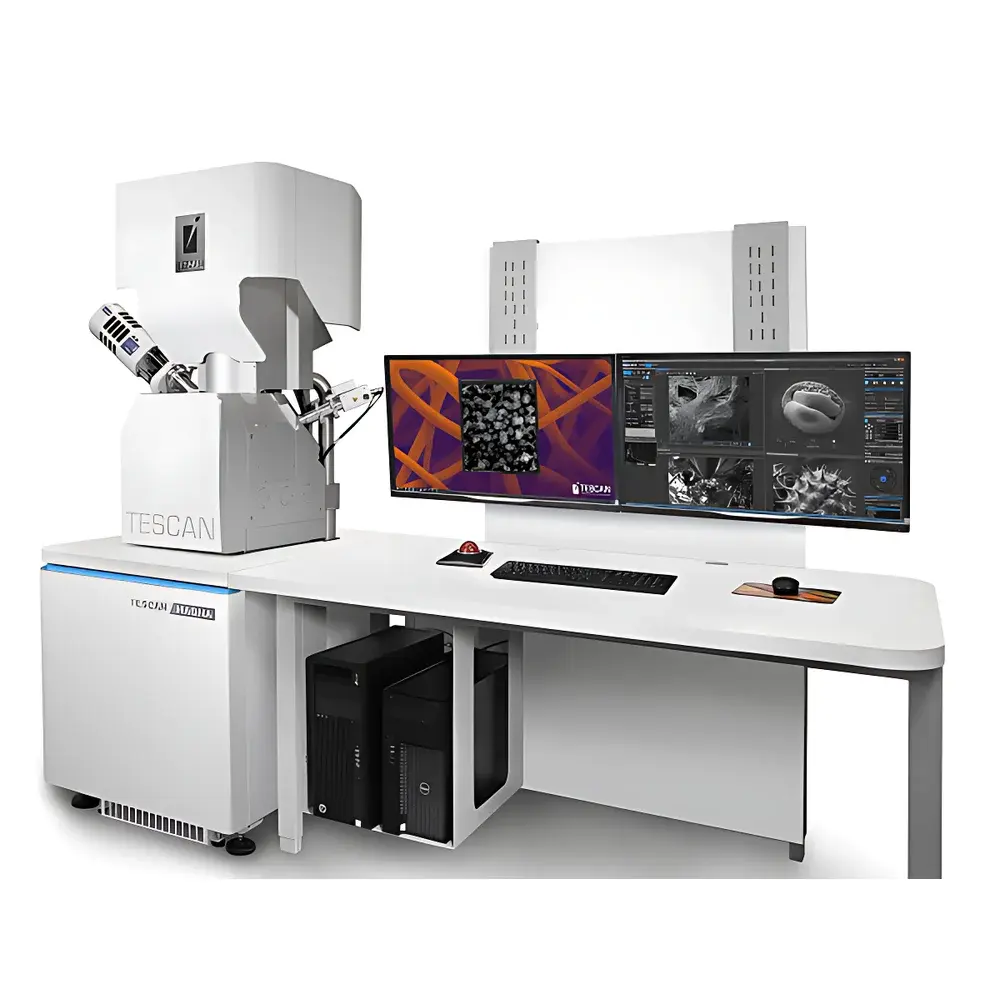
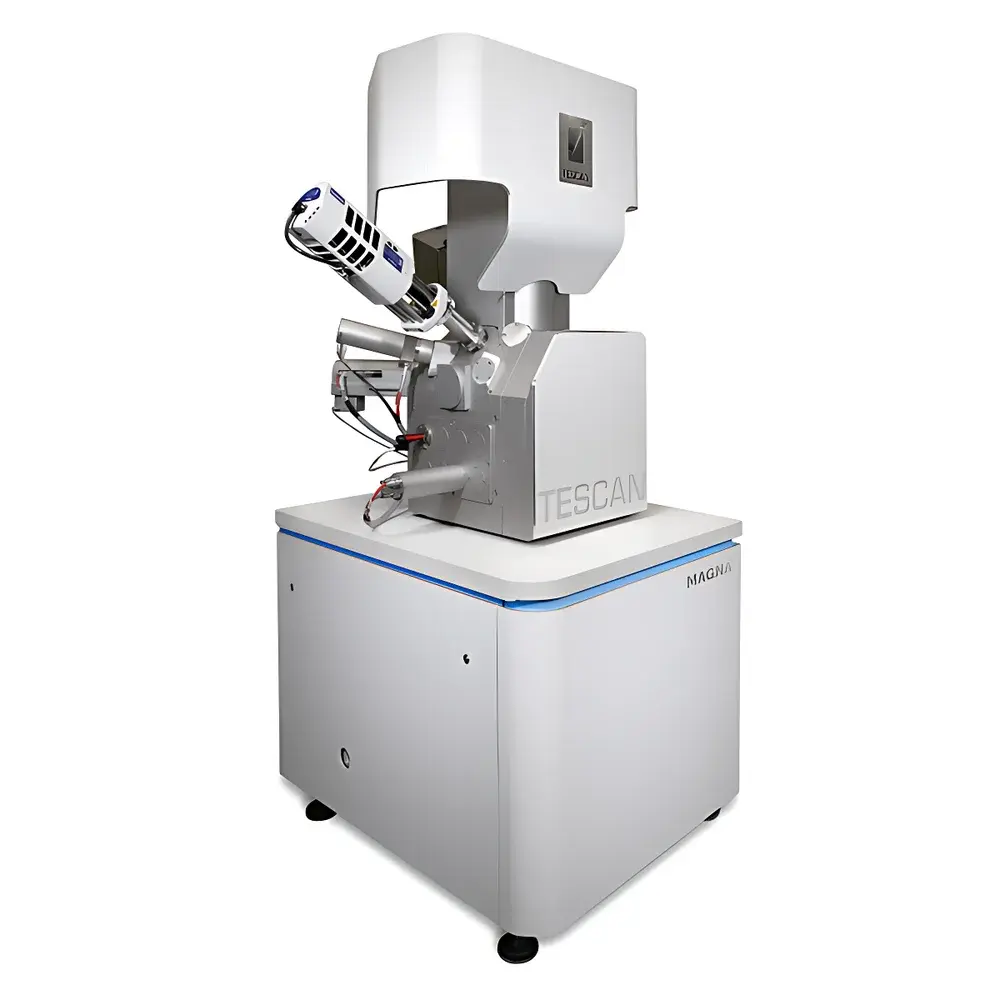
TESCAN MAGNA Next-Generation Ultra-High-Resolution Field-Emission Scanning Electron Microscope
| Brand | TESCAN |
|---|---|
| Origin | Czech Republic |
| Manufacturer Type | Original Equipment Manufacturer (OEM) |
| Instrument Type | Floor-Standing SEM |
| Electron Source | Schottky Field-Emission Gun (FEG) |
| Secondary Electron Resolution | 0.6 nm @ 15 kV |
| Magnification Range | 2× to 2,000,000× |
| Accelerating Voltage | 0.2–30 kV (deceleration mode down to <50 V) |
| Backscattered Electron Resolution | 1.6 nm @ 15 kV |
Overview
The TESCAN MAGNA is a next-generation ultra-high-resolution field-emission scanning electron microscope (FE-SEM), engineered for nanoscale morphological characterization and quantitative microanalysis in demanding research and industrial laboratories. Built upon the proven S9000 platform and incorporating fundamental architectural innovations, the MAGNA leverages TESCAN’s proprietary Triglav™ SEM column — a tri-lens optical system integrating three independently optimized objective lenses — to deliver simultaneous high-resolution imaging, high-sensitivity signal detection, and robust analytical performance across a broad operational parameter space. Its Schottky field-emission electron source provides stable, high-brightness electron beams with beam currents up to 400 nA, enabling both high-speed imaging and high-count-rate spectroscopic analysis (EDS, WDS, EBSD) without compromising spatial resolution. The system operates over an extended accelerating voltage range (0.2–30 kV), including sub-50 V deceleration mode, which significantly enhances surface sensitivity and minimizes charging on insulating or beam-sensitive specimens — such as uncoated biological tissues, ceramics, polymers, and photoresist-patterned semiconductor wafers.
Key Features
- Triglav™ Tri-Lens Column Architecture: Integrates UH-Resolution, Analytical, and Multi-Mode objective lenses — enabling seamless switching between ultra-high-resolution topography, magnetic-sample-compatible zero-field imaging, and multi-signal acquisition modes.
- TriBE™ Backscattered Electron Detection System: Comprises three BSE detectors — In-Beam f-BSE (axial), Mid-Angle BSE (lateral), and Chamber-Mounted Wide-Angle BSE — allowing energy- and angle-selective signal separation for compositional contrast, crystallographic orientation mapping, and phase discrimination.
- TriSE™ Secondary Electron Detection System: Features In-Beam SE (for short working distance and high signal-to-noise ratio), Beam-Deceleration Mode SE (BDM-SE, optimized for <1 kV operation and sub-nanometer resolution), and Chamber-Mounted SE (for optimal topographic contrast at variable WD).
- Adaptive Spot Optimization (ASO): Dynamically adjusts probe convergence and stigmation in real time during high-current operation, maintaining sub-nanometer probe size even at 400 nA — critical for high-fidelity EDS mapping, WDS trace analysis, and EBSD pattern indexing.
- Integrated Vacuum Architecture: Fully differential pumping with cold trap and ion getter pump ensures ultra-high vacuum (<1×10⁻⁷ Pa) in the gun and column regions, maximizing beam stability and source lifetime while minimizing contamination.
Sample Compatibility & Compliance
The TESCAN MAGNA supports a wide range of sample types without mandatory conductive coating, thanks to its low-voltage imaging capability, beam deceleration mode, and advanced charge compensation algorithms. It routinely accommodates non-conductive ceramics, geological thin sections, freeze-fractured biological specimens, battery electrode cross-sections, and lithographically patterned semiconductor devices. The system complies with international safety and electromagnetic compatibility standards (IEC 61000-6-3, IEC 61000-6-4, IEC 61010-1). For regulated environments, optional audit-trail-enabled software modules support 21 CFR Part 11 compliance, GLP/GMP documentation workflows, and ISO/IEC 17025 traceability requirements for analytical reporting. All detector configurations and acquisition parameters are fully logged and exportable for method validation and regulatory submissions.
Software & Data Management
TESCAN Essence™ is a modular, role-based software platform designed for multi-user laboratory environments. Its Layout Manager allows users to save and recall instrument configurations tailored to specific applications — e.g., “High-Resolution Nanoparticle Imaging”, “EBSD Crystallographic Mapping”, or “Low-kV Polymer Surface Analysis”. Automated scripting (Python API), batch acquisition, and AI-assisted feature recognition (e.g., particle sizing, pore network analysis) are embedded natively. Raw data is stored in open-format HDF5 containers with embedded metadata (acquisition parameters, calibration history, stage coordinates), ensuring long-term archival integrity and interoperability with third-party analysis tools (e.g., DigitalMicrograph, MATLAB, HyperSpy). All user actions — from parameter changes to image annotations — are recorded in a tamper-proof electronic log compliant with ALCOA+ principles.
Applications
The TESCAN MAGNA serves core functions across materials science, life sciences, geoscience, and semiconductor R&D. Typical use cases include: atomic-scale defect imaging in 2D transition metal dichalcogenides; high-fidelity EBSD phase mapping of additively manufactured nickel superalloys; low-kV secondary electron imaging of graphene wrinkles and carbon nanotube junctions; high-current EDS line scans across solid-electrolyte interphase (SEI) layers in lithium-ion battery anodes; and correlative FIB-SEM tomography of bone ultrastructure. Its dual-beam capability (when integrated with TESCAN’s XEIA3 FIB column) enables precise site-specific cross-sectioning, lamella preparation for TEM, and in situ nanomechanical testing.
FAQ
What vacuum level does the MAGNA maintain in the electron gun chamber?
The Schottky FEG chamber operates continuously at ≤1×10⁻⁸ Pa, supported by a combination of ion getter pumping and cryogenic trapping.
Can the MAGNA perform EBSD analysis on magnetic samples?
Yes — the Analytical objective lens operates in true zero-field mode, eliminating Lorentz deflection and enabling reliable EBSD pattern acquisition from ferromagnetic alloys and permanent magnets.
Is the TriSE™ detector system compatible with beam deceleration mode?
Yes — the BDM-SE detector is specifically engineered for decelerated beam operation and delivers optimal resolution at landing energies as low as 50 V.
How is beam current stability maintained during long-duration EDS mapping?
The ASO algorithm continuously monitors and corrects for thermal drift and source fluctuations, ensuring probe current stability within ±1.5% over 8-hour acquisitions.
Does the system support remote operation and multi-site collaboration?
Yes — Essence™ includes secure web-based remote access, real-time collaborative annotation, and synchronized multi-user session logging for distributed teams.





