TESCAN Quiin Nanoscale Quantum Ion Implantation FIB-SEM System
| Brand | TESCAN |
|---|---|
| Origin | Czech Republic |
| Manufacturer Type | Original Equipment Manufacturer (OEM) |
| Product Category | Imported High-Energy Ion Implanter |
| Model | Quiin |
| Product Type | Dual-Beam FIB-SEM with Integrated Quantum-Scale Ion Implantation Capability |
| Application Domain | IC Fabrication, Quantum Device Engineering, Advanced Materials Modification |
| Electron Source | Schottky Field-Emission Gun (e-CLIPSE), Lifetime ≥ 2 years |
| Electron Beam Landing Energy | 500 eV – 30 keV |
| Electron Probe Current | ~pA to >100 nA |
| FIB Sources | iVeloce (ECR plasma source, Xe/O₂/Ar/He/N₂), Veloce (Liquid Metal Ion Source, Ga⁺/Ge⁺/Au⁺/Au₃⁺/Si⁺/Au clusters) |
| Ion Beam Energy Range | 3–30 keV |
| Minimum Measurable Ion Current | 20 fA |
| Maximum Probe Current | 1 µA (iVeloce), 50 nA (Veloce) |
| FIB Resolution | 5 nm @ 30 keV (Veloce), 40 nm @ 30 keV (iVeloce) |
| SEM Resolution | 4 nm @ 25 keV |
| Working Distance | 12 mm |
| Beam Intersection Angle | 55° |
| In-situ Heating Stage (FurnaSEM 1000) | Max Temp = 950°C, Ramp Rate = 0.01–3 °C/s, Area = 50 × 30 mm |
| GIS | Energis system with 3 precursor reservoirs (e.g., Pt, W, C, SiOₓ, H₂O, XeF₂) |
| Software Platform | Pegasus GUI & API |
Overview
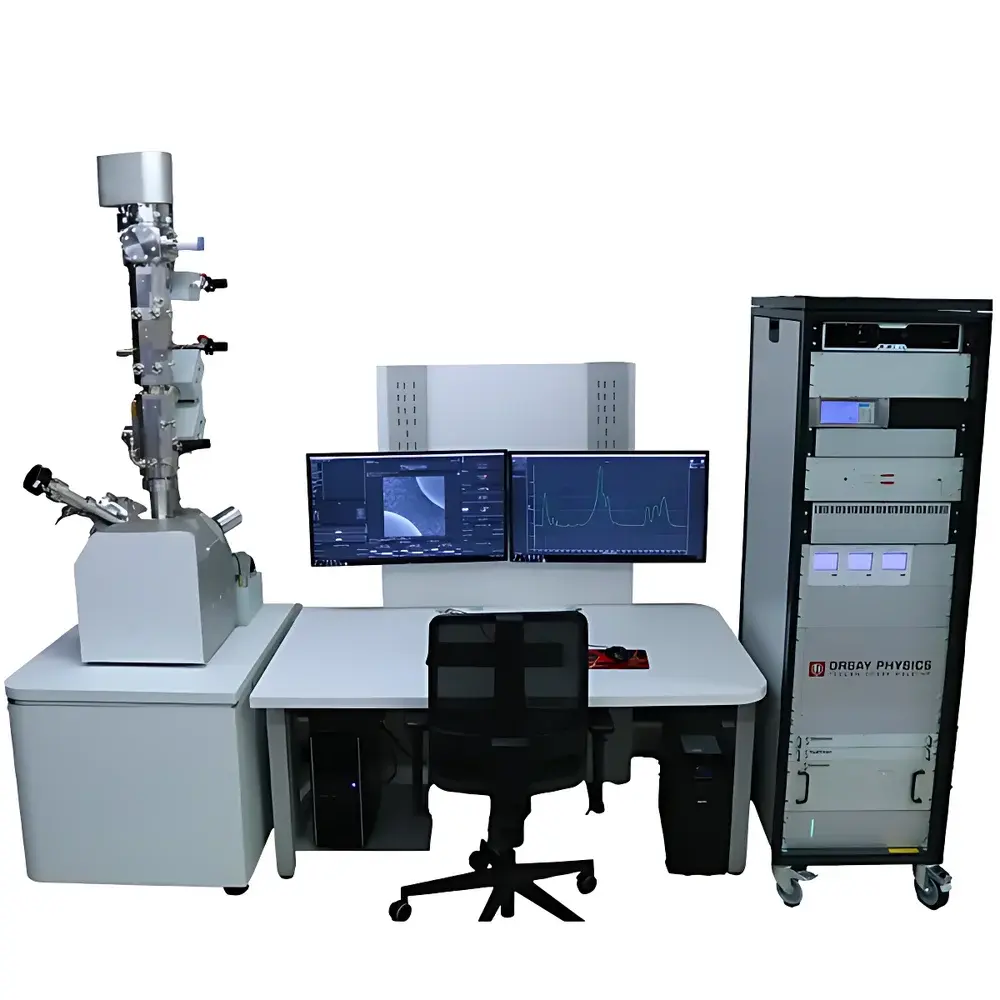
The TESCAN Quiin is a purpose-built dual-beam focused ion beam scanning electron microscope (FIB-SEM) engineered for nanoscale quantum ion implantation in semiconductor and quantum materials research. Unlike conventional ion implanters optimized for wafer-scale doping, the Quiin integrates high-resolution SEM imaging, two complementary FIB columns (Veloce and iVeloce), and sub-femtoamp beam current metrology into a single vacuum platform—enabling deterministic, site-specific ion delivery at atomic-scale precision. Its operational principle relies on Coulombic acceleration of mass-selected ions through electrostatic lenses, followed by controlled penetration into crystalline or amorphous substrates under ultra-high vacuum (UHV) conditions (<1×10⁻⁷ mbar). The system supports both elemental and isotopic implantation—critical for fabricating qubit arrays, single-photon emitters, and defect-engineered 2D materials—while maintaining real-time structural feedback via simultaneous secondary electron (SE) and backscattered electron (BSE) detection.
Key Features
- Dual-FIB architecture: Veloce LMIS column for metal ion species (Ga⁺, Au⁺, Ge⁺, Si⁺, Au₃⁺) and iVeloce ECR plasma column for gaseous ions (Xe⁺, O⁺, N⁺, Ar⁺, He⁺, CO₂⁺), each equipped with Wien filter mass selection for isotopic purity.
- Sub-20 fA beam current measurement capability using integrated Faraday cup and low-noise electrometer—enabling single-ion dose control and statistical validation of implantation yield.
- FurnaSEM 1000 in-situ heating stage with closed-loop temperature regulation (0.01–3 °C/s ramp rate, up to 950 °C), permitting real-time thermal activation of dopants and lattice recovery during or immediately after ion irradiation.
- Co-axial FIB-SEM geometry with 55° intersection angle and 12 mm working distance ensures sub-5 nm spatial registration between imaging and implantation coordinates—minimizing placement error in quantum dot or color center fabrication.
- Pegasus software framework with Python API support enables full experimental automation, including script-driven dose mapping, multi-species sequential implantation, and integration with external cryogenic or magnetic systems.
- Optimized YAP scintillator-based SE detector provides high signal-to-noise imaging at probe currents below 1 pA—essential for observing beam-sensitive quantum materials without knock-on damage.
Sample Compatibility & Compliance
The Quiin accommodates standard 100 mm semiconductor wafers, TEM lamellae, MEMS devices, and freestanding 2D crystals (e.g., h-BN, MoS₂) mounted on specialized heating-compatible holders. Its chamber design conforms to ISO 14644-1 Class 5 cleanroom requirements for contamination control. All ion beam parameters—including energy, current, dwell time, and raster pattern—are logged with timestamped metadata compliant with GLP and FDA 21 CFR Part 11 audit trail specifications. Optional hardware modules support integration with UHV transfer systems and cryo-stages meeting ASTM E2937-22 standards for low-temperature ion implantation characterization.
Software & Data Management
Pegasus serves as the unified control interface for all hardware subsystems—including beam alignment, stage navigation, GIS precursor delivery, and FurnaSEM thermal profiling. It implements hierarchical project management with version-controlled experiment templates, enabling reproducible ion dose calibration across laboratories. Raw beam current data, stage coordinates, and detector signals are stored in HDF5 format with embedded SI units and uncertainty annotations. The open API allows third-party integration with MATLAB, LabVIEW, or custom Python analysis pipelines for real-time dose verification, Monte Carlo SRIM simulation coupling, or machine learning–assisted defect clustering identification.
Applications
- Quantum device fabrication: Deterministic implantation of SiV⁻, GeV⁻, or SnV⁻ centers in diamond for solid-state qubits.
- Advanced CMOS node development: Sub-10 nm dopant profiling in FinFET and GAA transistor channels using isotopically enriched ²⁸Si or ¹⁰B.
- 2D material engineering: Localized n-/p-type doping of graphene or transition metal dichalcogenides via O⁺ or N⁺ implantation.
- Hard mask patterning: Gas-assisted FIB milling with XeF₂ or H₂O precursors for sub-20 nm feature definition in EUV resist development.
- In-situ ion irradiation studies: Real-time observation of defect evolution in nuclear ceramics or fusion reactor materials under simultaneous heating and ion bombardment.
FAQ
What ion species can be implanted with the Quiin?
The system supports over 15 ion species across two independent sources: metal ions (Ga⁺, Au⁺, Ge⁺, Si⁺, Au₃⁺) from the Veloce LMIS column and gaseous ions (Xe⁺, O⁺, N⁺, Ar⁺, He⁺, CO₂⁺) from the iVeloce ECR plasma source. Isotopic selection is available for ¹²C⁺/¹³C⁺, ¹⁴N⁺/¹⁵N⁺, and ²⁸Si⁺/²⁹Si⁺/³⁰Si⁺ via Wien filter tuning.
Is the Quiin suitable for production-line IC manufacturing?
No—the Quiin is a research-grade tool designed for prototyping, failure analysis, and quantum device R&D. It does not meet throughput, uptime, or process control requirements for high-volume semiconductor manufacturing. Its value lies in exploratory implantation, cross-sectional analysis, and nanofabrication of non-planar structures.
How is beam current calibrated and traceably verified?
Each FIB column includes a built-in Faraday cup with NIST-traceable calibration certificate. Current measurements down to 20 fA are validated using Keithley 6430 sub-femtoamp sources and cross-checked against reference samples with known sputtering yields per ISO 18516.
Can the Quiin perform simultaneous electron and ion irradiation?
Yes—the co-axial geometry and synchronized blanking allow concurrent SEM imaging and FIB implantation at defined dwell times and overlapping scan fields. This enables real-time monitoring of ion-induced surface modifications without interrupting the implantation sequence.
What level of vacuum is maintained during implantation?
The main chamber operates at ≤5×10⁻⁸ mbar during high-energy ion implantation (≥10 keV), achieved via turbomolecular pumping combined with cryo-trapping of reactive gases. Base pressure is monitored continuously with Bayard-Alpert and cold cathode gauges compliant with ISO 20483.