
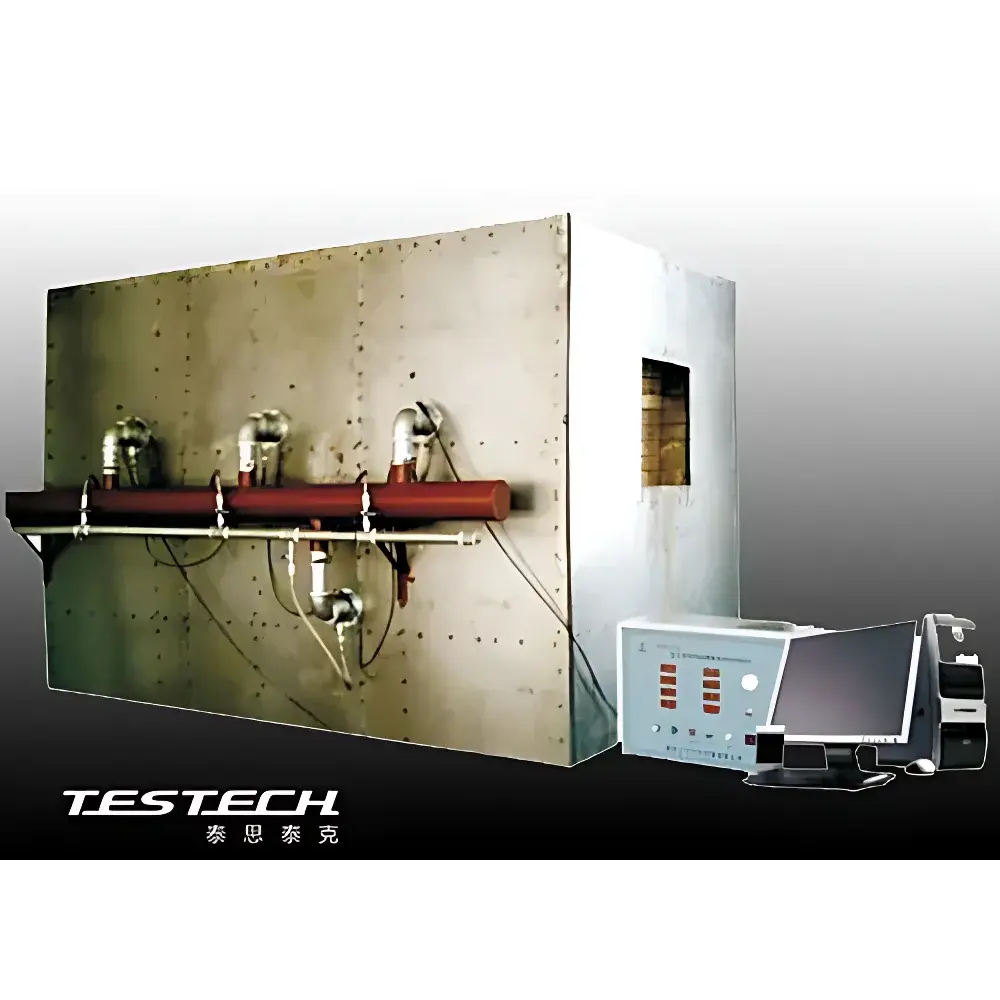
TESTech TTech-GAT537 Busway Fire Resistance Test Furnace Compliant with GA/T 537–2005
| Brand | TESTech |
|---|---|
| Model | TTech-GAT537 |
| Standard Compliance | GA/T 537–2005 |
| Input Voltage | AC 380 V ±10%, 50 Hz |
| Power Consumption | 5 kW |
| Furnace Pressure Range | 0–100 Pa (Accuracy: ≤±3 Pa) |
| Airflow Rate | 0–50 m³/min (Accuracy: ≤±0.5 m³/min) |
| Fuel Source | Propane or Liquefied Petroleum Gas (LPG) |
| Gas Cylinder Capacity | 4 × 50 kg |
| Temperature Ramp Profiles | 60 min to 925 °C, 120 min to 1050 °C, 180 min to 1115 °C, 240 min to 1150 °C |
| Furnace Internal Temp Uniformity | ±15 °C |
| Specimen Internal Temp Accuracy | ±10 °C |
| Backside (Unexposed Side) Temp Accuracy | ±4 °C |
| Thermocouples | 12 × K-type armored NiCr–NiSi (Class II accuracy), 6 for furnace zone, 6 for specimen backside |
| Timing Range | 0–360 min (Timing Accuracy: <±2 s) |
| Max Horizontal Specimen Length | 2.4 m |
| Max Vertical Specimen Length | 1.6 m |
| Dimensions (L×W×H) | 3.0 × 2.0 × 2.5 m |
| Weight | 4000 kg |
| Installation | On-site assembly required |
Overview
The TESTech TTech-GAT537 Busway Fire Resistance Test Furnace is a purpose-built thermal testing system engineered to evaluate the fire performance of low-voltage and medium-voltage busbar trunking systems (busways) in accordance with the Chinese public safety industry standard GA/T 537–2005. This furnace implements a controlled, time-temperature fire exposure profile—specifically designed to simulate real-world compartment fire development—to assess critical fire safety parameters including flame propagation resistance, structural integrity under thermal load, and thermal insulation capability on the unexposed surface. Unlike generic combustion chambers, the TTech-GAT537 integrates precise airflow regulation, high-stability pressure control, and multi-zone thermocouple monitoring to ensure reproducible test conditions across repeated evaluations. Its architecture adheres to fundamental principles of fire dynamics testing: heat flux calibration via standardized gas combustion, uniform temperature distribution within the test chamber, and strict metrological traceability of all thermal and temporal measurements.
Key Features
- Programmable multi-stage heating protocol compliant with GA/T 537–2005: four distinct ramp profiles (60/120/180/240 min to peak temperatures up to 1150 °C) enable evaluation across varying fire severity classifications.
- Dual thermocouple array: 6 Class II K-type armored thermocouples monitor furnace internal temperature; an additional 6 identical sensors measure backside (unexposed) surface temperature of the busway specimen—ensuring compliance with GA/T 537–2005’s ±4 °C tolerance requirement for insulation performance assessment.
- Integrated pressure and airflow control subsystem: maintains furnace static pressure within 0–100 Pa range (±3 Pa accuracy) and regulates combustion air supply from 0–50 m³/min (±0.5 m³/min accuracy), critical for consistent flame geometry and heat transfer characteristics.
- Propane/LPG dual-fuel compatibility with 4 × 50 kg cylinder manifold configuration—supports extended-duration tests without refueling interruption and meets gas supply stability requirements defined in Clause 6.2 of GA/T 537–2005.
- Heavy-duty steel frame and refractory-lined chamber (3.0 × 2.0 × 2.5 m external dimensions, 4000 kg total mass) ensures mechanical stability during thermal cycling and long-term dimensional integrity under cyclic thermal stress.
- High-precision timing module with <±2 s deviation over 360 min supports accurate recording of critical events: ignition onset, flame front progression, loss of circuit integrity, and insulation failure thresholds.
Sample Compatibility & Compliance
The TTech-GAT537 accommodates both horizontal and vertical busway configurations, supporting specimens up to 2.4 m in length (horizontal mounting) or 1.6 m (vertical mounting)—sufficient to represent typical segment lengths used in commercial and industrial electrical distribution installations. All test fixtures, support brackets, and thermal shielding components are fabricated from non-combustible, high-temperature-resistant materials (e.g., ceramic fiber boards, stainless steel 310S) to prevent interference with fire behavior. The system is fully aligned with GA/T 537–2005’s procedural, instrumentation, and reporting requirements—including mandatory calibration intervals for thermocouples, pressure transducers, and flow meters. While GA/T 537–2005 is a China-specific standard, the furnace’s measurement uncertainty budget, sensor traceability (to national metrology institutes), and documented verification protocols facilitate cross-referencing with international frameworks such as ISO 834-1 (fire resistance tests—elements of building construction) and IEC 61439-1 (low-voltage switchgear and controlgear assemblies) for global certification workflows.
Software & Data Management
Data acquisition is performed via a dedicated industrial-grade DAQ system synchronized with the furnace controller. Real-time temperature, pressure, airflow, and elapsed time values are logged at configurable sampling intervals (default: 1 Hz) and stored in timestamped CSV files compliant with GLP data integrity principles. The software interface provides waveform visualization, pass/fail flagging based on GA/T 537–2005 acceptance criteria (e.g., backside temperature rise ≤180 °C above ambient for ≥30 min), and automated report generation—including raw data export, annotated test curves, and summary tables referencing specific clauses of the standard. Audit trails record all user actions (configuration changes, manual overrides, calibration events), satisfying documentation requirements for third-party accreditation bodies and internal quality audits under ISO/IEC 17025.
Applications
- Fire resistance classification of prefabricated busbar trunking systems per GA/T 537–2005 for use in high-rise buildings, data centers, hospitals, and transportation infrastructure.
- Comparative evaluation of intumescent coatings, mineral insulation layers, and firestop collars applied to busway enclosures.
- Validation of fire-rated penetration seal systems where busways traverse fire-resistance-rated walls or floors.
- Developmental testing for new busway designs incorporating advanced thermal barrier composites or segmented joint configurations.
- Supporting evidence generation for CCC (China Compulsory Certification) applications and provincial fire department type-approval submissions.
FAQ
Does the TTech-GAT537 comply with any international fire test standards beyond GA/T 537–2005?
The furnace is primarily configured and validated for GA/T 537–2005. However, its temperature ramp fidelity, pressure control resolution, and thermocouple placement geometry allow adaptation—via software reconfiguration and procedural adjustments—to approximate ISO 834-1 or ASTM E119 heating curves, subject to customer-defined validation protocols.
What calibration documentation is provided with the system?
Each unit ships with factory calibration certificates for all primary sensors (thermocouples, pressure transducers, airflow meters), traceable to CNAS-accredited laboratories. A full calibration schedule and procedure manual are included for in-house or third-party recalibration.
Is remote monitoring supported during test execution?
Yes—the DAQ system supports Ethernet-based remote access for real-time data viewing and alarm notification (email/SMS) upon threshold breaches (e.g., backside temperature >180 °C). No direct remote control of combustion or safety interlocks is permitted for operational safety reasons.
Can the furnace be modified for testing other cable or conduit products?
While optimized for busway systems, the chamber volume and mounting infrastructure permit adaptation for large-diameter power cables or cable trays—provided modifications maintain thermal uniformity and do not compromise pressure or airflow specifications. Such adaptations require formal engineering review and revalidation per GA/T 537–2005 Annex C.
What site preparation is required prior to installation?
A reinforced concrete foundation (minimum 300 mm thick, with anchor bolt sleeves), dedicated 380 V / 32 A three-phase power supply with surge protection, LPG/propane gas line with emergency shutoff valve, and exhaust flue rated for continuous 1200 °C operation are mandatory. TESTech provides civil works specification sheets and on-site commissioning support.



