
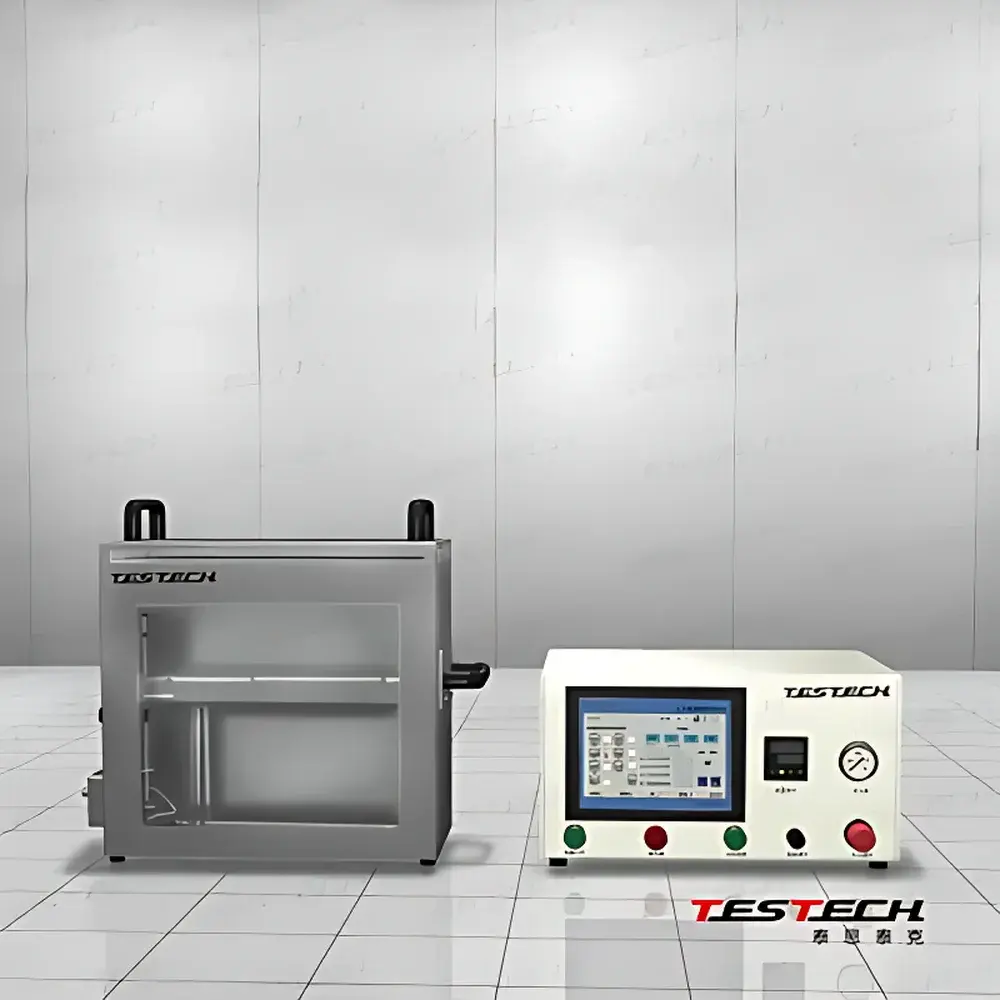
TESTech TTech-GBT8410-2 Automotive Interior Materials Horizontal Burning Test Chamber (FMVSS 302 / ISO 3795 / GB/T 8410-2006 Compliant)
| Brand | TESTech |
|---|---|
| Model | TTech-GBT8410-2 |
| Origin | Jiangsu, China |
| Manufacturer | TESTech Co., Ltd. |
| Compliance Standards | FMVSS 302, ISO 3795, GB/T 8410-2006, SAE J369:2003, NES M0094:2003, TL 1010:1997, GS 97038-2003, GM 9070P:1996 |
| Chamber Dimensions | 200(W) × 381(D) × 356(H) mm |
| Power Supply | AC 220 V, 50/60 Hz, 10 A |
| Weight | ~50 kg |
| Burner Tip-to-Specimen Distance | 19 mm |
| Burner Inner Diameter | Φ9.5 mm |
| Flame Height Adjustment Range | 20–100 mm |
| Standard Flame Height | 38 mm |
| Ventilation Hole Pattern | 10 × Ø19 mm, spacing 63.5 mm (horizontal) × 127 mm (vertical) |
| Integrated Steel Ruler in Chamber | ±1 mm resolution |
| Timing Range | 0–9999 s |
| Sample Capacity | 6 tests with data logging |
| Control System | PLC + 7-inch HMI touchscreen |
Overview
The TESTech TTech-GBT8410-2 Horizontal Burning Test Chamber is an engineered solution for evaluating the flammability characteristics of automotive interior materials in strict accordance with internationally recognized regulatory standards—including FMVSS 302 (U.S. Federal Motor Vehicle Safety Standard No. 302), ISO 3795:1995, and GB/T 8410-2006. This instrument implements the horizontal flame propagation test method, wherein a standardized Bunsen burner applies a defined flame to the free end of a horizontally mounted specimen for a fixed duration; subsequent measurement of burn length and afterflame time determines compliance. Designed for laboratory-grade repeatability and operational robustness, the system adheres to the physical geometry, thermal input, and environmental control requirements specified in each referenced standard—ensuring data integrity for OEM qualification, Tier-1 supplier validation, and third-party certification testing.
Key Features
- Integrated stainless-steel combustion chamber with precision-machined ventilation grid: 10 × Ø19 mm apertures arranged at 63.5 mm (transverse) × 127 mm (longitudinal) spacing per ISO 3795 Annex A.
- Calibrated U.S.-sourced Bunsen burner (Hamburg brand) with adjustable flame height (20–100 mm) and certified 38 mm reference height; burner tip positioned precisely 19 mm below the specimen’s free end centerline.
- On-board high-resolution steel ruler (±1 mm accuracy) embedded within the chamber wall—enabling direct post-test burn-length measurement without specimen removal.
- PLC-based control architecture with 7-inch industrial touchscreen HMI: supports automatic ignition sequence, real-time flame application timing (0–9999 s programmable), and dual-stage timer (application + afterflame).
- Comprehensive safety logic: flame failure detection, over-temperature cutoff, and interlocked door sensing prevent unintended operation during access.
- Dedicated stainless-steel specimen holders and alignment templates ensure consistent sample orientation and clamping force across all six test positions.
Sample Compatibility & Compliance
The TTech-GBT8410-2 accommodates flat, rigid or semi-rigid specimens up to 356 mm in length and 100 mm in width, conforming to dimensional tolerances outlined in FMVSS 302 §S5.2 and ISO 3795 Clause 6. Tested materials include polypropylene (PP), polyethylene terephthalate (PET), polyurethane (PU) foams, PVC composites, nonwovens, laminates, and coated fabrics used in dashboards, door trims, headliners, seat covers, and pillar garnishes. The system satisfies audit requirements for GLP and ISO/IEC 17025-accredited laboratories through traceable calibration documentation, event-logged operational history, and user-accessible firmware versioning. It supports full traceability for automotive OEM-specific protocols including Honda HES D6003-99, Nissan NES M0094:2003, Mitsubishi ES-X60410:2001, BMW GS 97038-2003, and Volkswagen TL 1010:1997.
Software & Data Management
Test execution and reporting are managed via an embedded PLC-HMI platform—not reliant on external PCs or proprietary software licenses. All test parameters (ignition delay, flame application time, afterflame duration, burn length) are captured digitally and stored locally for up to six consecutive tests. Historical records include timestamp, operator ID (if configured), ambient temperature/humidity (optional sensor input), and system fault logs. Data export is supported via USB interface in CSV format for integration into LIMS or QA documentation workflows. Audit trail functionality meets minimum requirements for FDA 21 CFR Part 11–aligned environments where electronic records must be attributable, legible, contemporaneous, original, and accurate (ALCOA+ principles).
Applications
This chamber serves as a primary qualification tool in automotive component development labs, Tier-1 material suppliers’ QC departments, and independent testing facilities performing type approval under UN Regulation No. 118 or ECE R118. Typical use cases include pre-production screening of new polymer formulations, root-cause analysis of flame-retardant additive efficacy, comparative evaluation of surface treatments (e.g., plasma coating, intumescent finishes), and periodic requalification of production lots per IATF 16949 clause 8.5.1.2. Its compact footprint and plug-and-play electrical interface (220 V / 10 A) enable deployment in controlled-environment rooms or mobile test trailers supporting on-site audits at manufacturing plants.
FAQ
What standards does the TTech-GBT8410-2 fully support?
FMVSS 302, ISO 3795:1995, GB/T 8410-2006, SAE J369:2003, NES M0094:2003, TL 1010:1997, GS 97038-2003, GM 9070P:1996, and TRANS/WP29/78/Rev.1:1997 Annex 4.
Is calibration certification included with shipment?
Yes—each unit ships with a factory calibration report covering burner alignment, flame height verification, timer accuracy (±0.1 s), and ruler linearity (±1 mm), traceable to NIM (China National Institute of Metrology) standards.
Can the system be integrated into a centralized lab management network?
While standalone operation is standard, optional RS-485 Modbus RTU output enables connection to SCADA or MES systems for remote status monitoring and alarm forwarding.
What maintenance intervals are recommended?
Burner nozzle inspection and cleaning every 50 tests; annual verification of thermocouple response time and HMI touch calibration; biannual review of ventilation aperture integrity per ISO 3795 Annex A dimensional tolerances.
Does the chamber meet requirements for accredited testing laboratories?
Yes—the mechanical design, control architecture, and data logging capability align with ISO/IEC 17025:2017 clauses 6.4 (equipment), 7.2.2 (test method validation), and 7.8 (reporting), provided site-specific uncertainty budgets and staff competency assessments are maintained.



