
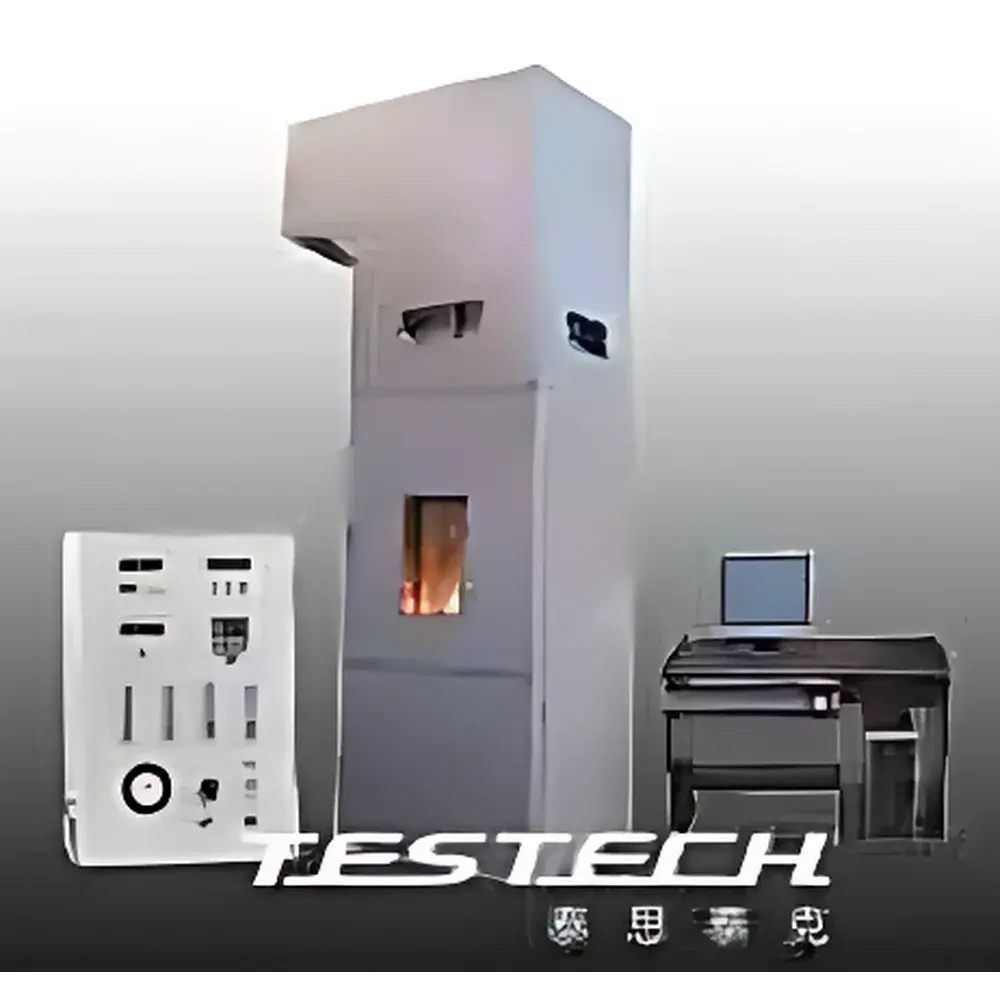
TESTech TTech-GBT8625 Non-Combustibility Testing Furnace for Building Materials
| Brand | TESTech |
|---|---|
| Origin | Jiangsu, China |
| Manufacturer Type | Direct Manufacturer |
| Product Category | Domestic |
| Model | TTech-GBT8625 |
| Pricing | Upon Request |
| Standards Compliance | GB/T 8625–2005 |
| Furnace Dimensions (L×W×H) | 1200 mm × 1200 mm × 3930 mm |
| Combustion Chamber Internal Dimensions | 800 mm × 800 mm × 2000 mm |
| Air Supply Duct Diameter | 200 mm |
| Flue Cross-Section | 500 mm × 500 mm |
| Operating Voltage | AC 220 V ±10%, 50 Hz, 3.5 kVA |
| Ambient Temperature Range | 19–30 °C |
| Furnace Wall Temperature Range | RT–100 °C ±1 °C |
| Internal Furnace Temperature Range | RT–300 °C ±2 °C |
| Methane Flow Rate | 0–50 L/min ±0.2 L/min |
| Air Flow Rate | 0–50 L/min ±0.2 L/min |
| Pressure Differential Range | 0–30 Pa ±1 Pa |
| Weight | 1500 kg |
| Thermocouple Type | Class II armored NiCr–NiSi, Ø ≤3 mm, wire diameter 0.5 mm |
| Temperature Measurement Accuracy | ±1 °C (system), ±0.5 °C (thermocouple) |
| Pressure Transmitter Accuracy | Class 0.5 |
| Gas Flowmeter Accuracy | ≥Class 2.5 (0.25–3 m³/h range) |
| Control System | PLC + HMI touchscreen interface with real-time data logging |
| Data Output | Time-stamped parameter records, trend curves, remote printing capability |
| Exhaust System | High-capacity axial fan |
| Ignition Method | High-voltage automatic ignition |
| Construction Material | Stainless steel (corrosion-resistant components) |
Overview
The TESTech TTech-GBT8625 Non-Combustibility Testing Furnace is a precision-engineered vertical furnace system designed specifically to evaluate the non-combustibility performance of building materials in accordance with the Chinese national standard GB/T 8625–2005, “Test Method for Non-Combustibility of Building Materials.” This standardized test determines whether a material, when subjected to high-temperature exposure under controlled air flow and defined thermal conditions, exhibits negligible heat release, flame propagation, or sustained combustion—criteria essential for classifying materials as non-combustible per fire safety regulations in construction applications. The furnace operates on the principle of controlled, steady-state thermal exposure in a vertically oriented combustion chamber, where specimen behavior—including temperature rise, mass loss, and flaming duration—is quantitatively assessed under reproducible gas flow, pressure differential, and thermal gradient conditions. Its architecture integrates rigorous thermal isolation, calibrated gas delivery, and traceable metrology to ensure measurement integrity required for regulatory submission and third-party certification.
Key Features
- Vertically oriented combustion chamber (800 mm × 800 mm × 2000 mm internal volume) constructed with double-wall insulated refractory structure for stable thermal distribution and minimal external heat leakage.
- Dual-hinged stainless steel furnace doors with mechanical locking via handwheel and fixed bolts, ensuring gas-tight sealing during operation and safe access for specimen loading.
- Stabilized air inlet system featuring a 200 mm diameter duct delivering conditioned ambient air at constant velocity and temperature to support consistent oxidative environment within the combustion zone.
- Multi-layer air-stabilizing assembly beneath the burner: fabricated from angle-steel framing, supporting wire mesh and stacked fiberglass pads to homogenize airflow prior to ignition.
- Rectangular flue (500 mm × 500 mm cross-section) integrated at the furnace crown, directly connected to external exhaust ducting to maintain defined draft and pressure differential across the test zone.
- Integrated instrumentation suite including Class II armored K-type thermocouples (0.5 mm wire, ≤3 mm sheath), Class 0.5 differential pressure transmitters, and Class 2.5 certified mass flow meters for methane and air—each traceable to national calibration standards.
- PLC-based control system with industrial HMI touchscreen interface enabling real-time monitoring of 12+ parameters: elapsed time (countdown), furnace wall temperature, internal chamber temperature, pressure differential, methane and air flow rates, inlet air temperature, and system status flags.
- Automated high-voltage ignition sequence with fail-safe interlocks, coupled with post-test forced-exhaust protocol using high-volume axial fans to evacuate residual combustion products before door opening.
Sample Compatibility & Compliance
The TTech-GBT8625 accommodates standard-sized specimens measuring 45 mm × 45 mm × 50 mm (or equivalent cross-sectional area with height ≤50 mm), cut from homogeneous or layered building materials such as mineral wool, calcium silicate boards, fiber-cement composites, gypsum-based panels, and ceramic tiles. Specimens are mounted vertically on a stainless steel support frame inside the combustion chamber, ensuring uniform exposure to convective and radiant heat flux. The system fully satisfies all apparatus requirements specified in GB/T 8625–2005, including dimensional tolerances, thermal stability criteria (≤100 °C wall temperature rise limit), pressure differential control (0–30 Pa ±1 Pa), and gas flow accuracy. While primarily aligned with Chinese national standards, the furnace’s metrological rigor and documented uncertainty budget support equivalency assessments against ISO 1182 (Non-combustibility tests for building materials) and ASTM E136 (Standard Test Method for Behavior of Materials in a Vertical Tube Furnace at 750 °C) when operated under corresponding procedural adaptations and validation protocols.
Software & Data Management
Data acquisition and reporting are managed through an embedded Windows-based microcomputer system interfaced with the PLC controller via Modbus RTU. All measured parameters—including time-stamped thermocouple readings, pressure differentials, and volumetric flow rates—are logged at user-configurable intervals (default: 1 s) into encrypted binary files compliant with long-term archival requirements. The software provides synchronized graphical overlays of up to six variables, allowing direct correlation of thermal response with gas dynamics and pressure behavior. Export functionality supports CSV and PDF formats for integration into laboratory information management systems (LIMS). Audit trails record operator login, method selection, calibration events, and manual overrides—supporting GLP compliance and internal quality audits. Remote printing is enabled via network-connected printers; no cloud connectivity or external data transmission is implemented by default, preserving data sovereignty and aligning with on-premise security policies typical in certified testing laboratories.
Applications
- Regulatory conformance testing of insulation, cladding, ceiling tiles, and structural boards for Class A1 (non-combustible) classification under GB 8624–2012 and related fire safety codes.
- Material development support for manufacturers optimizing inorganic binders, low-density ceramics, or intumescent additives intended for passive fire protection systems.
- Third-party certification testing by CNAS-accredited laboratories performing fire performance evaluations for CE marking, CCC certification, or green building rating schemes (e.g., LEED, Green Star).
- Comparative analysis of batch-to-batch consistency in production quality control, particularly for mineral-based composites subject to raw material variability.
- Research investigations into pyrolysis onset temperatures, char formation kinetics, and oxidative degradation thresholds under standardized thermal stress profiles.
FAQ
What standards does the TTech-GBT8625 strictly comply with?
It is engineered and validated exclusively for GB/T 8625–2005. Full compliance documentation—including dimensional verification reports, thermocouple calibration certificates, and pressure transducer traceability statements—is supplied with each unit.
Is the furnace suitable for testing composite or multi-layer materials?
Yes, provided the specimen meets dimensional and mounting requirements in GB/T 8625–2005. Layered samples must be tested in their as-installed orientation; delamination or edge effects are recorded qualitatively per standard observation clauses.
Can test data be exported for statistical process control (SPC) analysis?
Yes. Raw time-series data exports in CSV format include column headers, units, and UTC timestamps—compatible with Minitab, JMP, and Python-based SPC libraries without preprocessing.
What maintenance intervals are recommended for sustained metrological reliability?
Thermocouples require annual recalibration; flow meters and pressure transducers every 18 months. The stainless-steel combustion chamber requires visual inspection after every 50 cycles for warping or soot accumulation; fiberglass air-stabilizing pads should be replaced after 200 test cycles or visible degradation.
Does the system support automated pass/fail evaluation per GB/T 8625–2005 acceptance criteria?
No. The furnace delivers objective, high-fidelity measurements; final determination of non-combustibility (i.e., ΔT ≤50 K, no flaming, no continuous glowing) remains a manual assessment performed by trained technicians referencing recorded data and visual observations—per standard procedural requirements.



