
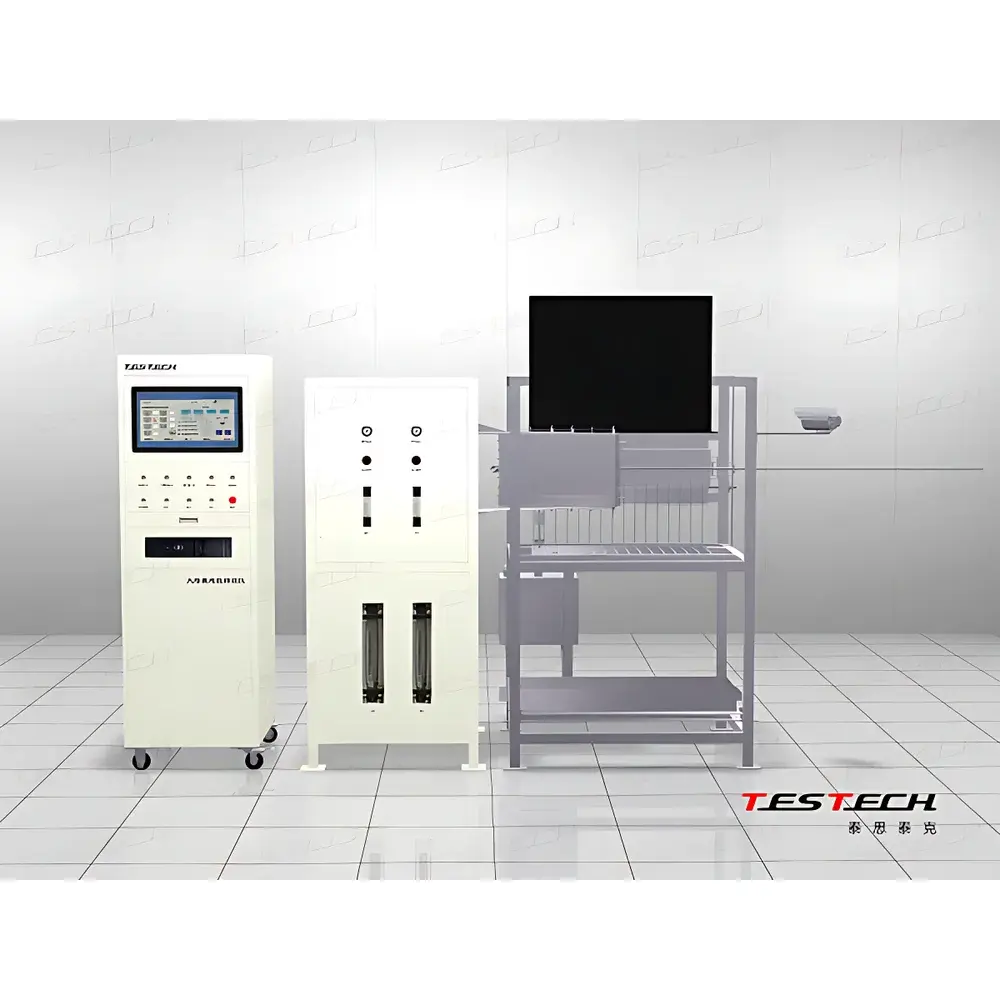
TESTech TTech-ISO5658 Flame Spread Property Tester
| Brand | TESTech |
|---|---|
| Origin | Jiangsu, China |
| Manufacturer Type | Direct Manufacturer |
| Country of Origin | China |
| Model | TTech-ISO5658 |
| Pricing | Upon Request |
Overview
The TESTech TTech-ISO5658 Flame Spread Property Tester is a precision-engineered bench-scale apparatus designed to quantify the lateral flame spread behavior of building products under controlled radiant heat exposure. It operates in strict accordance with ISO 5658-2:2006 “Reaction to fire tests — Ignitability of building products subjected to thermal attack by a radiant heat source — Part 2: Lateral flame spread”, and is fully compliant with IMO FTP Code Resolution A.653(16), ASTM E1317, and GB/T 28752–2012. The instrument employs a calibrated radiant panel (200 mm × 450 mm ceramic surface) delivering adjustable incident heat fluxes (typically 0–60 kW/m²) to vertically mounted specimens. Ignition is initiated via a non-contact propane pilot flame, ensuring reproducible thermal initiation without mechanical interference. Flame front progression is optically tracked across predefined horizontal intervals (e.g., 50 mm increments), enabling calculation of flame spread rate (mm/s), time-to-ignition (TTI), critical radiant flux (CRF), and sustained combustion heat release characteristics. This methodology provides quantitative, traceable data essential for fire safety classification, material development, and regulatory conformance assessment in construction, marine, and transportation sectors.
Key Features
- Stainless steel test chamber with corrosion-resistant finish and modular frame architecture—comprising independent burner and specimen support subframes secured via precision-adjustable bolts for repeatable alignment.
- Dual-mode ignition system: (1) Radiant panel heating combined with (2) a U.S.-sourced propane burner for standardized pilot flame application per IMO A.653(16) and ASTM E1317.
- 200 ± 10 mm dual-orifice ceramic burner tube optimized for uniform thermal output and stable combustion profile.
- Automated IMO-compliant flame impact test module using pneumatic ignition cylinder, eliminating manual intervention during critical timing phases.
- Optical observation system featuring double-layer wire mesh grating and enlarged 750 mm × 120 mm tiltable viewing mirror with integrated specimen rake—enabling real-time visual monitoring of flame propagation dynamics.
- Integrated radiation calibration subsystem: includes sliding rail-mounted heat flux meter (calibrated thermopile sensor), multi-hole reference plate, and localized 50 mm spatial resolution mapping capability across the radiant panel surface.
- Full-safety gas control train: incorporating pressure-reducing valve, zero-pressure valve, flashback arrestor, explosion-proof solenoid shut-off valve, and precision air/gas mixing manifold for methane/propane/air blends.
- Exhaust-compatible design with minimum 30 m³/min ventilation requirement; includes dedicated exhaust chimney equipped with metal-sheathed thermocouples for flue gas temperature monitoring.
- Explosion-proof PLC-based control system (Siemens or Mitsubishi) with spark ignition interlock, redundant safety logic, and hardware-enforced emergency gas cutoff.
Sample Compatibility & Compliance
The TTech-ISO5658 accommodates rigid and semi-rigid flat specimens up to 1000 mm height × 250 mm width × nominal thickness ≤ 50 mm, including insulation boards, wall claddings, ceiling tiles, deck coverings, and coated substrates. Specimen mounting follows ISO 5658-2 Annex A requirements—vertical orientation, edge-sealed mounting, and defined gap tolerances. All operational sequences—including pre-test radiant panel stabilization, ignition protocol execution, flame front tracking, and post-test cooldown—are programmable and auditable. The system supports full traceability per GLP/GMP frameworks, with timestamped event logging compatible with FDA 21 CFR Part 11–ready data acquisition modules (optional configuration). Calibration procedures adhere to ISO/IEC 17025 principles, with documented uncertainty budgets for radiant flux measurement (< ±2.5% k=2) and timing resolution (±0.1 s).
Software & Data Management
Data acquisition is performed via a 19-inch industrial rack-mounted controller interfaced with high-speed analog inputs for thermocouple arrays, heat flux sensors, and flame detection photodiodes. Synchronized video capture (via external IP camera or integrated HD camera) is time-stamped and stored alongside numerical datasets. Software enables automated calculation of flame spread rate (FSR), critical radiant flux (CRF), time-to-sustained-flaming (TSF), and total heat release (THR) based on user-defined analysis windows. Export formats include CSV, PDF test reports (with ISO/IMO/ASTM header templates), and XML for LIMS integration. Audit trail functionality records all parameter modifications, operator logins, calibration events, and system alarms—ensuring compliance with regulatory review requirements.
Applications
This tester serves as a core evaluation tool for fire performance R&D in architectural product manufacturing, shipbuilding compliance labs, national fire testing institutes (e.g., UL, FM Global, SP Fire Research), and third-party certification bodies. Typical use cases include: comparative screening of intumescent coatings; validation of fire-retardant additives in polymer composites; qualification of sandwich panel core materials; verification of IMO FTP Code compliance for marine interior finishes; and generation of input data for computational fire modeling (e.g., CFD-based zone models requiring FSR and CRF boundary conditions).
FAQ
Which international standards does the TTech-ISO5658 fully support?
ISO 5658-2:2006, IMO FTP Code Resolution A.653(16), ASTM E1317, and GB/T 28752–2012.
Is the radiant panel calibration traceable to NIST or equivalent national metrology institutes?
Yes—the supplied heat flux meter is factory-calibrated against NIST-traceable reference standards, with certificate of calibration included.
Can the system be configured for automated reporting aligned with ISO/IEC 17025 documentation requirements?
Yes—optional software modules provide report generation with embedded uncertainty statements, operator signatures, equipment calibration status, and environmental condition logging.
What safety certifications apply to the PLC and gas control system?
The control architecture complies with IEC 61508 SIL2 and ATEX Zone 2/Class I Div 2 requirements for hazardous area operation.
Does the system support remote diagnostics or integration with enterprise laboratory information management systems (LIMS)?
Yes—Ethernet-enabled communication (Modbus TCP/IP or OPC UA) allows secure remote monitoring and bidirectional LIMS data exchange.



