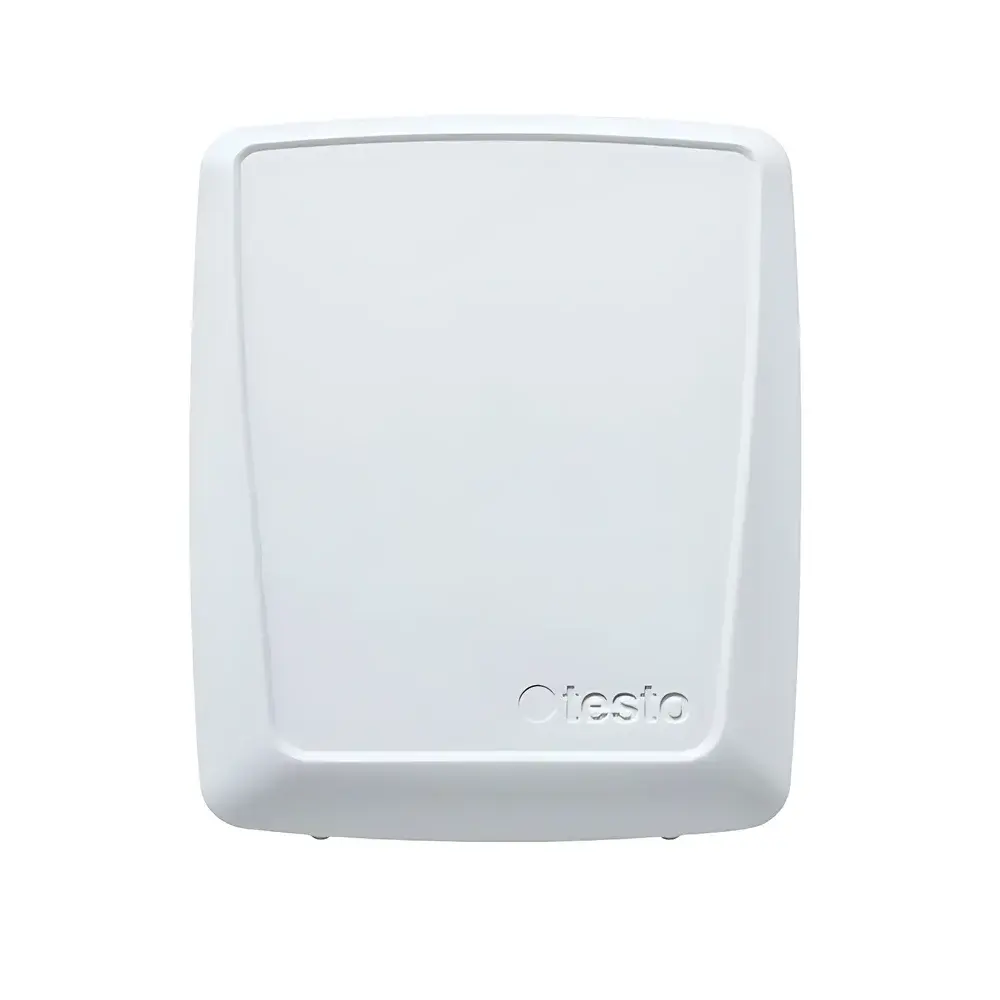
testo 160 E Wireless Environmental Monitoring System
| Brand | testo |
|---|---|
| Origin | Germany |
| Model | 0572 2022 |
| Channel Count | Multi-channel |
| Communication | Wi-Fi (IEEE 802.11 b/g/n, WPA2-Enterprise & WPA2-Personal) |
| Enclosure Rating | IP20 |
| Dimensions | 76 × 64 × 22 mm |
| Operating Temperature | −10 °C to +50 °C |
| Storage Temperature | −20 °C to +50 °C |
| Battery Life | Up to 18 months (4 × AAA alkaline) |
| Internal Memory | 32,000 measurements |
| Data Upload Interval | 1 min – 24 h (cloud license dependent) |
| Power Options | Replaceable batteries or optional external USB power supply |
Overview
The testo 160 E Wireless Environmental Monitoring System is an engineered solution for continuous, unobtrusive monitoring of ambient conditions critical to the preservation of sensitive cultural assets. Designed specifically for museums, galleries, archives, and conservation laboratories, it operates on a robust wireless architecture compliant with IEEE 802.11 b/g/n standards and supports enterprise-grade security protocols including EAP-TLS, EAP-PEAP, and WPA2-AES encryption. Unlike standalone loggers, the testo 160 E functions as a node within a scalable cloud-based infrastructure—testo Cloud—enabling centralized configuration, real-time data streaming, and audit-ready traceability. Its dual probe interface supports simultaneous measurement of temperature, relative humidity, illuminance (lux), and UV irradiance (UVA/UVB), all referenced to internationally recognized metrological frameworks. The system does not incorporate built-in sensors; instead, it interfaces exclusively with calibrated, traceable external probes—ensuring measurement integrity aligned with ISO/IEC 17025 principles and GLP-compliant workflows.
Key Features
- Compact, low-profile housing (76 × 64 × 22 mm) optimized for discreet installation inside display cases, vitrines, or archival storage enclosures
- Dual high-impedance probe ports supporting hot-swappable, NIST-traceable probes—including capacitive RH sensors, Pt100/Pt1000 temperature elements, silicon photodiodes (illuminance), and broadband UV radiometers
- Internal memory capacity of 32,000 timestamped measurement records with automatic overwrite logic and time-synchronized logging
- Configurable measurement interval from 1 minute (Advanced Cloud license) to 24 hours (Basic license), synchronized across distributed nodes
- IP20-rated enclosure suitable for indoor climate-controlled environments; operating range certified from −10 °C to +50 °C
- 18-month battery life using standard AAA alkaline cells; field-replaceable without tools; optional USB-powered operation via micro-USB port
- Integrated QR code label for rapid device onboarding into testo Cloud; supports zero-touch provisioning in multi-unit deployments
Sample Compatibility & Compliance
The testo 160 E is not a direct-reading instrument but a communications and data-handling platform that relies entirely on externally connected, application-specific probes. Probe selection must comply with domain-specific requirements—for example, museum-grade illuminance monitoring per CIE S 014/E:2006 and UV exposure limits defined in ISO 18937:2017 (Imaging materials — Photographic activity test). All supported probes are CE-marked and manufactured under ISO 9001-certified processes. When deployed in regulated environments (e.g., federally funded repositories or ISO 14001-certified institutions), the system supports full ALCOA+ data integrity principles through immutable cloud-stored records, user-level access control, electronic signatures (Advanced Cloud tier), and audit trails compliant with FDA 21 CFR Part 11 Annex 11 requirements. Calibration certificates for connected probes are managed independently and linked to each measurement series within the cloud interface.
Software & Data Management
All configuration, visualization, and reporting occur exclusively via testo Cloud—a secure, ISO 27001-certified SaaS platform hosted in EU-based data centers. Users access historical and live data through responsive web interfaces or native iOS/Android applications. The Basic license provides unlimited read-only access, configurable alarm thresholds, email notifications, and exportable CSV/PDF reports. The Advanced license adds role-based user management (up to 10 accounts per subscription), SMS alerting, custom dashboard widgets, automated compliance reports (e.g., daily max/min RH excursions), and integration-ready RESTful APIs for LIMS or BMS interoperability. Data retention policies are configurable; raw measurement logs—including probe serial numbers, calibration expiry dates, and firmware version stamps—are retained for ≥36 months by default. No local software installation is required—eliminating version fragmentation and ensuring consistent validation across global deployments.
Applications
The testo 160 E is validated for long-term environmental surveillance across three primary use cases: (1) Exhibition space monitoring—tracking diurnal and seasonal fluctuations in microclimates within sealed display cases to prevent hygroscopic stress on parchment, textiles, or lacquerware; (2) Archival storage monitoring—verifying compliance with BS 4971:2017 (Conservation and care of archive and library collections) and PAS 198:2012 (Specification for managing environmental conditions for cultural collections); and (3) Transport condition verification—deployed alongside GPS-enabled loggers during inter-institutional loans to correlate environmental exposure with transit timelines. Its non-invasive form factor enables permanent mounting beneath plinths or behind framing—minimizing visual impact while maintaining line-of-sight connectivity to existing WLAN infrastructure. Optional custom decorative faceplates allow seamless aesthetic integration with historic interiors or modern exhibition design schemes.
FAQ
Does the testo 160 E include built-in sensors?
No. It is a probe-hosting gateway only. All sensing elements must be selected and purchased separately based on application-specific metrological needs.
Is local data storage possible without internet connectivity?
Yes—the internal 32,000-measurement buffer retains data during WLAN outages and uploads automatically upon reconnection.
Can multiple testo 160 E units be managed under a single cloud account?
Yes. testo Cloud supports unlimited device registration per subscription, with hierarchical site/group organization and permission tiers.
What probe compatibility standards does testo enforce?
All officially supported probes carry CE marking, RoHS compliance, and factory calibration certificates with stated uncertainty budgets traceable to national metrology institutes (e.g., PTB, NPL).
How is data security maintained during transmission and storage?
End-to-end TLS 1.2+ encryption is enforced between device and cloud; stored data is encrypted at rest using AES-256; authentication uses OAuth 2.0 with mandatory MFA for Advanced-tier accounts.