
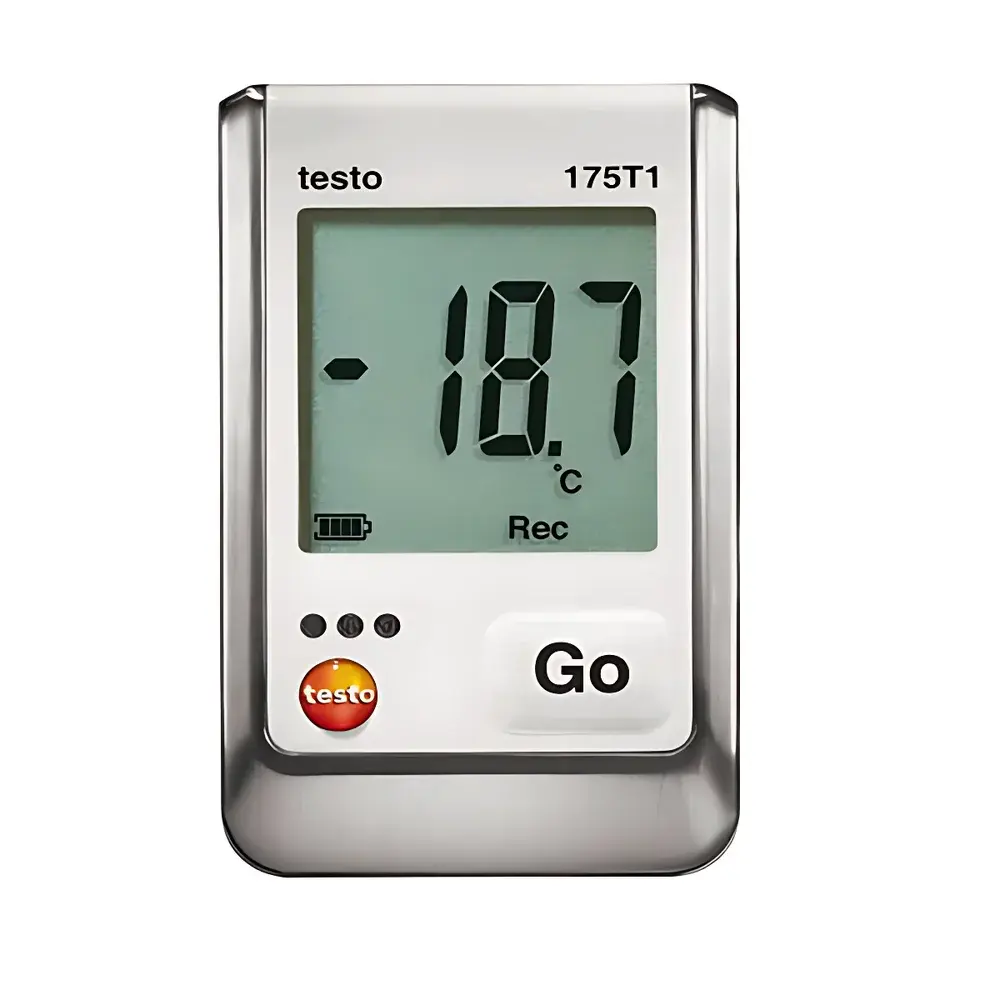
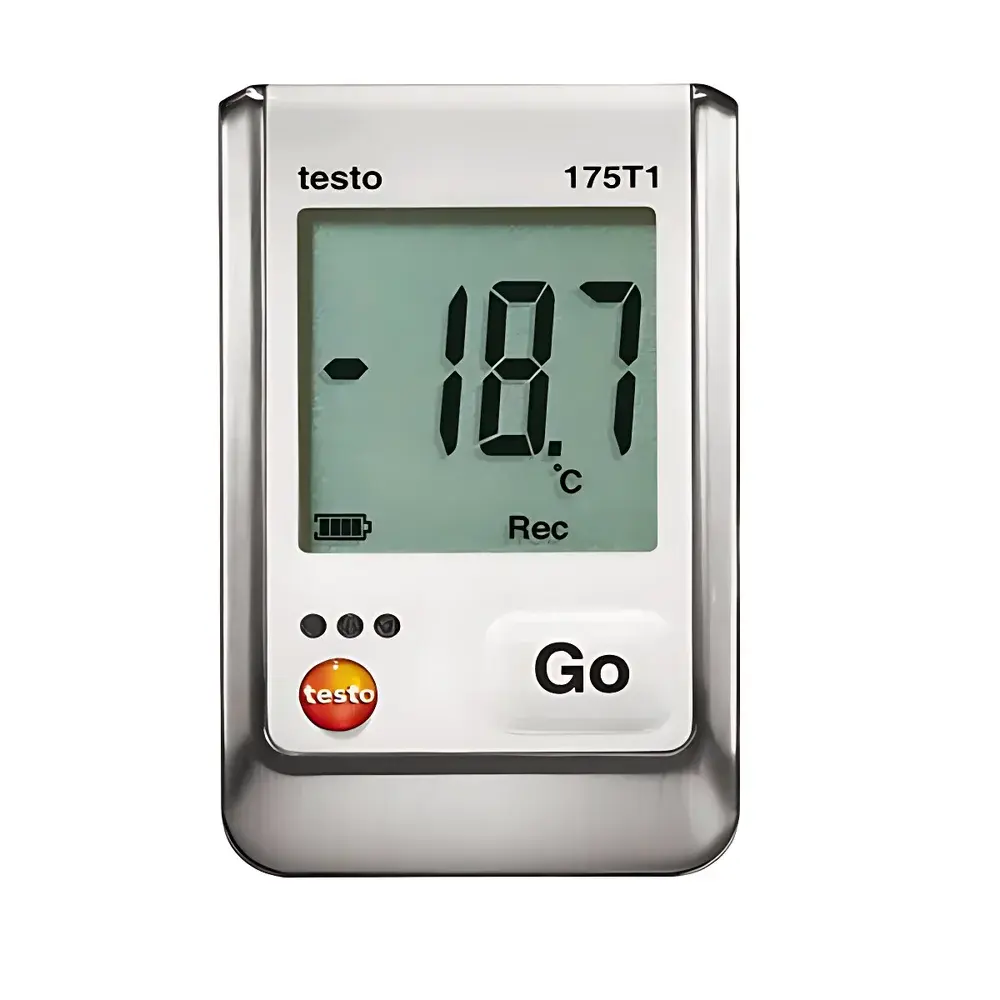
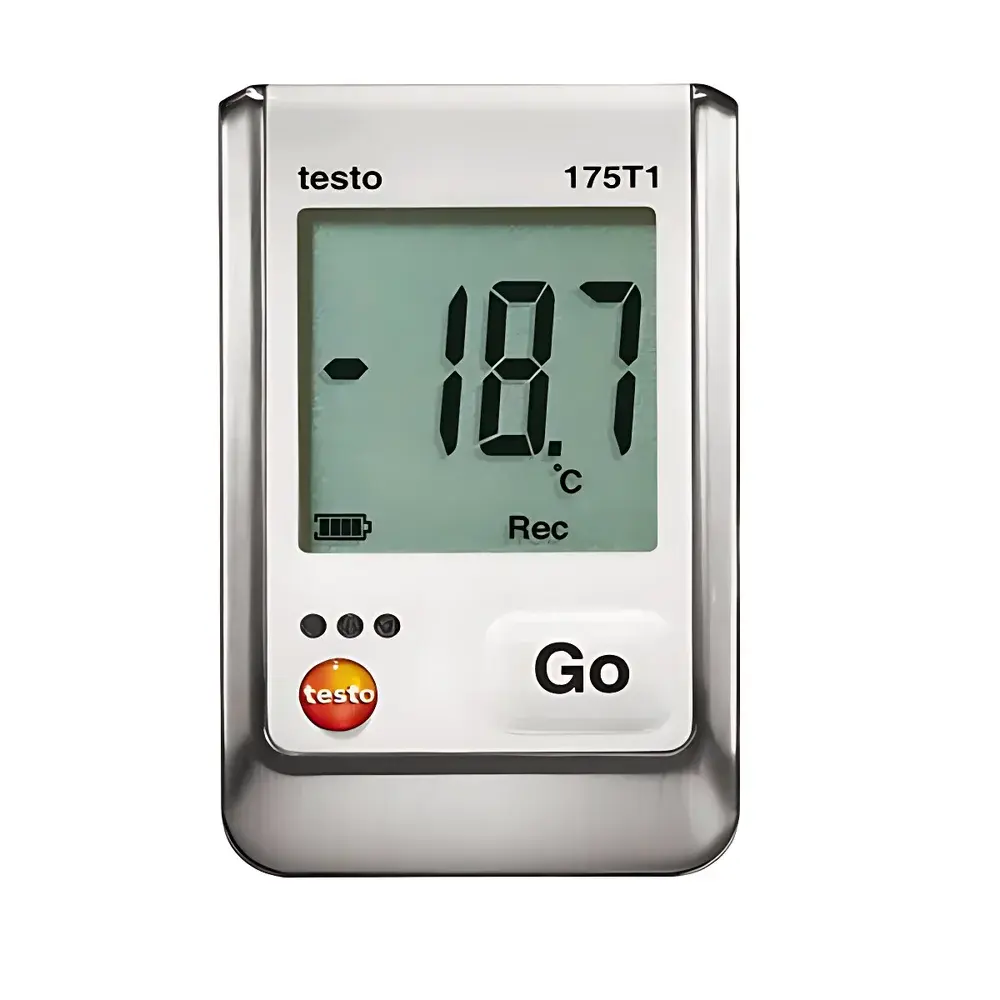
testo 175 T1 Single-Channel NTC Temperature Data Logger (Model 0572 1751)
| Brand | testo |
|---|---|
| Origin | Germany |
| Model | 0572 1751 |
| Measurement Range | -35 °C to +55 °C |
| Accuracy | ±0.5 °C (-35 °C to +55 °C) ±1 digit |
| Resolution | 0.1 °C |
| Memory Capacity | 1,000,000 readings |
| Battery Life | Up to 3 years (15-min interval, +25 °C) |
| Power Supply | 3 × AAA alkaline batteries |
| Protection Rating | IP65 |
| Dimensions | 89 × 53 × 27 mm |
| Weight | 130 g |
| Interface | Mini-USB port & SD card slot |
| Compliance | EN 12830, HACCP, EU Directive 2014/30/EU (EMC), RoHS 2011/65/EU |
Overview
The testo 175 T1 is a single-channel, battery-powered temperature data logger engineered for long-term, unattended monitoring in cold chain environments—specifically refrigerated and frozen storage areas, transport vehicles, and food processing facilities. It integrates a high-stability NTC (Negative Temperature Coefficient) thermistor sensor directly into its robust housing, eliminating external probe cabling and associated calibration drift or mechanical vulnerability. The device operates on the principle of resistance-based temperature sensing, where the NTC element’s predictable change in electrical resistance correlates linearly with ambient temperature across its specified range (–35 °C to +55 °C). Its design adheres strictly to DIN EN 12830:2018, the European standard governing performance requirements for temperature recorders used in the cold chain of perishable foodstuffs, and supports Hazard Analysis and Critical Control Point (HACCP) compliance through configurable alarm thresholds, traceable limit deviation logging, and tamper-resistant data integrity features.
Key Features
- Integrated NTC sensor with ±0.5 °C accuracy over full operating range (–35 °C to +55 °C), verified per EN 12830 calibration protocol
- IP65-rated enclosure—dust-tight and protected against low-pressure water jets—enabling deployment in wash-down warehouse zones or refrigerated transport without removal
- 1 million measurement storage capacity, supporting continuous logging at user-defined intervals from 10 seconds to 24 hours
- Three-year battery life under typical use (15-minute sampling at +25 °C) using standard AAA alkaline cells; automatic data backup during battery replacement prevents loss of active logs
- Backlit LCD display showing real-time temperature, programmable upper/lower limits, min/max values, elapsed time since last download, and remaining battery charge—no PC required for field verification
- Dual data transfer options: direct Mini-USB connection for fast readout and reprogramming, or removable SD card (optional) for offline batch transfer and redundancy
Sample Compatibility & Compliance
The testo 175 T1 is purpose-built for ambient air temperature monitoring in controlled environments where thermal stability is critical to product safety and regulatory conformance. It is not intended for immersion, surface contact, or aggressive chemical exposure beyond its IP65 rating. Its validation pathway aligns with internationally recognized frameworks: EN 12830 certification confirms metrological suitability for food cold chain applications; HACCP alignment is achieved via configurable deviation alerts, timestamped exceedance events, and audit-ready data export; and optional ComSoft CFR 21 Part 11 software enables electronic signature, audit trail, and role-based access control required for FDA-regulated pharmaceutical and biologics storage. The device complies with EU EMC Directive 2014/30/EU and RoHS Directive 2011/65/EU, ensuring electromagnetic compatibility and restriction of hazardous substances in industrial settings.
Software & Data Management
Data configuration, retrieval, and analysis are supported by testo’s ComSoft software suite—available in three tiers to match operational rigor and regulatory scope. ComSoft Basic (freely downloadable) provides intuitive instrument setup, real-time graphing, and CSV/Excel export for routine quality checks. ComSoft Professional adds multi-device fleet management, statistical process control (SPC) tools, automated report generation, and customizable alarm notifications via email or SMS. For regulated industries, ComSoft CFR 21 Part 11 delivers full 21 CFR Part 11 compliance—including electronic signatures, system audit trails, user authentication, and data integrity safeguards—validated for use in GxP environments. All versions support PDF report generation with embedded metadata (device ID, calibration status, operator ID, timestamp), enabling seamless integration into internal quality management systems (QMS) and third-party audits.
Applications
- Continuous temperature surveillance in refrigerated warehouses, blast freezers, and chilled distribution centers
- Validation and routine monitoring of cold rooms and walk-in coolers in food manufacturing and retail facilities
- Transport temperature logging for refrigerated trucks, railcars, and intermodal containers—compliant with ATP and IATA Perishables Regulations
- Baseline environmental monitoring during equipment qualification (IQ/OQ/PQ) of HVAC and refrigeration systems
- Supporting ISO 22000, BRCGS Food Safety, and SQF certification through documented, retrievable, and time-stamped thermal records
FAQ
Does the testo 175 T1 require external calibration?
No—the integrated NTC sensor is factory-calibrated per EN 12830 and supplied with an accredited calibration certificate. Field recalibration is not supported; however, users may perform functional verification using traceable reference sources.
Can the device be mounted permanently in a humid environment?
Yes—its IP65-rated housing permits fixed wall mounting (included bracket) in high-humidity or wash-down zones without degradation of sealing or measurement stability.
Is USB cable included in the standard package?
No—the Mini-USB programming and readout cable is sold separately. SD cards are also optional accessories.
How is data integrity ensured during power interruption?
The logger performs automatic non-volatile memory backup prior to shutdown, preserving all logged values and configuration parameters even during abrupt battery depletion or replacement.
What is the maximum recommended logging duration before data retrieval?
While memory allows up to one million entries, best practice—particularly under GxP or HACCP—recommends downloading and archiving data at least every 90 days to maintain traceability and prevent potential overwrite cycles.
Related Products



