
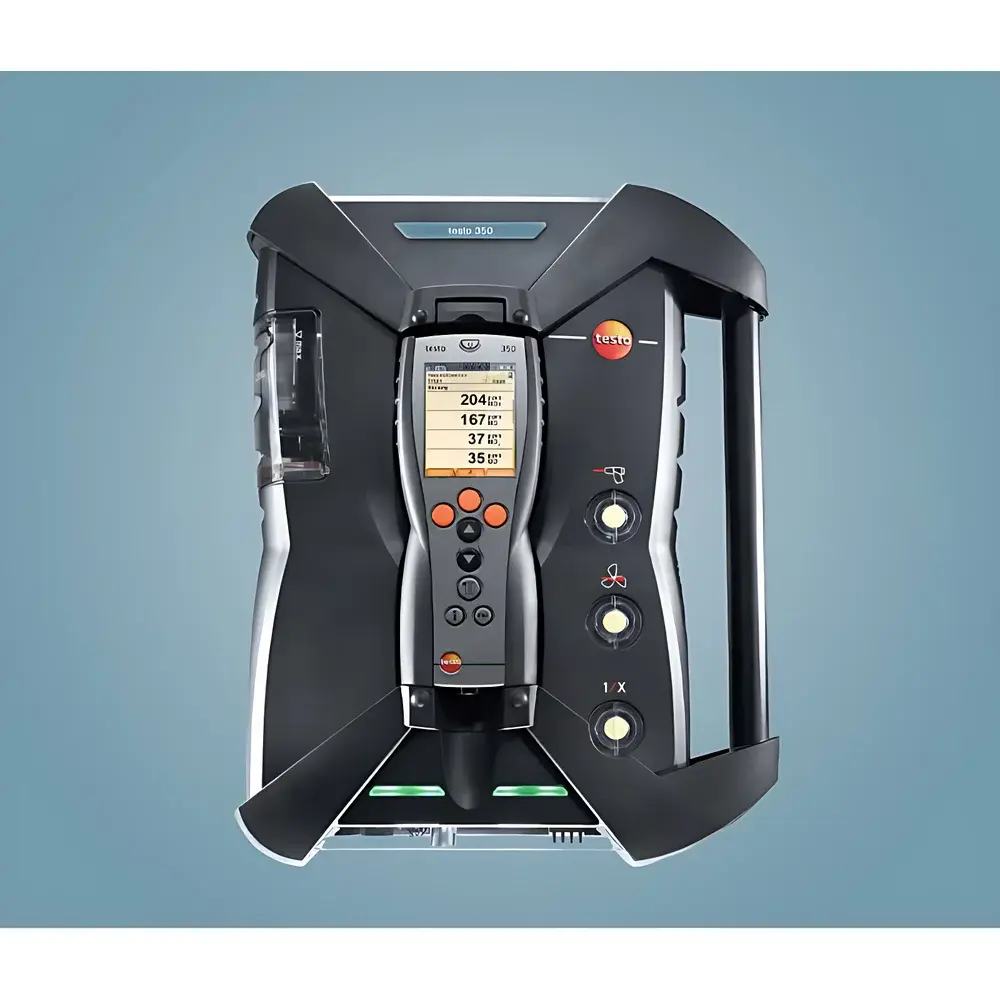
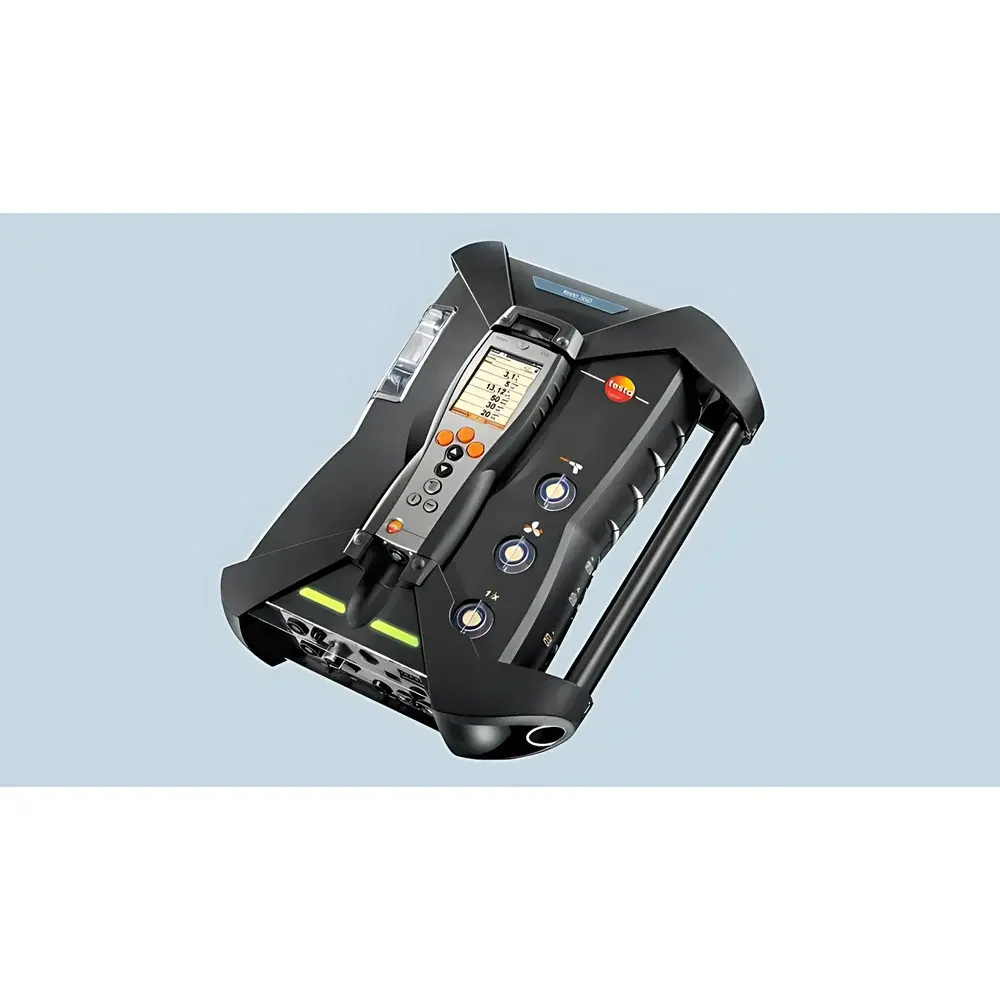
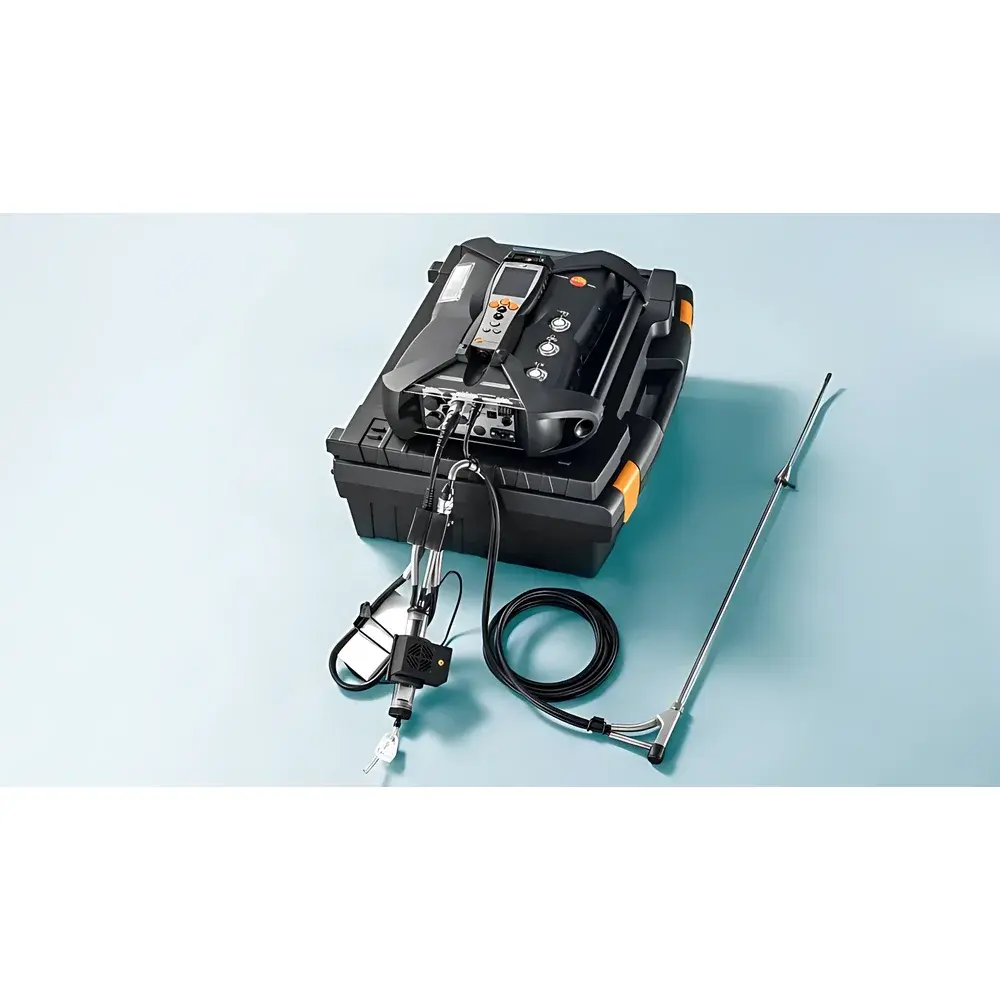
testo 350 Blue Edition Flue Gas Analyzer Analysis Box
| Brand | testo |
|---|---|
| Origin | Germany |
| Model | 0632 3520 |
| Instrument Type | Portable Flue Gas Analyzer |
| Measurement Accuracy | ±5 % of reading |
| Repeatability | ≤2 % |
| Response Time | 10 s |
| Stability | ±5 % |
| Measurable Gases | CO, CO₂, NO, NO₂, SO₂, H₂S, and CₓHᵧ |
Overview
The testo 350 Blue Edition Flue Gas Analyzer Analysis Box is a CE-certified, portable emissions measurement system engineered for high-accuracy, regulatory-compliant flue gas analysis in industrial and environmental monitoring applications. Built upon the proven electrochemical and infrared sensing architecture of the testo 350 platform, the Blue Edition introduces critical hardware and firmware enhancements specifically aligned with China’s HJ 57–2017 standard for sulfur dioxide determination via potentiostatic electrolysis. Its core measurement principle relies on selective electrochemical cells for O₂, CO, NO, NO₂, SO₂, H₂S, and CₓHᵧ, supplemented by optional NDIR sensors for CO₂ and advanced thermal compensation for temperature, pressure, and differential pressure. The analysis box integrates six sensor slots (O₂ standard; five configurable from CO, NO, NO₂, SO₂, H₂S, CₓHᵧ, or CO₂), enabling simultaneous multi-parameter analysis under real-world stack conditions—including high-moisture, low-sulfur, and high-CO environments where cross-sensitivity has historically compromised data integrity.
Key Features
- SO₂ sensor with full-range CO interference immunity up to 10,000 ppm—achieved via proprietary electrolyte formulation eliminating electrochemical coupling with CO.
- Modular, hot-swappable sensor design: users replace individual gas sensors in-field without calibration gases; zeroing completed in ≤30 s with probe remaining in-situ.
- Integrated Peltier-based condensate management: built-in cold trap and automatic condensate pump with level monitoring and audible/visual alerts prevent sensor flooding and extend service intervals.
- Auto-ranging dilution capability (single-channel and full-stream) for safe, accurate measurement of unknown high-concentration gas samples without manual range switching.
- Adjustable-temperature heated sampling probe (titanium construction) compliant with HJ 57–2017 requirements for controllable, traceable heating profiles across the entire sampling line.
- Dual cooling architecture: external air-cooled loop isolates electronics and sensors from ambient particulates and corrosive vapors; internal heat exchange maintains stable operating temperatures.
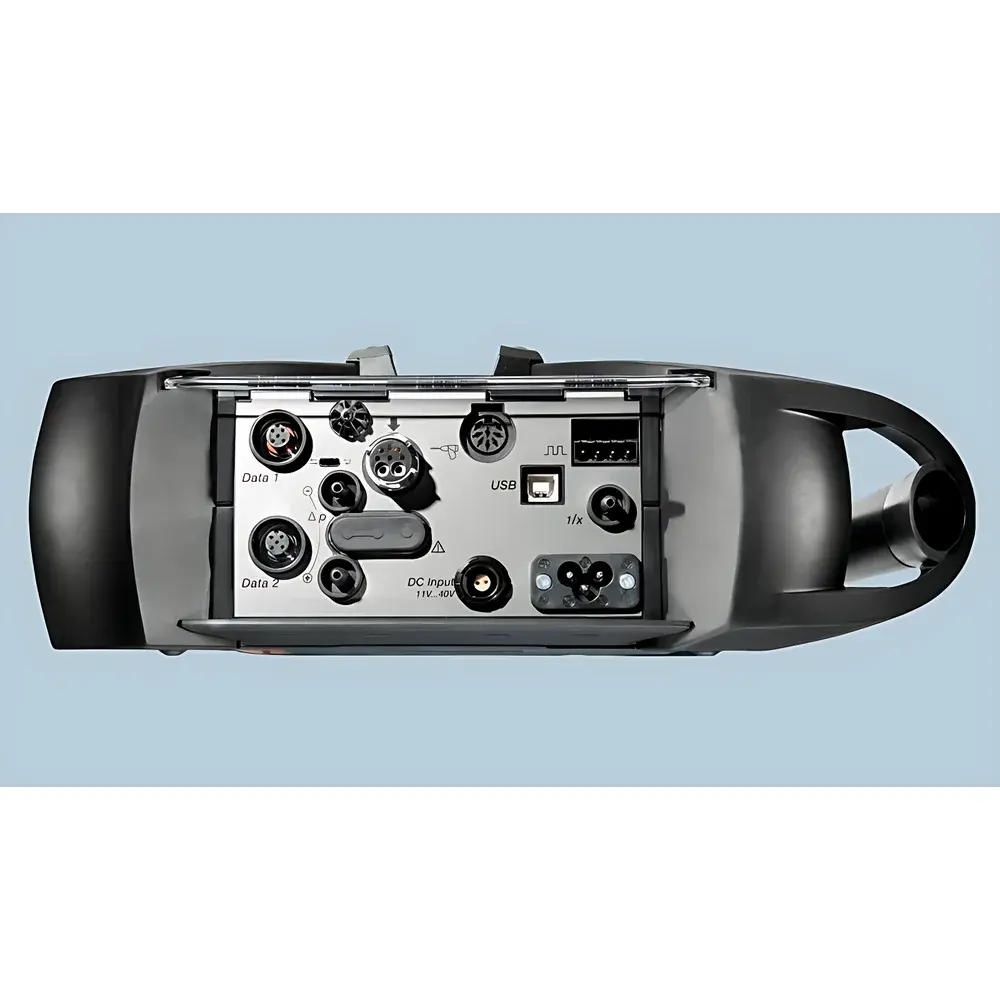
- Open-system firmware architecture supporting bi-directional communication with LIMS, SCADA, and custom enterprise platforms via standardized protocols (e.g., Modbus TCP, ASCII over RS232/USB).
Sample Compatibility & Compliance
The testo 350 Blue Edition is validated for use across diverse combustion sources—including coal-fired boilers, gas turbines, waste incinerators, and industrial kilns—under variable flue gas conditions. It accommodates flue gas temperatures up to +70 °C dew point at the inlet, negative pressures down to −300 mbar, and positive pressures up to +50 mbar. Maximum allowable dust loading is 20 g/m³. All electrochemical sensors meet IEC 60751 and EN 50104 requirements for hazardous area suitability (non-intrinsically safe configuration). Firmware includes preloaded Chinese regulatory calculation algorithms per GB/T 16157 and HJ 57–2017, delivering mg/m³ concentration outputs referenced to standard dry flue gas conditions (11% O₂, 273.15 K, 101.325 kPa). The instrument supports audit-ready data logging compliant with GLP and ISO/IEC 17025 documentation requirements, including timestamped sensor calibrations, zero/span checks, and user-accessible interference test reports (e.g., CO–SO₂ cross-sensitivity verification).
Software & Data Management
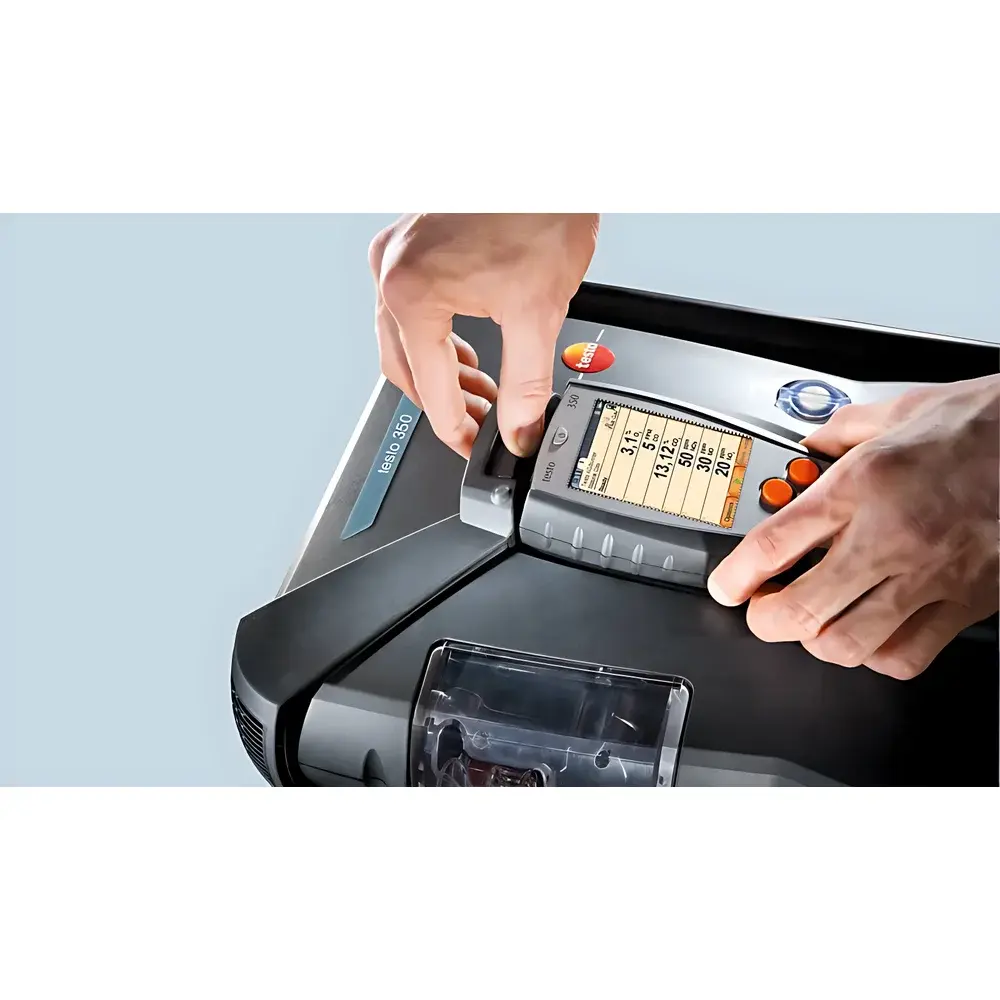
The analysis box operates in tandem with the testo 350 handheld controller, featuring a 3.5-inch color TFT display with intuitive Chinese (Simplified/Traditional) and English UI navigation. Firmware v2.10+ enables secure, encrypted data export via USB or Wi-Fi to CSV, PDF, or XML formats. Internal memory stores up to 250,000 measurement records with metadata (date/time, GPS coordinates if enabled, operator ID, probe serial, calibration status). LIMS integration is implemented via configurable ASCII message templates and HTTP POST endpoints, supporting automated ingestion into laboratory workflows. Audit trails record all configuration changes, sensor swaps, and zeroing events with user authentication. Optional testo 3007 external gas conditioning system—featuring thermoelectric cooling, particle filtration, and adjustable bypass flow—further extends operational envelope for high-humidity or high-acid-gas applications.
Applications
This analyzer serves as a primary tool for environmental compliance verification, combustion optimization, and continuous emission monitoring system (CEMS) validation. Typical use cases include:
- Stack testing per HJ 57–2017, HJ 693–2014 (NOₓ), and HJ 870–2017 (CO₂).
- Boiler efficiency assessment: real-time calculation of excess air (λ), flue gas loss, dew point, and combustion efficiency using embedded stoichiometric models.
- Regulatory reporting for provincial ecological environment bureaus and third-party inspection agencies.
- Commissioning and periodic maintenance of industrial burners, thermal oxidizers, and catalytic converters.
- Field validation of fixed CEMS installations during QA/QC audits.
FAQ
Does the testo 350 Blue Edition support direct connection to a LIMS?
Yes—the device features an open communication interface with configurable ASCII output and supports Modbus TCP and HTTP-based data push for seamless LIMS integration.
Is the SO₂ sensor truly immune to CO interference across its full scale?
Yes—its redesigned electrolyte exhibits zero electrochemical reaction with CO, verified per HJ 57–2017 Annex B under CO concentrations up to 10,000 ppm.
Can I replace sensors without sending the unit to a service center?
Yes—all electrochemical and NDIR sensors are field-replaceable via tool-free bayonet mount; no recalibration is required post-swap.
What is the maximum allowable flue gas moisture content?
The system handles inlet gas with dew point up to +70 °C when used with the optional testo 3007 external cooler and heated probe.
Does the instrument comply with FDA 21 CFR Part 11 for electronic records?
While not certified for pharmaceutical GMP environments, its audit trail, user authentication, and tamper-evident logging meet foundational ALCOA+ principles applicable to environmental QA/QC workflows.







