
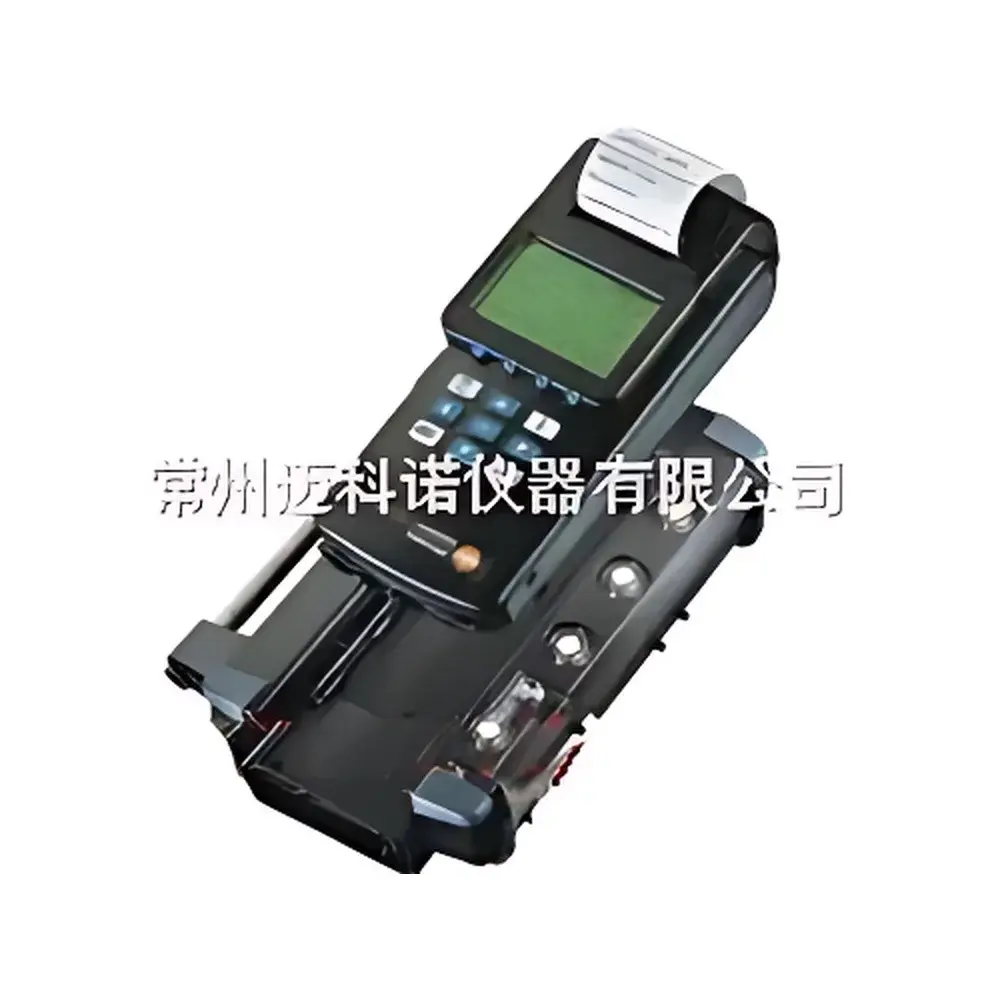
testo 350EPA (2) Flue Gas Analyzer
| Origin | Zhejiang, China |
|---|---|
| Manufacturer Type | Authorized Distributor |
| Origin Category | Domestic (China) |
| Model | testo 350EPA (2) |
| Pricing | Upon Request |
| Sensor Configuration | O₂, NO, CO, SO₂ (standard) |
| Probe Length | 700 mm |
| Max. Probe Temp. | 500 °C |
| Differential Pressure Range | −200 to +200 hPa (DP1), −40 to +40 hPa (DP2) |
| O₂ Range | 0–25 vol.% |
| NO Range | 0–3000 ppm |
| CO Range | 0–10,000 ppm |
| SO₂ Range | 0–5000 ppm |
| Temperature Measurement (K-type) | −40 to +1200 °C |
| Data Storage Capacity | 250,000 readings |
| Power | Rechargeable battery or 110/230 V AC, 50–60 Hz |
| Enclosure Material | ABS |
| Operating Temperature | −5 to +45 °C |
| Storage Temperature | −20 to +50 °C |
| Analysis Box Dimensions | 395 × 275 × 95 mm |
| Analysis Box Weight | 3200 g |
| Handheld Controller Weight | 850 g |
Overview
The testo 350EPA (2) Flue Gas Analyzer is a field-deployable, EPA-compliant portable emission monitoring system engineered for precision stack testing and continuous compliance verification in industrial combustion processes. Designed in accordance with U.S. EPA Method 6C (SO₂), Method 7E (NO), Method 10 (CO), and Method 3A (O₂), the instrument employs electrochemical sensor technology for real-time, multi-component flue gas analysis—including O₂, NO, CO, and SO₂—as well as differential pressure, temperature, and derived parameters such as flue gas velocity, volumetric flow rate, and annual mass emissions (kg/year). Its modular architecture supports future expansion to six gas components, enabling adaptability across evolving regulatory requirements including NSPS Subpart Db, MATS, and state-level air permitting conditions. The analyzer integrates a high-torque diaphragm pump capable of sustaining stable sampling under challenging negative pressures (−200 hPa) or low-flow conditions, ensuring representative gas capture even in low-velocity ducts or high-backpressure stacks.
Key Features
- Standard quad-sensor configuration: electrochemical O₂ (0–25 vol.%), NO (0–3000 ppm), CO (0–10,000 ppm), and SO₂ (0–5000 ppm), all calibrated and certified per EPA performance specifications
- Heated sensor module—maintains operational stability down to −5 °C ambient, preventing condensation-induced drift and cross-sensitivity errors
- Patented sulfur-resistant probe tubing: PTFE-lined, 2 mm inner diameter capillary with hydrophobic surface geometry; enables self-cleaning via condensate sloughing and minimizes adsorption artifacts during long-duration SO₂ measurement
- Dual differential pressure channels: DP1 (−200 to +200 hPa, ±1.5% accuracy) and DP2 (−40 to +40 hPa, 0.01 hPa resolution) for simultaneous velocity profile mapping and draft control assessment
- Integrated cold trap condensate management: optional active cooling unit with independent condensate pump and auto-drain functionality—critical for extended unattended operation in high-moisture flue streams
- Robust ABS housing rated IP54; magnetic rear mount, backlit LCD, built-in thermal printer, RS232 interface, and dual thermocouple inputs (flue gas + ambient temperature)
Sample Compatibility & Compliance
The testo 350EPA (2) is validated for use across coal-, oil-, and natural gas-fired boilers; cement kilns; waste incinerators; and industrial process heaters. Its probe assembly (700 mm length, 500 °C max. tip temperature) accommodates standard 4″–12″ duct diameters and complies with ASTM D6784-22 (Standard Test Method for Elemental, Oxidized, Particle-Bound, and Total Mercury in Flue Gas) when paired with optional Hg-add-on modules. While not itself a certified CEMS per 40 CFR Part 60 Appendix B, it meets PS-1/PS-2 equivalency criteria for relative accuracy test audits (RATA) and linearity checks of installed continuous emission monitoring systems. All firmware and calibration logs support audit-ready traceability aligned with GLP principles and 21 CFR Part 11 electronic record requirements when used with testo’s compliant data management software.
Software & Data Management
Data acquisition, visualization, and reporting are managed via testo’s proprietary analysis software (compatible with Windows OS), which imports measurement files (.tdf format) over RS232 or USB. The software enables automatic calculation of emission rates (g/s, kg/h, tons/year), stoichiometric excess air ratio (λ), combustion efficiency, and NOₓ/SO₂ conversion efficiencies. Each stored reading (up to 250,000) includes timestamp, GPS coordinates (when connected to external GNSS), sensor status flags, and full metrological metadata—including zero/span drift logs, calibration certificate IDs, and user-defined site tags. Audit trails are immutable; modifications require supervisor-level authentication and generate versioned log entries compliant with ISO/IEC 17025 documentation controls.
Applications
- Regulatory stack testing per EPA Methods 2, 3A, 6C, 7E, and 10 during initial startup, periodic recertification, or deviation investigations
- Combustion optimization studies—adjusting air/fuel ratios, burner tuning, and heat recovery system diagnostics
- Performance verification of scrubbers, SNCR/SCR systems, and electrostatic precipitators via pre- and post-control gas profiling
- Leak detection and flue gas recirculation (FGR) flow balancing using differential pressure and O₂ gradient analysis
- Field validation of CEMS bias and drift prior to RATA execution
- Emissions inventory development for GHG reporting (Scope 1) and Title V permit renewals
FAQ
Is the testo 350EPA (2) certified for use in U.S. EPA compliance testing?
Yes—it meets the performance criteria outlined in EPA Methods 3A, 6C, 7E, and 10 for portable reference analyzers and is routinely deployed for RATA support and relative accuracy assessments.
Can the instrument measure mercury (Hg) concentrations?
Not natively; however, it supports integration with third-party thermal desorption Hg modules (e.g., Tekran 2537B analog output interface) for elemental mercury screening in accordance with ASTM D6784.
What is the recommended calibration frequency for field use?
Per EPA guidance, daily zero/span verification is required before each test run; full multi-point calibration is recommended every 30 days or after sensor exposure to >80% of full scale.
Does the system support automated data upload to cloud-based environmental reporting platforms?
Direct cloud sync is not embedded; however, exported .csv/.tdf files are compatible with common EHS platforms (e.g., Sphera, Intelex, ETQ Reliance) via API or batch import protocols.
Is the 700 mm probe suitable for sampling from small-diameter ducts or ceramic-lined stacks?
Yes—the slim 2 mm ID PTFE tube minimizes residence time and particulate deposition; optional 300 mm and 1000 mm probes are available for constrained or ultra-high-temp applications.







