
testo 416 Precision Vane Anemometer
| Brand | testo |
|---|---|
| Model | 416 |
| Type | Vane Anemometer |
| Measurement Range | 0.6–40 m/s |
| Resolution | 0.1 m/s |
| Accuracy | ±(0.2 m/s + 1.5 % of reading) |
| Operating Temperature | −20 to +50 °C |
| Storage Temperature | −40 to +70 °C |
| Weight | 325 g |
| Dimensions (L×W×H) | 182 × 64 × 40 mm |
| Probe Diameter | 16 mm |
| Telescopic Handle Max Length | 890 mm |
| Power Supply | 9 V battery |
| Battery Life | up to 80 h |
| Housing Material | ABS |
| Display | Backlit LCD |
Overview
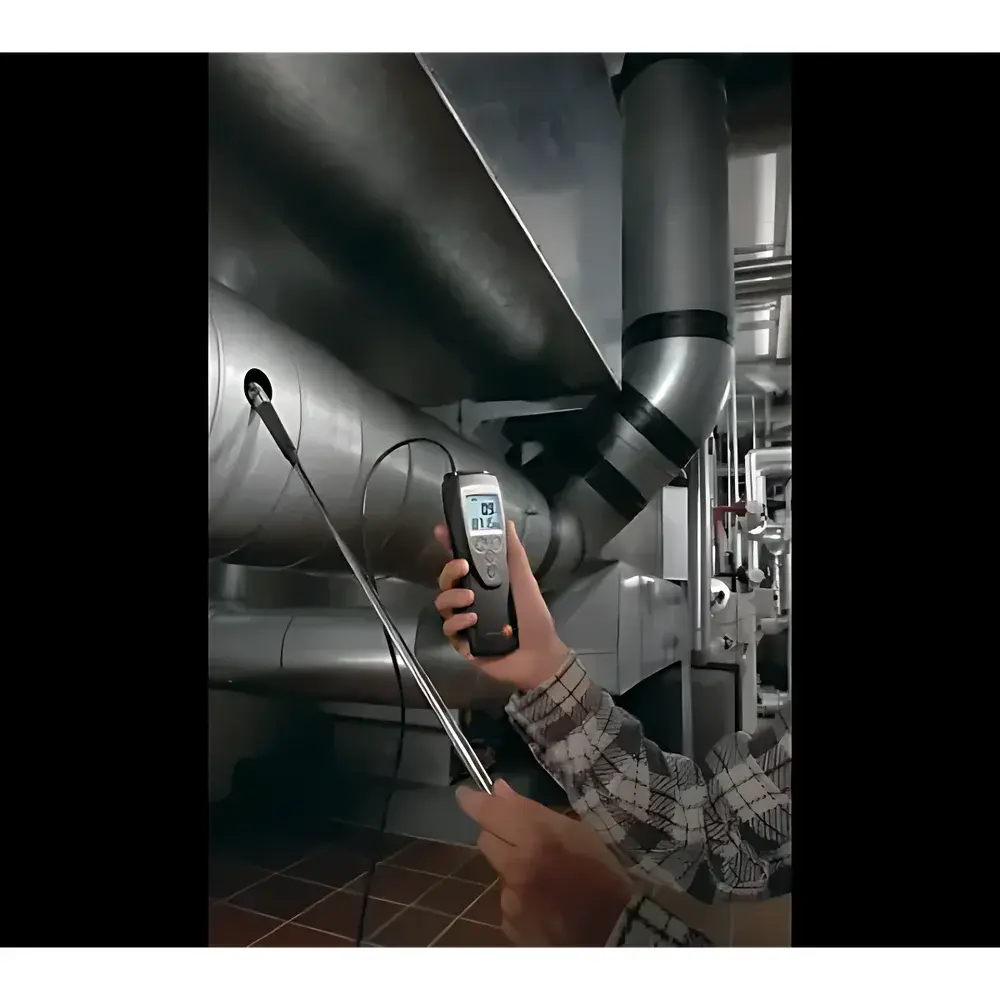
The testo 416 Precision Vane Anemometer is a handheld, field-deployable instrument engineered for reliable and repeatable air velocity measurement in HVAC system commissioning, duct traversing, ventilation audits, and indoor air quality (IAQ) assessments. It operates on the principle of rotational torque transduction: airflow imparts angular momentum to a calibrated 16 mm diameter vane rotor; the resulting rotational speed is converted into a linear velocity output via factory-traceable calibration curves. Unlike thermal anemometers, the vane design delivers stable performance across fluctuating humidity levels and moderate particulate loads—making it especially suitable for industrial ductwork, ceiling diffuser testing, and exhaust stack surveys where condensation or dust accumulation may compromise thermal sensor integrity. Its compact form factor, integrated telescopic handle (extendable to 890 mm), and ergonomic grip enable single-handed operation in confined or elevated access points without requiring auxiliary mounting hardware.
Key Features
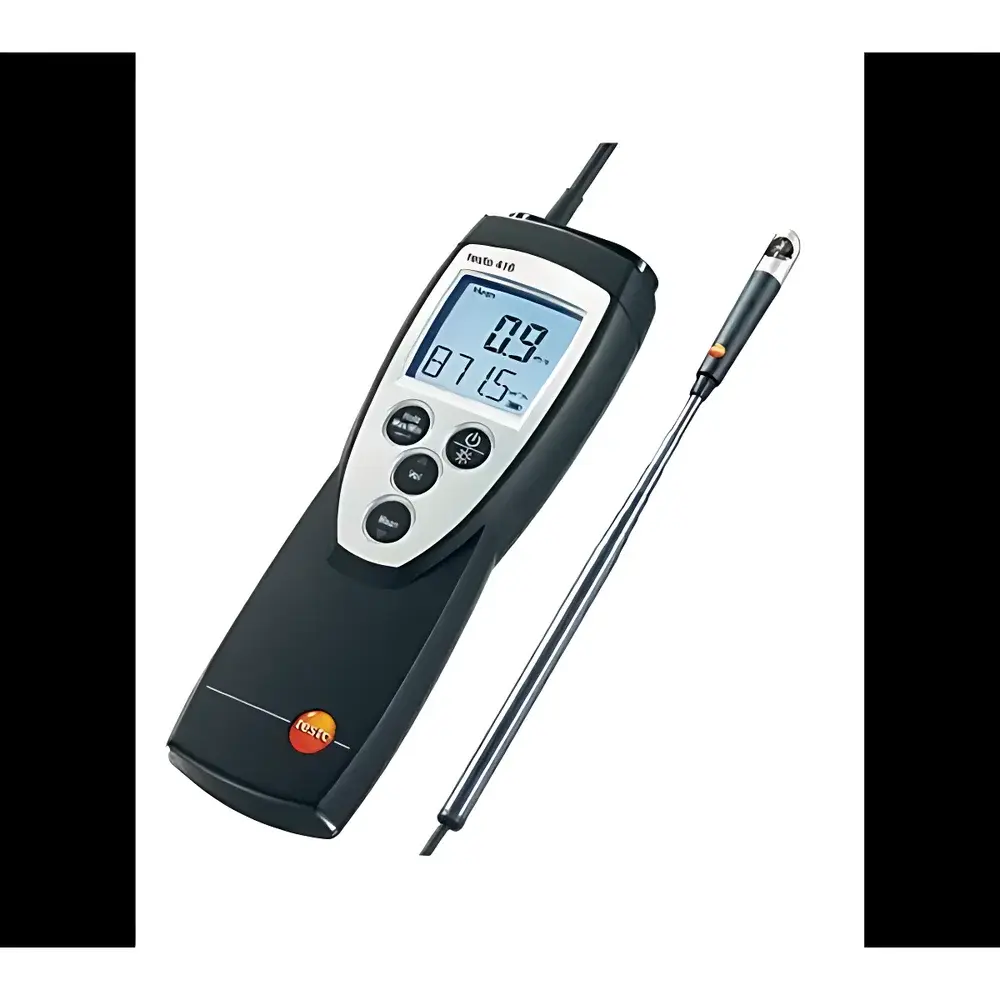
- Fixed 16 mm vane probe with precision-balanced rotor geometry for minimal flow disturbance and high directional sensitivity
- Telescopic handle extending up to 890 mm—enables safe, non-intrusive measurements in deep ducts, plenums, and ceiling cavities
- Backlit LCD display with real-time wind speed readout, automatic unit switching (m/s, ft/min, knots, km/h), and intuitive icon-driven interface
- On-device volumetric flow calculation: enter duct cross-sectional area (in m² or ft²) to derive instantaneous and time-weighted average airflow (m³/s or CFM)
- Multi-point averaging function supporting up to 99 sequential readings with statistical summary (mean, min, max, standard deviation)
- Hold function to freeze displayed value during recording or documentation; dedicated Min/Max buttons for rapid extremum capture
- Auto power-off after 20 minutes of inactivity; low-battery indicator and audible alert prior to shutdown
- Rugged ABS housing rated for mechanical shock resistance and compliant with IP52 ingress protection (dust-resistant, drip-proof)
Sample Compatibility & Compliance
The testo 416 is validated for use in non-explosive, non-corrosive ambient air streams within its specified operating temperature range (−20 to +50 °C) and relative humidity ≤95 % RH (non-condensing). It meets the general requirements of EN 12599 (Ventilation for buildings – Test procedures for measuring air flow rates in ducts) and supports compliance with ASHRAE Guideline 12-2020 (Managing the Risk of Legionellosis Associated with Building Water Systems) when used for ventilation verification. While not intrinsically safe, its non-sparking construction and absence of exposed electronics make it appropriate for routine HVAC maintenance under OSHA 1910.137 and EU Directive 2014/34/EU (ATEX) Category 3G environments. Calibration certificates traceable to national standards (e.g., NIST, PTB) are provided with each unit per ISO/IEC 17025 guidelines.
Software & Data Management
Data export is performed manually via visual readout or documented using external logging tools. The device does not feature Bluetooth, USB, or wireless connectivity—ensuring electromagnetic compatibility (EMC) in electrically noisy environments such as switchgear rooms or near variable-frequency drives (VFDs). All internal calculations—including multi-point averages and volumetric conversions—are performed in accordance with ISO 5167-1:2003 principles for uniform flow profile assumptions. The included factory calibration report documents as-delivered accuracy against reference standards and satisfies baseline GLP documentation requirements for field instrumentation used in facility qualification (IQ/OQ) protocols. Optional accessories—including protective soft cases, rugged transit cases, and compact carry pouches—facilitate organized transport and reduce risk of mechanical damage during repeated site deployments.
Applications
- HVAC duct traverse surveys per ASHRAE Standard 111 and ISO 16813 for air distribution system balancing
- Commissioning and periodic verification of fume hoods, biosafety cabinets, and cleanroom supply/exhaust systems
- Occupational hygiene assessments for workplace ventilation adequacy (OSHA Technical Manual Section III: Chapter 2)
- Energy audit support—quantifying fan system efficiency, identifying leakage paths, and validating damper positions
- Educational laboratory use in thermodynamics, fluid mechanics, and building science curricula
- Post-construction IAQ verification in accordance with LEED EQ Credit 1 and WELL Building Standard v2 Air Concept
FAQ
What is the recommended recalibration interval for the testo 416?
Testo recommends annual calibration verification under normal usage conditions; more frequent checks are advised if the instrument is subjected to mechanical shock, extreme temperature cycling, or exposure to airborne contaminants.
Can the testo 416 measure airflow in round and rectangular ducts?
Yes—the device calculates volumetric flow based on user-input cross-sectional area; users must determine duct geometry and dimensions separately using tape measure or laser distance meter.
Is the telescopic handle detachable or replaceable?
The handle is permanently integrated with the probe assembly and not designed for field replacement; however, optional protective sleeves and carrying cases are available to extend service life.
Does the testo 416 comply with FDA 21 CFR Part 11 for electronic records?
No—it is a standalone analog-digital hybrid instrument without audit trail, electronic signature, or data export capability; manual recording remains the primary documentation method.
How does the accuracy specification account for low-velocity measurements?
At the lower end of the range (e.g., 0.6 m/s), the absolute error term (±0.2 m/s) dominates; therefore, measurements below 1.0 m/s should be interpreted with increased uncertainty and confirmed using alternative methods where regulatory thresholds apply.







