
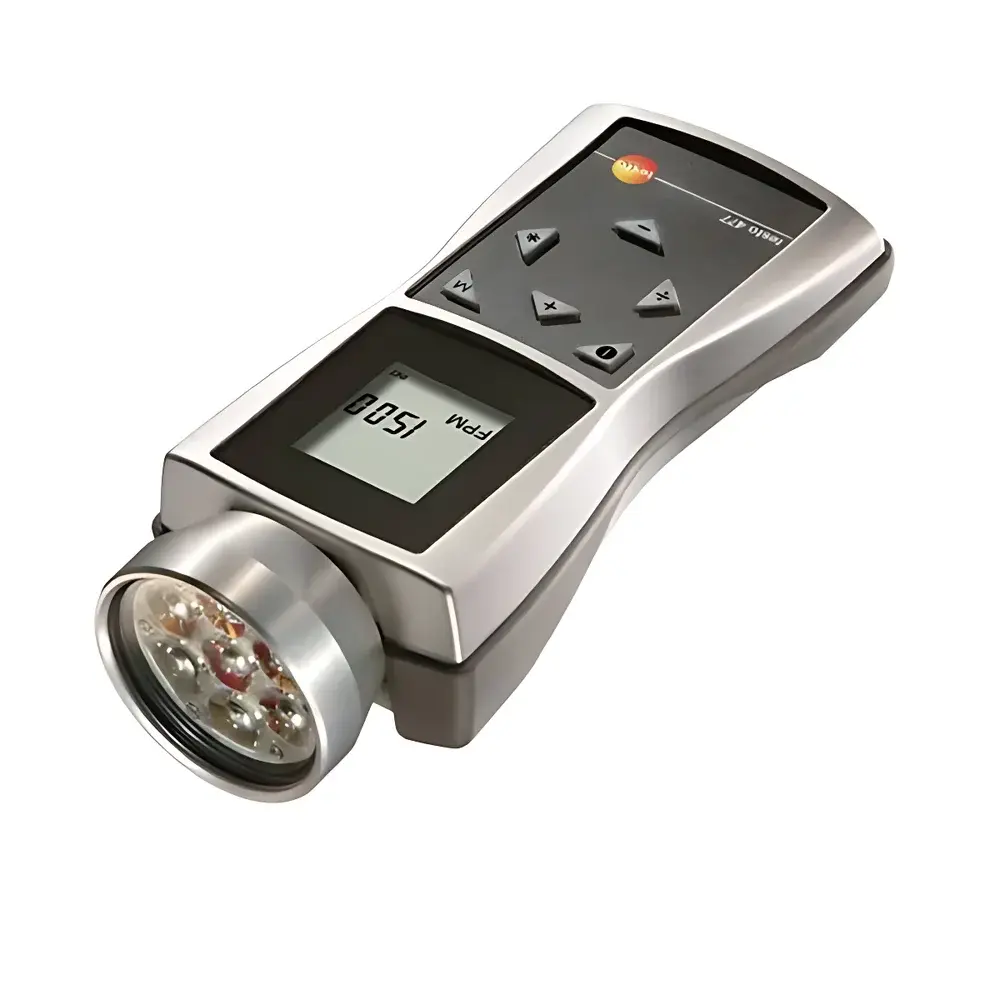
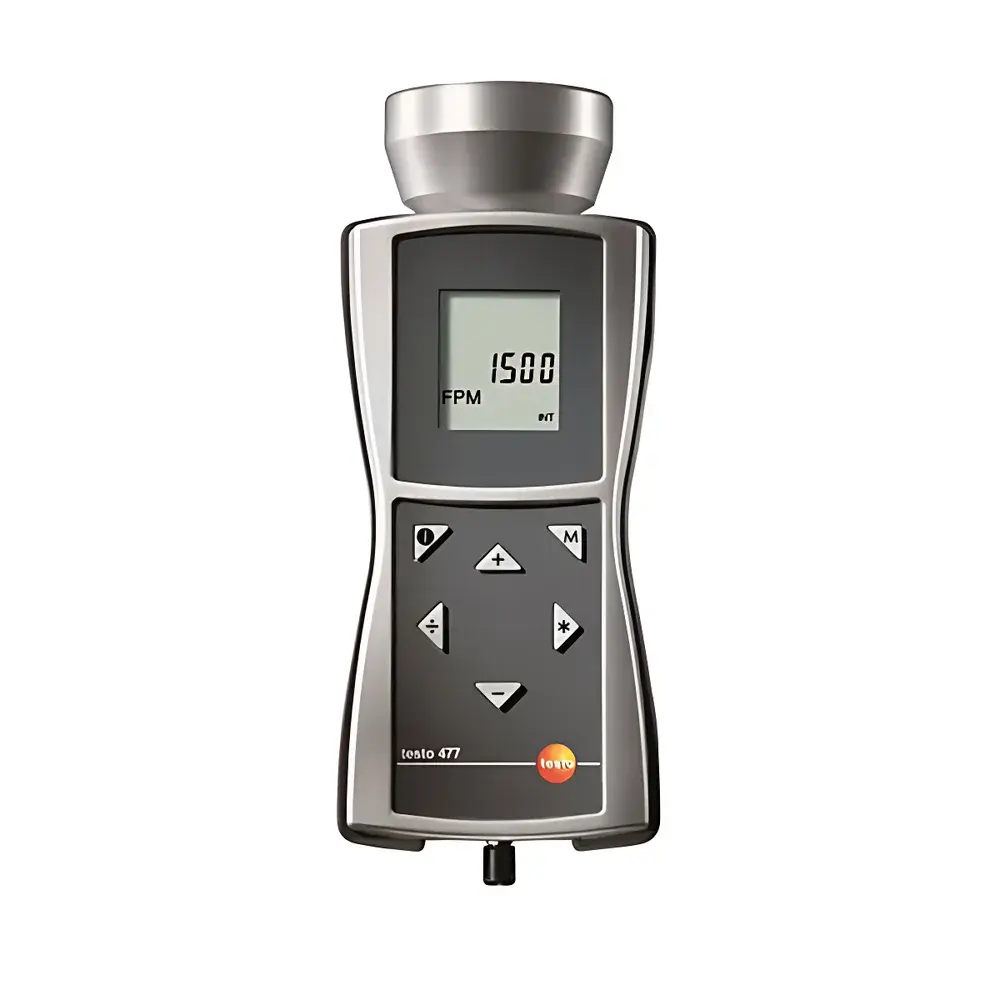
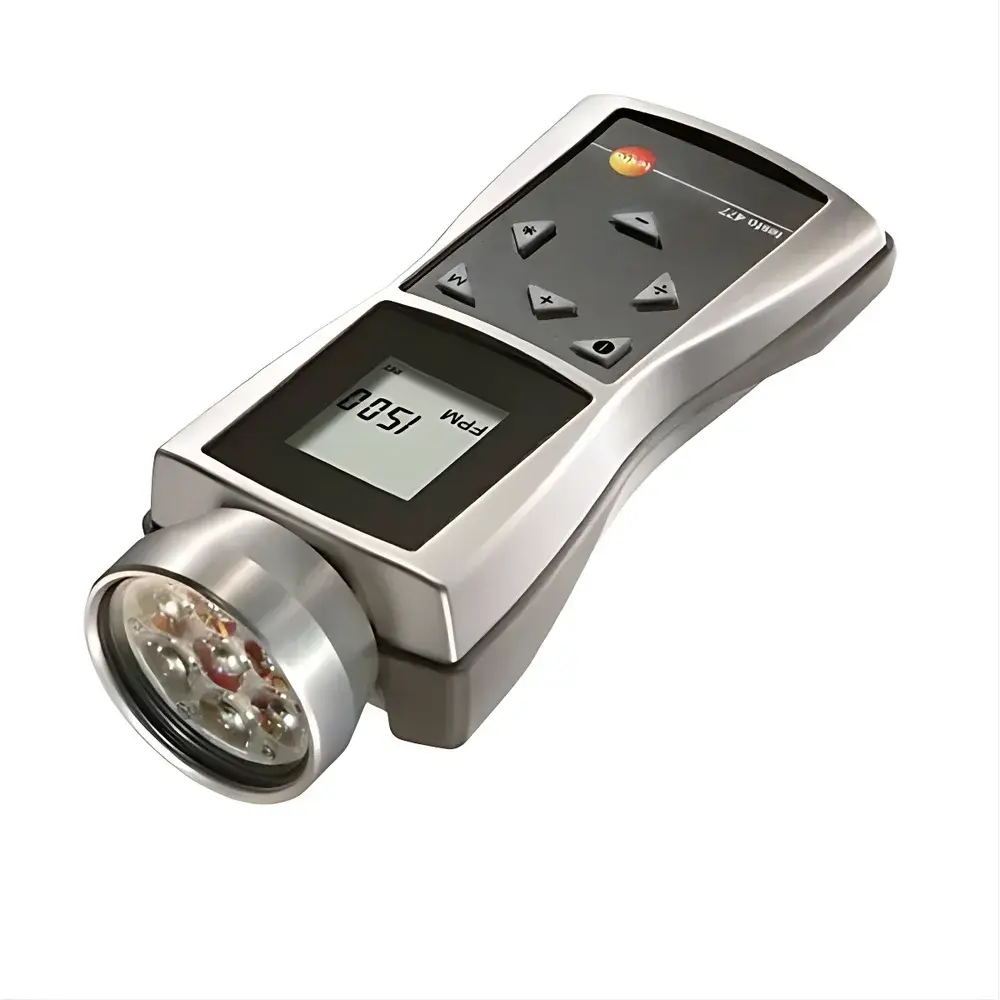
testo 477 LED Handheld Stroboscope
| Brand | testo |
|---|---|
| Origin | Germany |
| Model | 0563 4770 |
| Measurement Range | 30–300,000 fpm (flashes per minute) |
| Flash Intensity | up to 4800 lux @ 30 cm / 6000 fpm |
| Flash Duration | Adjustable |
| Display | LCD |
| Protection Rating | IP65 |
| Battery Life | ~11 h (NiMH rechargeable, at 6000 fpm) / ~5 h (alkaline, at 6000 fpm) |
| Accuracy | ±0.02 % of reading |
| Resolution | ±0.1 fpm (30–999 fpm), ±1 fpm (1000–300,000 fpm) |
| Trigger I/O | Yes |
| Flash Color Temperature | ~6500 K |
| Operating Current | ≤50 mA |
| Low-Voltage Cutoff | <1 V |
Overview
The testo 477 LED Handheld Stroboscope is an industrial-grade optical measurement instrument engineered for non-contact rotational and vibrational analysis of high-speed machinery under operational conditions. Utilizing precisely timed, high-intensity LED flash emission synchronized with periodic motion, the device leverages the stroboscopic effect to visually “freeze” rotating or oscillating components—enabling real-time qualitative assessment and quantitative speed determination without mechanical intervention. Unlike contact tachometers or reflective tape-dependent systems, the testo 477 operates independently of surface preparation, physical attachment, or process interruption. Its core principle relies on temporal aliasing: when flash frequency matches or is a submultiple of the object’s rotational frequency, motion appears stationary or slowed, allowing visual inspection of dynamic behavior—including imbalance, misalignment, belt slippage, gear tooth wear, or cam follower timing errors. Designed for continuous use in demanding production environments, it supports diagnostics across rotating equipment such as textile looms, printing presses, packaging conveyors, HVAC fans, CNC spindles, and automotive engine components.
Key Features
- Ultra-wide measurement range: 30 to 300,000 flashes per minute (fpm), corresponding to rotational speeds up to 300,000 rpm for single-event-per-revolution targets.
- High-brightness adjustable LED flash source delivering up to 4800 lux at 30 cm distance (at 6000 fpm), ensuring visibility even under ambient industrial lighting conditions.
- Adjustable flash duration optimized for sharp image capture across varying rotational velocities and object geometries.
- Integrated trigger input/output interface enabling synchronization with external sensors (e.g., proximity switches, encoders, or vibration transducers) for phase-locked measurements and automated data acquisition workflows.
- Rugged IP65-rated housing—dust-tight and protected against low-pressure water jets—designed for resilience in workshops, cleanrooms, and factory floors.
- Long operational runtime: approximately 11 hours using included NiMH rechargeable battery (at 6000 fpm), or ~5 hours with standard alkaline cells; intelligent low-voltage cutoff (<1 V) prevents deep discharge damage.
- Backlit LCD display with intuitive menu navigation, supporting direct readout in fpm, rpm, and Hz, plus real-time stability indicators.
Sample Compatibility & Compliance
The testo 477 is compatible with any rotating, reciprocating, or vibrating component that exhibits periodic motion—regardless of size, material, or accessibility. It is routinely deployed for inspecting needle bars in knitting machines, web tension rollers in converting lines, centrifuge rotors, turbine blades, and micro-motors where physical sensor mounting is impractical. No retro-reflective tape, paint, or adhesive markers are required, eliminating contamination risk and calibration drift associated with surface-based methods. The instrument complies with EN 61326-1 (EMC requirements for electrical equipment used in industrial environments) and meets RoHS 2011/65/EU directives. Its design supports integration into GLP- and GMP-aligned quality control procedures, particularly where traceable, non-intrusive verification of machine health is mandated—e.g., in pharmaceutical packaging line validation or aerospace component maintenance logs.
Software & Data Management
While the testo 477 operates as a standalone field instrument, its trigger I/O port facilitates connection to external data loggers, PLCs, or PC-based acquisition systems via standard 3.5 mm mono jack (TTL-compatible). When paired with testo’s optional ComSoft software suite (v5.x or later), users can archive measurement sessions—including timestamped flash frequency values, operator notes, and environmental metadata—for audit-ready reporting. All stored records maintain full traceability per ISO/IEC 17025 requirements, including instrument ID, calibration status, and user authentication logs. The device itself does not store historical readings internally but supports immediate export of current parameters via USB (when used with testo’s optional interface cable), satisfying FDA 21 CFR Part 11 criteria for electronic records when deployed within validated systems.
Applications
- Real-time monitoring of textile machinery—e.g., warp beam rotation, shuttle movement, or yarn guide oscillation—to verify timing consistency and detect thread break precursors.
- Verification of print cylinder registration and ink transfer fidelity in offset and flexographic presses without halting press operation.
- Vibration amplitude estimation on conveyor drive pulleys or motor couplings by observing apparent displacement during stroboscopic freeze.
- Functional testing of safety-critical rotating components—such as brake drum balance or fan blade integrity—in automotive service bays and rail maintenance depots.
- Validation of packaging machine cycle timing, including fill-nozzle dwell, capping head engagement, and label applicator synchronization.
- Academic and R&D labs conducting kinematic analysis of prototype mechanisms where optical non-interference is essential.
FAQ
Can the testo 477 measure RPM on objects with multiple repeating features (e.g., gears with 24 teeth)?
Yes—when measuring multi-feature objects, the displayed value corresponds to the flash frequency required to freeze one feature. To obtain true shaft RPM, divide the reading by the number of equally spaced features.
Is the flash intensity sufficient for outdoor daylight use?
The 4800 lux output enables reliable operation in shaded industrial exteriors or well-lit indoor facilities; however, direct sunlight may necessitate localized shading or reduced working distance for optimal contrast.
Does the device require annual recalibration?
testo recommends calibration every 12 months or after 200 hours of cumulative use—per ISO/IEC 17025 guidelines—to maintain traceable accuracy within ±0.02% of reading.
Can it be powered continuously via external DC supply?
No—the testo 477 is designed exclusively for battery operation; no external power input port is provided to preserve IP65 integrity and electromagnetic compatibility.
What is the minimum measurable flash duration?
Flash pulse width is continuously adjustable from 1 µs to 200 µs, permitting optimization for both high-speed clarity and low-light sensitivity depending on target reflectivity and ambient conditions.




