
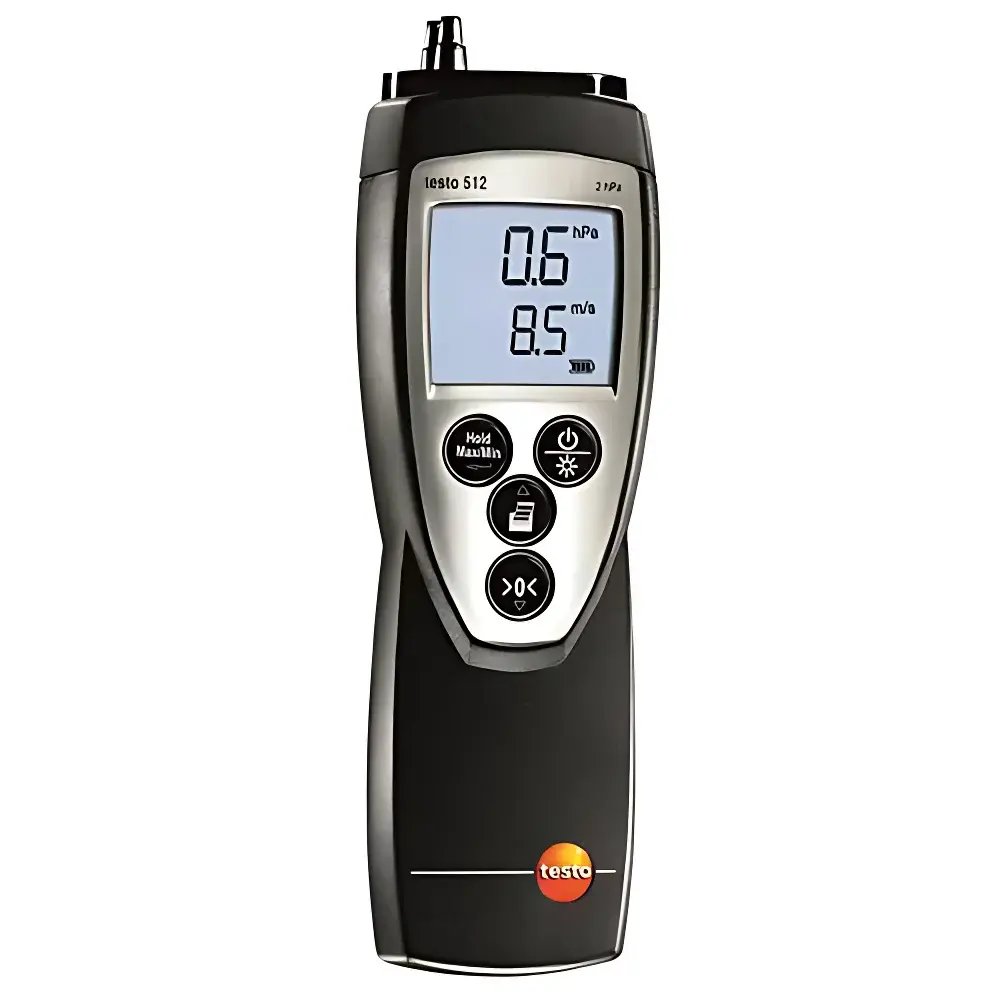
testo 512 Differential Pressure Meter
| Brand | testo |
|---|---|
| Origin | Germany |
| Model | 510560 / 5129 |
| Measurement Range | ±2 hPa |
| Velocity Resolution | 0.6 m/s |
| Display | 3.5-digit LCD |
| Power Supply | 9 V alkaline battery (included) |
| Enclosure Rating | IP54 (dust and splash resistant) |
| Operating Temperature | -10 to +50 °C |
| Storage Temperature | -20 to +70 °C |
| Dimensions (L×W×H) | 160 × 65 × 38 mm |
| Weight | approx. 220 g (without probe) |
Overview
The testo 512 Differential Pressure Meter is a compact, handheld instrument engineered for precise measurement of differential pressure (Δp) in HVAC systems, cleanrooms, fume hoods, and industrial ventilation ducts. Based on piezoresistive sensor technology, it delivers stable, repeatable readings across its calibrated range of ±2 hPa with a resolution of 0.01 hPa. Its design adheres to fundamental principles of fluid dynamics—specifically, the application of Bernoulli’s equation via pitot-static tube configuration—to derive volumetric airflow velocity from measured pressure differentials. The device operates as a primary field tool for commissioning, preventive maintenance, and regulatory compliance verification where low-pressure differentials are critical indicators of system integrity and performance.
Key Features
- Piezoresistive differential pressure sensor with temperature compensation for enhanced long-term stability and minimal zero drift
- Integrated 3.5-digit backlit LCD display enabling clear readability under low-light or confined-space conditions
- IP54-rated housing providing protection against dust ingress and water splashes during routine field use
- Pre-calibrated stainless-steel pitot tube (standard) with flexible silicone hose (1.5 m) for remote sensing and reduced thermal conduction error
- TOPSAFE protective case (optional accessory) offering mechanical impact resistance, contamination shielding, and moisture barrier functionality
- Battery-powered operation (9 V alkaline, included) supporting continuous usage for up to 20 hours; low-battery indicator ensures uninterrupted data collection
- Ergonomic form factor (160 × 65 × 38 mm, ~220 g) optimized for single-hand operation and extended handheld measurement sessions
Sample Compatibility & Compliance
The testo 512 is intended for gaseous media only—primarily ambient air and non-corrosive, non-explosive process gases within standard HVAC and laboratory environments. It is not rated for use with liquids, saturated steam, or aggressive chemical vapors. The instrument complies with EN 61326-1:2013 (EMC requirements for laboratory and industrial measurement equipment) and meets essential safety requirements per EN 61010-1:2010. While not certified to ISO/IEC 17025 for accredited calibration laboratories, its factory calibration traceability aligns with DIN EN ISO/IEC 17025:2018 standards when performed by testo’s DAkkS-accredited calibration service. The device supports routine verification against NIST-traceable reference manometers and is routinely employed in facilities operating under ISO 14644 (cleanroom classification), ASHRAE Guideline 12 (HVAC infection control), and EU GMP Annex 1 (airborne particle monitoring infrastructure validation).
Software & Data Management
The testo 512 operates as a standalone field meter without embedded data logging or Bluetooth/Wi-Fi connectivity. All measurements are displayed in real time and require manual recording. However, its analog output (0–1 V DC proportional to Δp) enables integration into third-party SCADA or BMS platforms for continuous trending. For documentation traceability, users may pair the instrument with testo’s optional ComSoft Basic software (via USB interface adapter) to generate basic PDF reports—including date/time stamps, operator ID fields, and measurement notes—for internal QA records. While the device does not support FDA 21 CFR Part 11-compliant electronic signatures or audit trails, its simplicity ensures full compatibility with GLP-aligned paper-based SOPs requiring signed hardcopy printouts or handwritten log entries.
Applications
- Verification of filter pressure drop across HEPA/ULPA filters in cleanrooms and pharmaceutical manufacturing suites
- Commissioning and balancing of supply/exhaust air systems in hospitals, laboratories, and biosafety cabinets
- Leak testing of ductwork and containment enclosures using controlled pressurization/depressurization protocols
- Monitoring differential pressure gradients between adjacent zones (e.g., anterooms, isolation rooms) to maintain directional airflow per HTM 03-01 and CDC guidelines
- Field validation of fan static pressure and system resistance in commercial HVAC retrofits and energy audits
- Supporting ISO 50001 energy management system implementation through periodic Δp trend analysis
FAQ
What is the maximum recommended operating temperature for the testo 512?
The instrument is rated for continuous operation between –10 °C and +50 °C. Extended exposure above +50 °C may affect sensor linearity and battery life.
Can the testo 512 measure absolute pressure or gauge pressure?
No—it is designed exclusively for differential pressure measurement between two points using the provided pitot-static probe assembly.
Is the included pitot tube suitable for high-velocity airflow applications?
The standard stainless-steel pitot tube is optimized for velocities up to 20 m/s at ambient conditions. For higher velocities or turbulent flow profiles, users should consult testo’s technical documentation regarding dynamic pressure correction factors.
Does the testo 512 require annual recalibration?
While not mandatory, annual recalibration is recommended for applications governed by ISO 9001 or ISO/IEC 17025 quality systems. Field verification using a known reference source prior to each critical measurement session is considered best practice.
How is the 0.6 m/s velocity resolution derived?
This value reflects the minimum detectable change in calculated airflow velocity based on the instrument’s ±2 hPa range, 0.01 hPa pressure resolution, and default air density assumption (1.2 kg/m³) in the integrated calculation algorithm.
Related Products







