
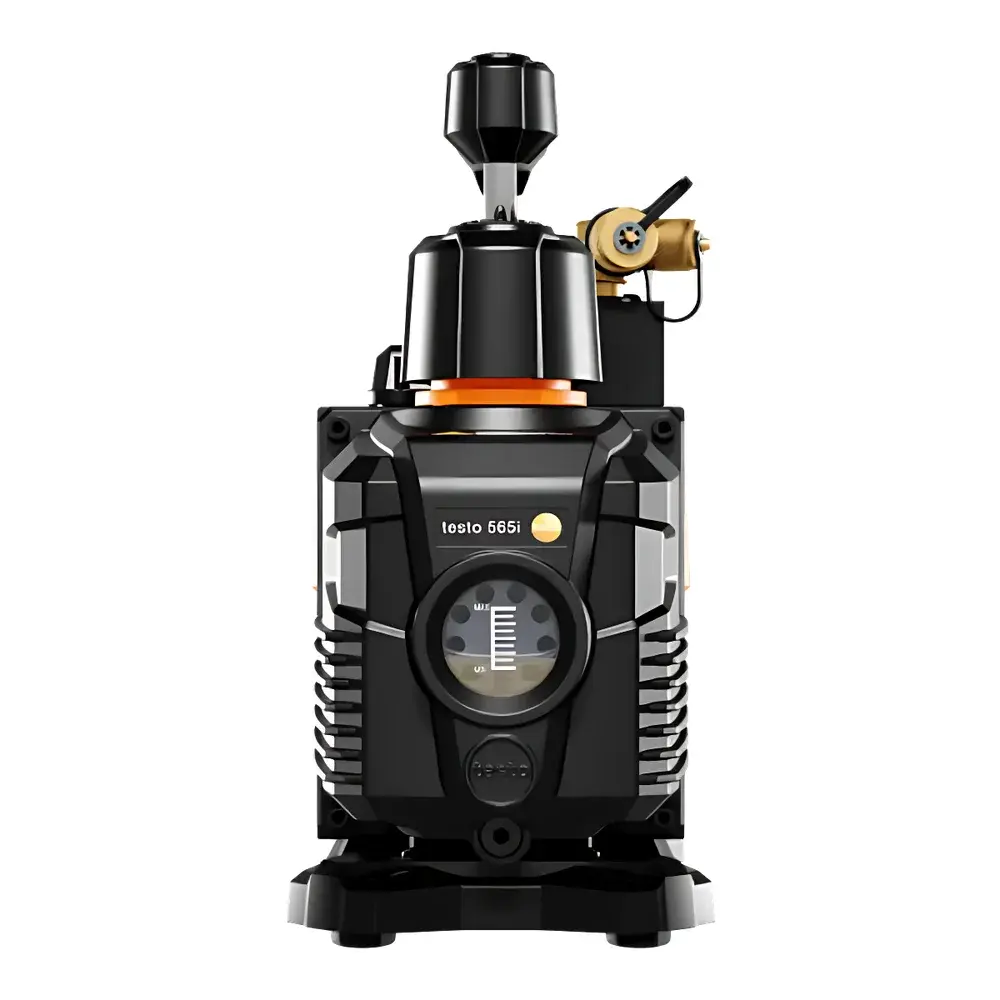
testo 565i Smart Dual-Stage Rotary Vane Vacuum Pump with Integrated Hold Test and Bluetooth 5.0 Connectivity
| Brand | testo |
|---|---|
| Origin | Germany |
| Pump Type | Two-Stage Rotary Vane |
| Oil Compatibility | ISO VG 46 |
| Ultimate Vacuum | 15 µm Hg |
| Flow Rate | 283 L/min (10 CFM) |
| Weight | 13 kg |
| Operating Temperature | +5 °C to +40 °C |
| Connection Ports | 1/4", 3/8", and 1/2" SAE |
| Radio Range (Bluetooth 5.0) | 30 m |
| Motor Power | Not specified (industrial-grade AC motor) |
| Refrigerant Compatibility | A2L and A3 classes |
| Compliance | CE, RoHS, UL/cUL listed for refrigeration service environments |
Overview
The testo 565i is an intelligent, dual-stage rotary vane vacuum pump engineered specifically for precision evacuation and integrated hold testing in refrigeration, HVAC-R, and industrial gas system commissioning. Unlike conventional vacuum pumps requiring manual intervention between evacuation and pressure decay verification, the 565i implements a closed-loop control architecture that autonomously transitions from deep vacuum generation to standardized hold testing upon reaching a user-defined ultimate vacuum threshold—typically configured in conjunction with the testo 552i vacuum probe. Its measurement principle relies on volumetric displacement via precision-machined vanes rotating within an eccentric stator chamber, achieving stable base pressures down to 15 µm Hg (microns of mercury), equivalent to ≈2 Pa absolute. This performance level ensures effective removal of non-condensable gases and moisture—critical prerequisites for system integrity prior to refrigerant charging. Designed for field-deployed reliability, the unit integrates mechanical safety features—including a built-in check valve—to preserve vacuum during unexpected power loss, eliminating risk of backstreaming or recontamination.
Key Features
- Automated dual-phase operation: seamless transition from vacuum evacuation to timed hold test without operator input
- Bluetooth 5.0 wireless interface enabling real-time parameter configuration, live vacuum monitoring, and post-test report export via testo Smart App
- Dual-stage rotary vane architecture delivering high pumping speed (283 L/min) and low ultimate vacuum (15 µm Hg) for rapid system conditioning
- Refrigerant-class certified design supporting safe handling of flammable A2L (e.g., R32) and A3 (e.g., R290, R600a) refrigerants per EN 378-1 and IEC 60335-2-89 requirements
- Ergonomic carry handle and transparent oil sight glass for quick visual oil-level assessment and simplified maintenance
- Tool-free oil drain and refill system compatible with ISO VG 46 mineral or synthetic lubricants; oil change intervals aligned with ASTM D2422 specifications
- Integrated non-return valve preventing vacuum loss during power interruption—critical for GLP-aligned documentation workflows
Sample Compatibility & Compliance
The testo 565i is validated for use across sealed refrigerant circuits, heat exchangers, chillers, and commercial refrigeration systems where residual moisture and air content must be quantified and controlled per industry standards. It complies with EN 12900 (vacuum pump safety), EN 378-2 (refrigerating systems), and meets electromagnetic compatibility (EMC) requirements under EN 61326-1. Its construction and operational logic support adherence to ASHRAE Guideline 3-2019 (vacuum procedures) and ISO 8573-1 Class 2 particulate/oil aerosol limits when used with appropriate filtration. The pump’s intrinsic safety profile—verified through third-party certification for A2L/A3 applications—enables deployment in environments governed by local fire codes and OSHA 1910.110 regulations.
Software & Data Management
Control and documentation are fully managed through the testo Smart App (iOS/Android), which implements secure, timestamped data logging with audit-trail functionality. Each evacuation–hold cycle generates a tamper-resistant PDF report containing vacuum curve plots, final pressure values, hold duration, leakage rate calculations (in mbar·L/s), and environmental metadata (ambient temperature, date/time, operator ID). Export options include email, cloud sync (via testo cloud), or direct transfer to enterprise CMMS platforms. All communications conform to Bluetooth SIG v5.0 specifications, with end-to-end encryption ensuring compliance with GDPR and internal data governance policies. The app supports multi-device pairing, allowing simultaneous coordination with testo 552i probes, clamp meters, and manifold gauges—enabling unified workflow traceability across commissioning tasks.
Applications
- Pre-charge evacuation of residential and commercial HVAC-R systems prior to refrigerant introduction
- Leak integrity validation of low-pressure chillers, CO₂ transcritical systems, and ammonia-based industrial plants
- Moisture removal verification in refrigerant recovery and recycling operations per AHRI 700 standards
- Field calibration support for vacuum reference instruments requiring stable low-pressure sources
- Quality assurance testing in OEM production lines for heat pump assemblies and refrigerated transport units
FAQ
What vacuum level does the testo 565i achieve, and how is it verified?
The pump delivers an ultimate vacuum of ≤15 µm Hg (≈2 Pa), measured using a calibrated capacitance manometer traceable to NIST standards. Verification is performed at factory acceptance testing and may be repeated in-field using the testo 552i probe.
Can the testo 565i be used with refrigerants classified as A2L or A3?
Yes—the unit is explicitly certified for safe operation with A2L (e.g., R32, R1234yf) and A3 (e.g., R290, R600a) refrigerants, incorporating spark-resistant components and thermal cutoffs compliant with IEC 60335-2-89.
Is the hold test duration configurable?
Yes—users define custom hold times (1–60 minutes) and acceptable pressure rise thresholds (e.g., ≤50 µm Hg over 10 min) directly in the testo Smart App.
Does the pump support regulatory documentation for audits?
Yes—each test cycle produces a digitally signed, time-stamped report with full metrological traceability, satisfying FDA 21 CFR Part 11 electronic record requirements when deployed in GxP-regulated facilities.
How often should the vacuum pump oil be changed?
Under normal operating conditions (≤4 hrs/day), oil replacement is recommended every 500 operating hours or annually—whichever occurs first—using ISO VG 46 lubricant meeting DIN 51506 VB specifications.



