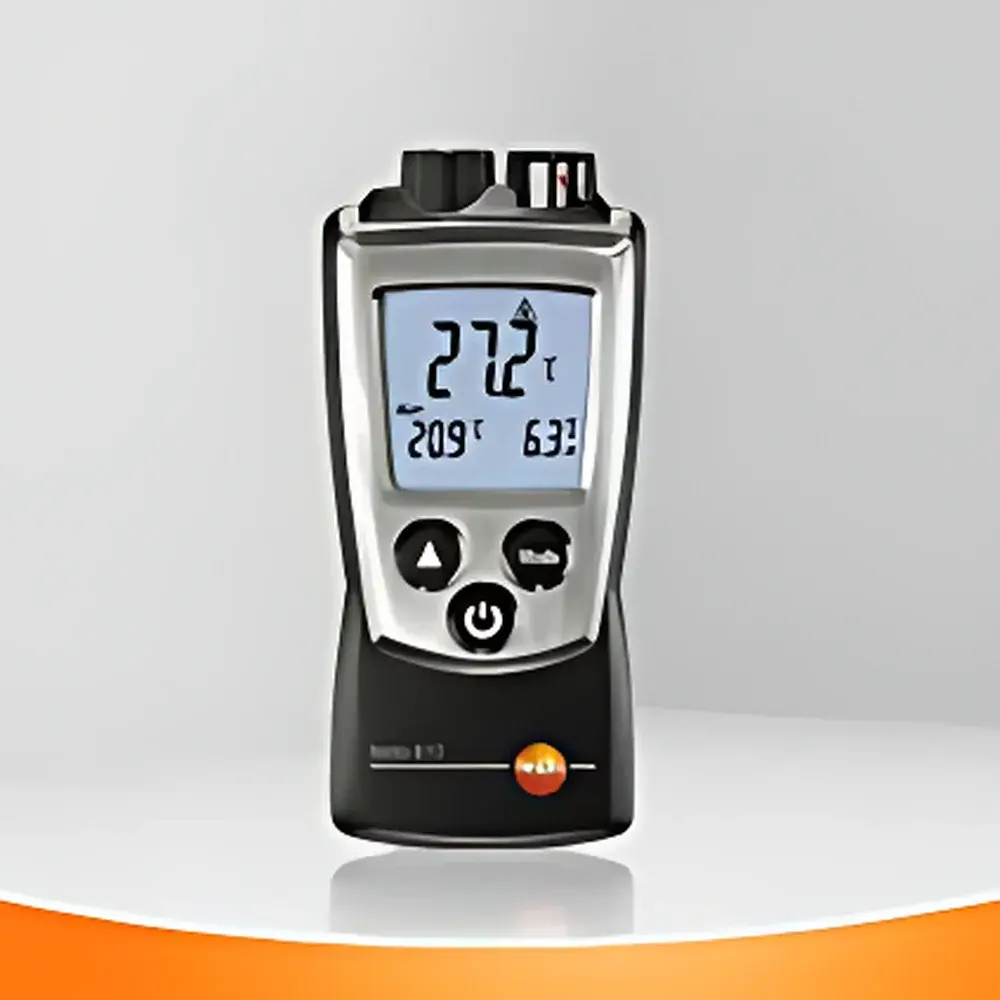
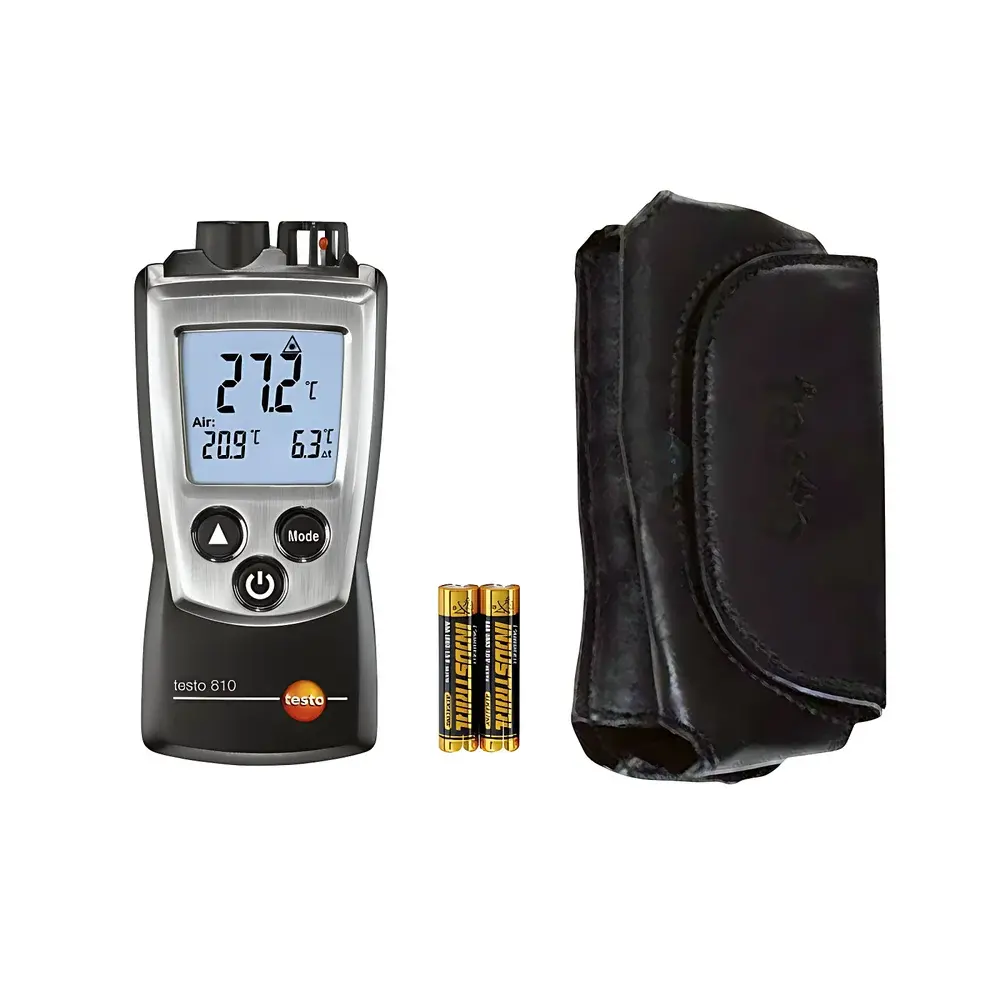
testo 810 Infrared Thermometer with Dual-Channel Air & Surface Temperature Measurement
| Brand | testo |
|---|---|
| Origin | Germany |
| Model | testo 810 |
| Type | Portable Infrared Thermometer |
| Infrared Temperature Range | -30 to +300 °C |
| Air Temperature Range (NTC) | -10 to +50 °C |
| IR Accuracy | ±2.0 °C (-30 to +100 °C), ±2 % of reading (remaining range) |
| NTC Accuracy | ±0.5 °C |
| Optical Resolution | 6:1 |
| Emissivity Adjustment | 0.10–1.00 (adjustable in 0.01 steps) |
| Display | Backlit LCD with ΔT calculation |
| Laser Targeting | Single-point |
| IP Rating | IP40 |
| Weight | 90 g (incl. batteries and protective sleeve) |
| Dimensions | 119 × 46 × 25 mm (with sleeve) |
| Operating Temperature | -10 to +50 °C |
| Battery | 2 × AAA, ~50 h life (backlight off) |
| Response Time | 0.5 s (both channels) |
| Resolution | 0.1 °C (both IR and NTC) |
| Data Functions | Max/Min/Hold |
Overview
The testo 810 Infrared Thermometer is a compact, handheld dual-channel temperature measurement instrument engineered for precision diagnostics in HVAC/R, building commissioning, energy auditing, and facility maintenance applications. It integrates non-contact infrared (IR) surface temperature sensing with a built-in NTC air temperature sensor—enabling simultaneous acquisition of both parameters within a single measurement cycle. The device operates on the principle of infrared radiometry: detecting mid-wave infrared radiation emitted from surfaces and converting it into temperature values based on Planck’s law and user-adjustable emissivity settings. Its 6:1 optical resolution ensures reliable spot measurements at moderate working distances (e.g., 60 cm target distance yields a 10 cm measurement diameter), while the single-point laser targeting system provides visual confirmation of the measurement area center. Designed for field use, the testo 810 delivers repeatable, traceable readings under ambient conditions ranging from –10 °C to +50 °C and conforms to IEC 60529 for IP40 ingress protection against solid objects larger than 1 mm.
Key Features
- Dual-channel real-time measurement: Simultaneous infrared surface temperature (–30 °C to +300 °C) and contactless air temperature (–10 °C to +50 °C) via integrated NTC sensor
- Automatic delta-T (ΔT) calculation and display: Instantly computes and shows the difference between surface and ambient air temperatures—critical for evaluating heat transfer efficiency in ductwork, radiators, windows, and HVAC components
- Adjustable emissivity (0.10–1.00 in 0.01 increments): Enables accurate compensation for diverse surface materials including painted metal, concrete, glass, and insulation
- Backlit high-contrast LCD: Ensures legibility in low-light environments such as mechanical rooms or crawl spaces
- Max/Min/Hold functions: Supports transient thermal analysis and manual data logging without external software
- Ergonomic, pocket-sized housing (119 × 46 × 25 mm) with protective sleeve and cap: Optimized for one-handed operation and daily carry in tool belts or inspection kits
- Low-power design: 2 × AAA batteries provide up to 50 hours of continuous operation with backlight disabled—aligned with ISO 9001-compliant calibration interval recommendations
Sample Compatibility & Compliance
The testo 810 is validated for routine thermal assessment of common HVAC infrastructure elements—including finned-tube heat exchangers, supply/return grilles, chilled beams, thermal bridges in building envelopes, and refrigerant line surfaces. Its NTC air temperature sensor meets DIN EN 60751 Class B tolerances, while the IR detector complies with ASTM E1933-19 (Standard Test Methods for Measuring and Compensating for Emissivity Using Infrared Imaging Systems). Although not certified for safety-critical process control, the instrument supports GLP-aligned documentation workflows through its factory calibration certificate (traceable to DKD/DAkkS-accredited standards). No hazardous substances are used in construction; RoHS 2011/65/EU and WEEE 2012/19/EU compliance is fully documented in the technical dossier.
Software & Data Management
The testo 810 operates as a standalone field instrument with no onboard memory or PC connectivity. All measurement data remain on-device only during active use—supporting immediate visual interpretation and manual transcription. For audit-ready reporting, users may record ΔT values alongside contextual notes (e.g., location ID, component type, time stamp) in accordance with ISO/IEC 17025 clause 7.5.2 on observation recording. While no proprietary software is required, the device’s consistent output format (°C with 0.1 °C resolution) facilitates direct entry into Excel-based QA checklists or CMMS platforms. Calibration certificates include uncertainty budgets per EA-4/02 guidelines, enabling integration into laboratory quality management systems requiring documented metrological traceability.
Applications
- HVAC performance verification: Quantifying supply air–surface temperature differentials across diffusers and coils to detect airflow obstructions or fouling
- Building envelope diagnostics: Identifying thermal bridging and insulation gaps by comparing interior surface temperatures against ambient room air
- Energy efficiency audits: Assessing radiator surface uniformity and return temperature depression in hydronic systems
- Refrigeration system checks: Monitoring condenser coil surface gradients and suction line frost patterns relative to ambient air
- Preventive maintenance: Trending ΔT shifts over time on electrical enclosures, motor housings, or duct joints to anticipate failure modes
- Commissioning documentation: Generating field-validated thermal baselines for ASHRAE Guideline 0–2019 compliance reports
FAQ
What is the recommended minimum target size for accurate IR measurement?
For optimal accuracy, the measured surface should fully cover the instrument’s spot size—calculated as distance divided by optical resolution (e.g., at 60 cm, the 6:1 ratio yields a 10 cm diameter circle). Smaller targets risk background radiation interference.
Can the testo 810 be recalibrated in-house?
No. Field recalibration requires traceable blackbody sources and environmental controls per ISO/IEC 17025. Users must send the unit to an accredited testo service center or authorized calibration laboratory.
Is the laser Class 1 or Class 2?
The integrated aiming laser is Class 1 (IEC 60825-1:2014), posing no eye hazard under normal operating conditions.
Does the device meet FDA 21 CFR Part 11 requirements?
No—this is a field measurement tool without electronic record storage, audit trail, or user authentication capabilities. It is not intended for regulated pharmaceutical or medical device manufacturing environments.
How does emissivity adjustment affect measurement uncertainty?
An incorrect emissivity setting introduces systematic bias—not random error. For example, setting ε = 0.95 on an oxidized aluminum surface (true ε ≈ 0.3) may result in underestimation exceeding ±15 °C. Always verify material-specific emissivity values using reference tables or comparative contact probe validation.