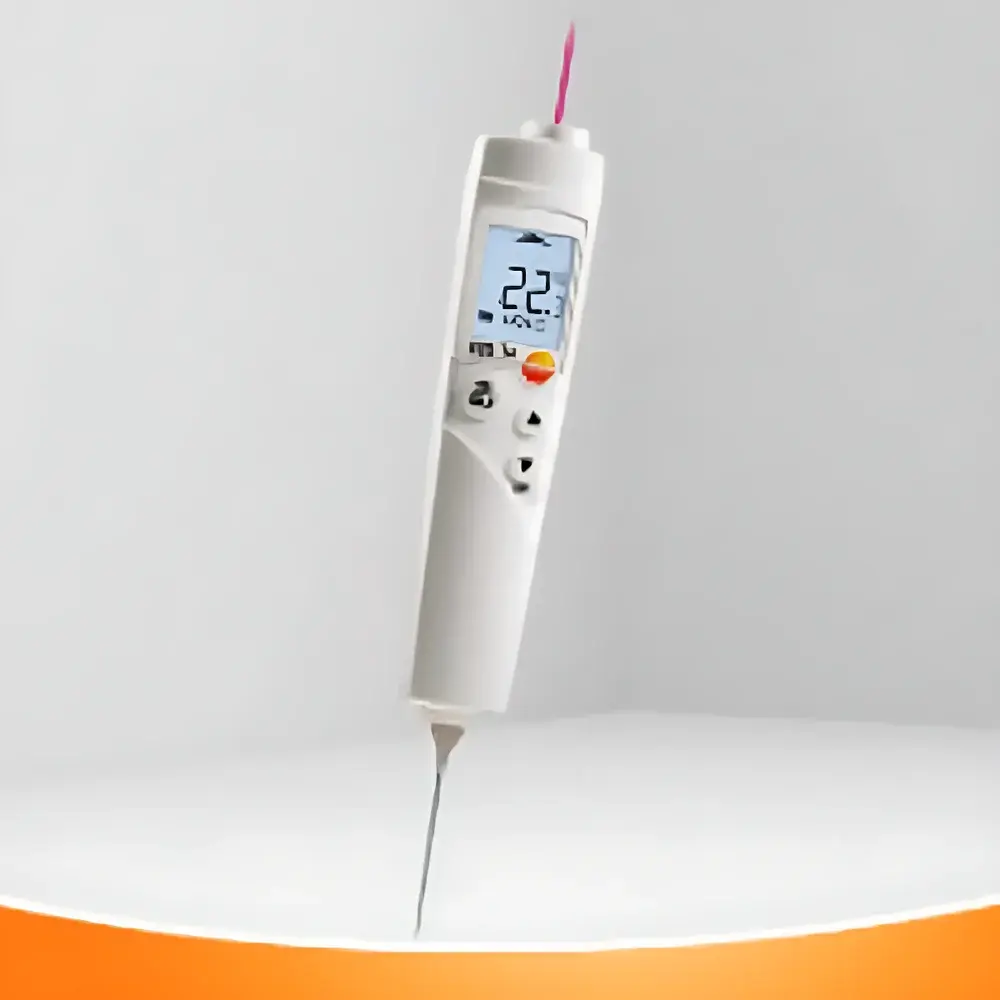
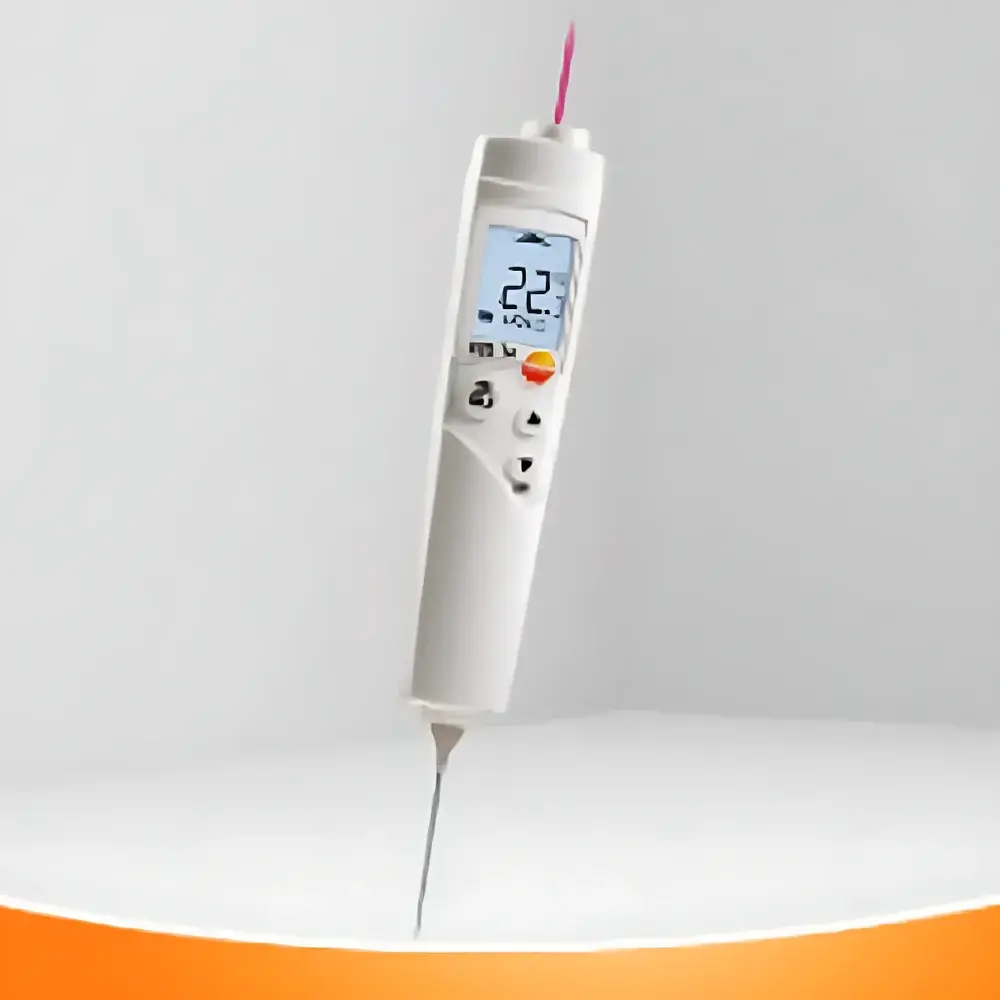
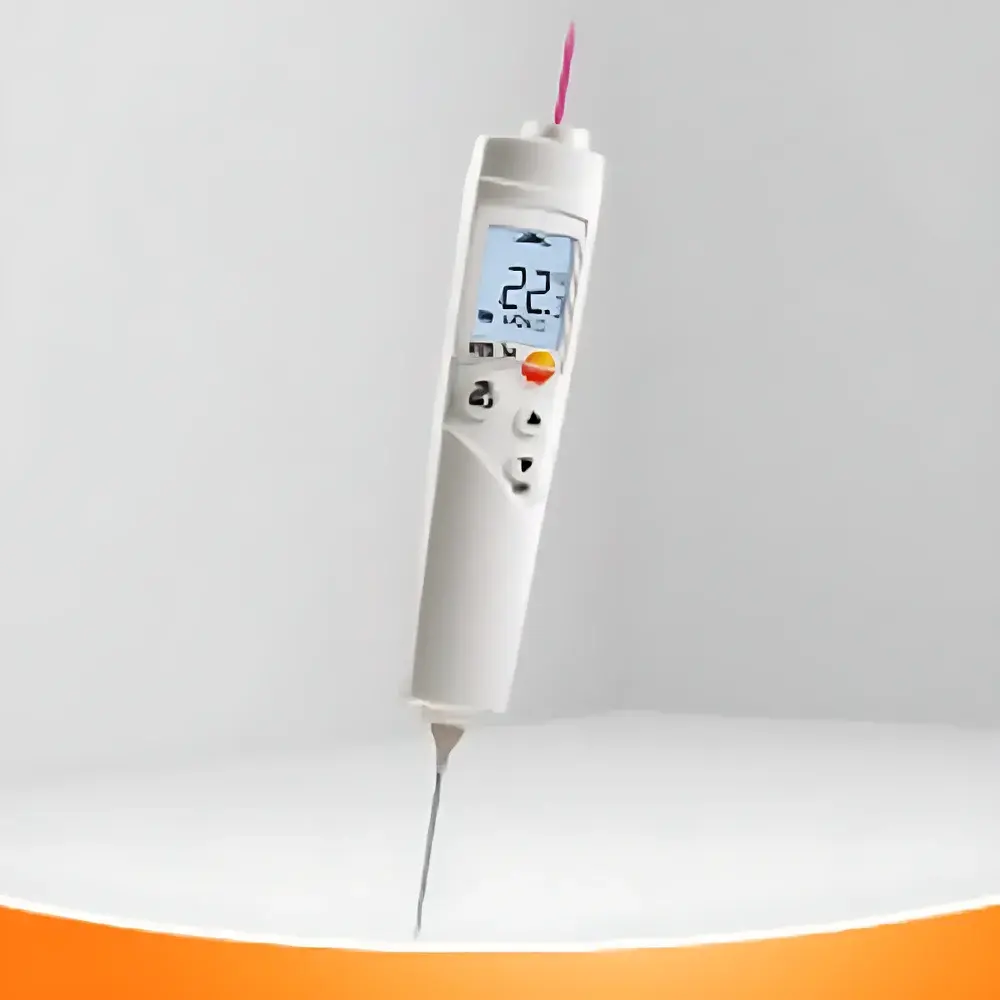
testo 826-T4 Infrared & Immersion Thermometer
| Brand | testo |
|---|---|
| Origin | Germany |
| Model | 826-T4 |
| Type | Portable Dual-Mode Thermometer |
| Infrared Temperature Range | −50 to +300 °C |
| NTC Probe Temperature Range | −50 to +230 °C |
| IR Accuracy | ±1.5 °C (−20 to +100 °C), ±2 °C or ±2 % of reading (remaining range) |
| NTC Accuracy | ±0.5 °C (−20 to +99.9 °C), ±1 °C or ±1 % of reading (remaining range) |
| IR Resolution | 0.1 °C |
| NTC Resolution | 0.1 °C |
| IR Measurement Time | 0.5 s |
| NTC Measurement Time | 1.25 s |
| Optical Resolution | 6:1 |
| Laser Targeting | Single-point |
| IP Rating | IP67 (with protective sleeve) |
| Dimensions | 148 × 34.4 × 19 mm |
| Weight | 80 g |
| Operating Temperature | −20 to +50 °C |
| Storage Temperature | −40 to +70 °C |
| Power Supply | 2 × AAA batteries |
| Battery Life | Approx. 20 h |
| Display | Monochrome LCD, single-line |
| Compliance | EN 13485, HACCP-aligned |
Overview
The testo 826-T4 is a certified dual-mode handheld thermometer engineered for precision and operational efficiency in food safety-critical environments. It integrates non-contact infrared (IR) surface temperature measurement with direct-contact NTC immersion probe functionality—enabling rapid verification of both external and core temperatures within a single instrument. Its measurement principle relies on calibrated infrared radiation detection (via thermopile sensor) for surface readings and high-stability negative temperature coefficient (NTC) thermistor technology for volumetric thermal assessment. Designed explicitly for compliance-driven workflows, the device supports real-time decision-making during goods receipt, cold chain monitoring, production line checks, and post-processing validation. With an optical resolution of 6:1 and single-point laser targeting, it ensures accurate spatial localization of measurement spots at practical working distances—critical for minimizing cross-contamination risk while maintaining measurement fidelity across heterogeneous surfaces such as stainless steel trays, plastic packaging, or irregular food matrices.
Key Features
- Dual-sensor architecture: Simultaneous IR and NTC measurement modes—eliminates need for separate instruments and reduces procedural redundancy.
- High-speed acquisition: IR response time of 0.5 seconds; NTC response time of 1.25 seconds—optimized for high-throughput inspection cycles without compromising repeatability.
- User-configurable dual alarm thresholds: Programmable upper and lower limits trigger audible and visual alerts upon deviation—supporting immediate corrective action per HACCP prerequisite programs.
- Max/min value tracking and hold function: Automatically records extremum values from consecutive measurements and freezes displayed readings on demand—essential for documenting thermal excursions during transport or storage.
- Ruggedized design with IP67-rated protective sleeve: Fully submersible and dishwasher-safe (including sleeve); resistant to moisture, dust, and mechanical impact under routine food processing conditions.
- Integrated accessories: Includes freeze-core drill bit for frozen product penetration, mounting bracket for hands-free operation, probe protection cap, and battery—ensuring readiness for field deployment.
Sample Compatibility & Compliance
The testo 826-T4 is validated for use across diverse food matrices—including dairy products (yogurt, cheese), raw and cooked meats, seafood, baked goods, and frozen commodities. Its 55 mm stainless-steel probe sheath enables deep-center insertion into viscous or semi-solid items while maintaining thermal equilibrium stability. The device conforms to EN 13485:2016 for medical device quality management systems—a benchmark adopted by many food safety auditors to assess instrumentation traceability and calibration integrity. While not a medical device per se, its metrological performance and documentation structure align with HACCP Principle 4 (monitoring procedures) and support adherence to FDA Food Code §3-201.11, EC Regulation No. 852/2004, and ISO 22000:2018 requirements for temperature control points. All measurement data are inherently time-stamped and attributable to operator-defined parameters—facilitating audit-ready recordkeeping.
Software & Data Management
The testo 826-T4 operates as a standalone, firmware-based instrument with no embedded Bluetooth or wireless connectivity. Data capture is manual and observation-driven—consistent with low-infrastructure, hygiene-sensitive environments where electronic transmission may introduce contamination vectors or cybersecurity concerns. However, its deterministic output format (numeric display with clear unit annotation and status indicators) ensures unambiguous interpretation by trained personnel. For organizations requiring digital traceability, the device’s consistent resolution (0.1 °C), repeatable accuracy profile, and defined measurement uncertainty bands enable integration into paper-based or LIMS-linked log sheets compliant with GLP and GMP documentation standards. Calibration certificates—traceable to national metrology institutes (e.g., PTB)—are available upon request to satisfy internal QA protocols and third-party audit requirements.
Applications
- Receiving inspection: Rapid screening of incoming refrigerated/frozen shipments against critical control limits (e.g., ≤7 °C for chilled foods, ≤−18 °C for frozen).
- Thermal mapping validation: Spot-checking surface uniformity of blast chillers, proofing cabinets, and holding ovens prior to batch release.
- HACCP monitoring: Routine verification of cooking endpoints (e.g., ≥70 °C for 2 min in poultry), cooling rate compliance (e.g., 60 → 21 °C within 2 h), and hot-holding stability (>63 °C).
- Sanitation verification: Surface temperature assessment of cleaning-in-place (CIP) equipment to confirm thermal efficacy of sanitization cycles.
- Supplier qualification: Objective, operator-independent temperature evidence supporting vendor performance evaluations and corrective action tracking.
FAQ
What is the effective measurement distance for the infrared mode?
The 6:1 optical resolution allows reliable measurements at distances up to 60 cm from a 10 cm target diameter—ideal for scanning palletized goods or conveyor-belt items without physical contact.
Can the NTC probe be used in liquids or only solids?
Yes—the stainless-steel probe sheath is rated for immersion in aqueous and viscous foodstuffs including soups, sauces, and liquid dairy products, provided the IP67 sleeve remains intact.
Is calibration required before each use?
No—factory calibration is stable under normal operating conditions; however, daily user verification using a reference source (e.g., ice bath or calibrated dry-block) is recommended per HACCP monitoring best practices.
Does the device meet FDA 21 CFR Part 11 requirements?
As a non-networked, non-auditable instrument, it does not implement electronic signatures or audit trails—but its deterministic output and documented uncertainty budget support manual compliance with Part 11 principles when integrated into controlled procedural documentation.
How is battery life affected by ambient temperature?
At the lower end of the operating range (−20 °C), battery discharge accelerates; average runtime decreases to approximately 12–14 hours—accounted for in shift planning for cold-storage facilities.