testo 830-T1 Infrared Thermometer
| Brand | testo |
|---|---|
| Model | 830-T1 |
| Type | Portable Infrared Thermometer |
| Measuring Range | -30 to +400 °C |
| Accuracy | ±2 °C or ±2 % of reading (-30 to 0 °C), ±1.5 °C or ±1.5 % of reading (0.1 to +400 °C) |
| Optical Resolution | 10:1 |
| Response Time | 0.5 s |
| Temperature Resolution | 0.1 °C |
| Measurement Frequency | 2 Hz |
| Emissivity Adjustment | 0.10–1.00 (adjustable in 0.01 steps) |
| Display | Backlit LCD |
| Operating Temperature | -20 to +50 °C |
| Storage Temperature | -40 to +70 °C |
| Weight | 200 g |
| Dimensions | 190 × 75 × 38 mm |
| Power Supply | 9 V alkaline battery |
| Battery Life | Up to 15 hours |
| Housing Material | ABS |
Overview
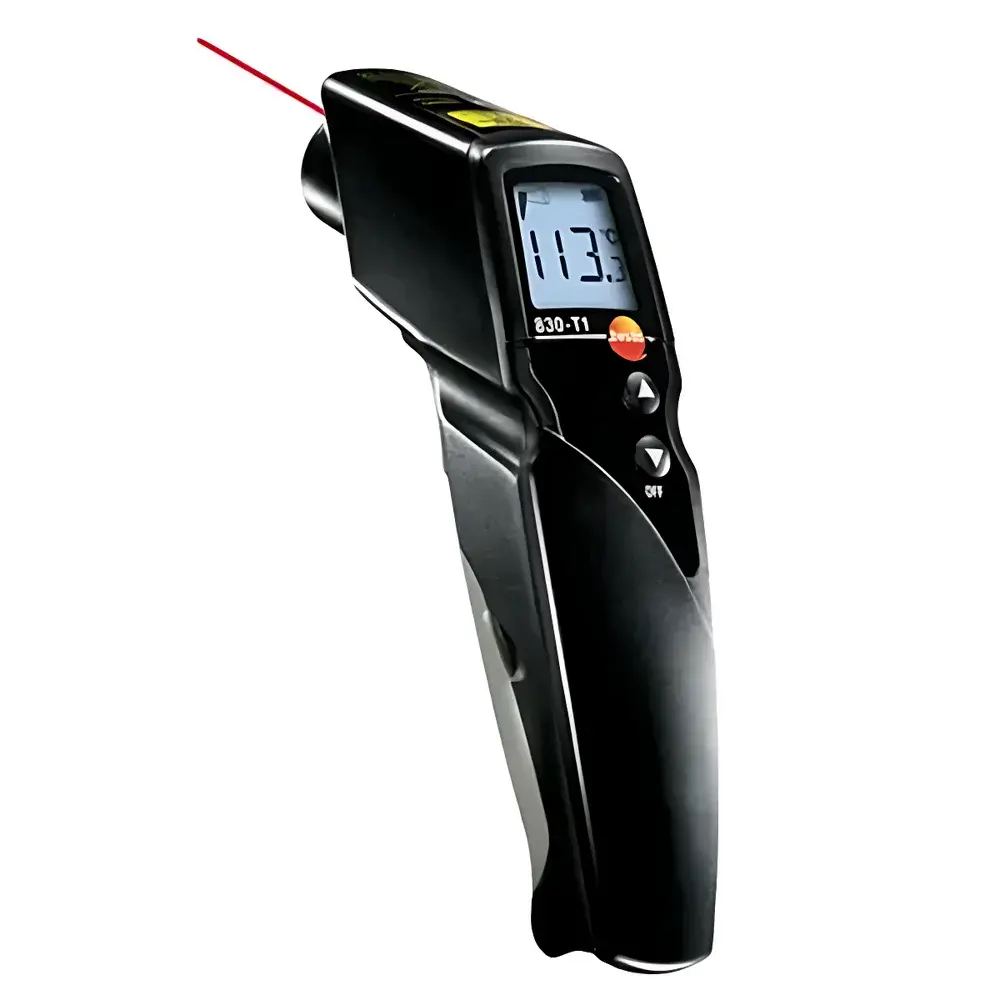
The testo 830-T1 Infrared Thermometer is a precision-engineered, handheld non-contact temperature measurement instrument designed for rapid, reliable surface temperature assessment across industrial maintenance, HVAC, food safety, electrical inspection, and laboratory support applications. Utilizing infrared radiation detection based on Planck’s law of blackbody radiation, the device captures thermal energy emitted from surfaces and converts it into calibrated temperature readings without physical contact. Its fixed 10:1 optical resolution enables accurate targeting at moderate distances—e.g., measuring a 10 mm spot from 100 mm away—making it suitable for both confined and accessible environments. The integrated single-point laser targeting system provides intuitive aiming assistance while minimizing parallax error. Engineered for field durability and operational simplicity, the testo 830-T1 delivers high repeatability and traceable performance within its specified range of –30 °C to +400 °C.
Key Features
- High-precision infrared sensor with 0.1 °C temperature resolution and dual-mode accuracy specification (±1.5 °C or ±1.5 % above 0.1 °C; ±2 °C or ±2 % below 0 °C)
- 10:1 optical resolution for confident mid-range targeting and reduced measurement uncertainty from ambient reflections
- Adjustable emissivity (0.10–1.00 in 0.01 increments) to accommodate diverse surface materials—from polished metals to oxidized surfaces and organic substrates
- Real-time hold function to freeze and retain the most recent reading on the backlit LCD display
- Dual user-defined alarm thresholds with simultaneous visual (LED) and audible (buzzer) alerts upon exceedance
- Max/min value tracking for transient thermal events and comparative analysis
- Ergonomic, one-hand operable design with ABS polymer housing rated for mechanical robustness and chemical resistance
- Fast response time of 0.5 seconds and continuous 2 Hz measurement output for dynamic process monitoring
Sample Compatibility & Compliance
The testo 830-T1 is optimized for non-contact surface temperature measurements on solid, opaque, and semi-opaque materials including metals, plastics, ceramics, painted surfaces, and food products. It is not intended for transparent media (e.g., glass, thin plastic films) or highly reflective, low-emissivity surfaces without corrective measures—such as application of high-emissivity tape (optional accessory)—to ensure metrological validity. The instrument complies with IEC 61326-1:2013 for electromagnetic compatibility (EMC) and IEC 61010-1:2010 for electrical safety in measurement equipment. While not certified for intrinsic safety or hazardous area use, its design supports routine calibration verification per ISO/IEC 17025-accredited laboratories and aligns with common quality management expectations under ISO 9001 and GxP-aligned workflows where documented traceability is required.
Software & Data Management
The testo 830-T1 operates as a standalone field instrument with no embedded data logging or PC connectivity. All measurement data remains on-device only during active use; values are retained temporarily in volatile memory until overwritten or powered off. For documentation purposes, users may manually record readings or integrate the instrument into broader QA/QC protocols using external digital logbooks or LIMS platforms. Though no proprietary software is bundled, the device’s consistent output format and stable calibration characteristics facilitate straightforward integration into audit-ready reporting frameworks—including those requiring adherence to FDA 21 CFR Part 11 principles when paired with validated procedural controls.
Applications
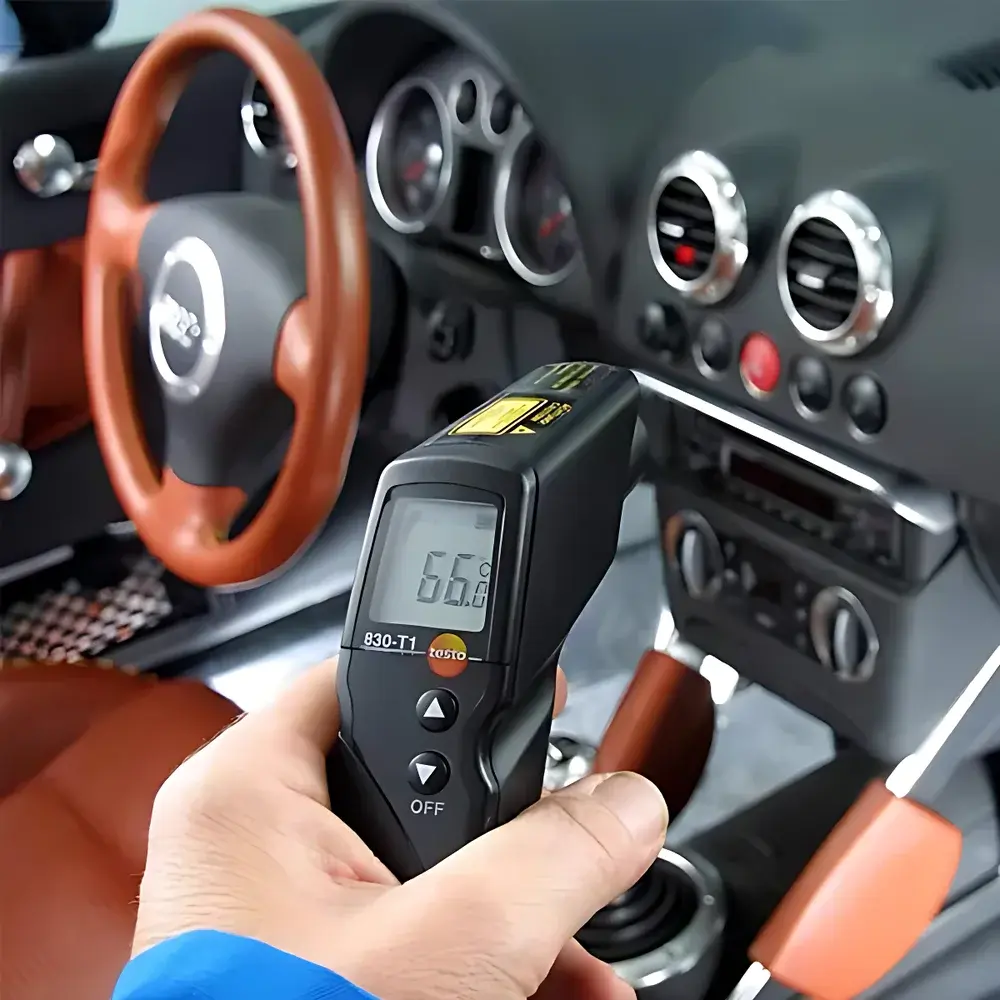
- HVAC system diagnostics: Surface temperature mapping of ductwork, heat exchangers, refrigerant lines, and insulation integrity checks
- Electrical infrastructure inspection: Detection of hotspots in switchgear, busbars, connectors, and transformer casings prior to failure
- Food processing & storage: Spot-checking holding temperatures, refrigeration units, cooking surfaces, and transport containers per HACCP guidelines
- Mechanical maintenance: Bearing temperature trending, motor casing evaluation, and steam trap functionality assessment
- Building envelope analysis: Thermal bridging identification and moisture-related anomalies in façades and roofing systems
- Research & education: Introductory thermography exercises, material emissivity studies, and comparative thermal behavior experiments
FAQ
What is the minimum spot size measurable with the testo 830-T1?
At a 10:1 distance-to-spot ratio, the smallest measurable diameter equals the measurement distance divided by 10—for example, a 20 mm target requires a maximum distance of 200 mm.
Can the testo 830-T1 measure through glass or plastic covers?
No. Standard glass and many clear polymers are opaque to the 8–14 µm spectral band used by this instrument; measurements will reflect the surface temperature of the cover, not the underlying object.
How often should the instrument be calibrated?
Annual calibration is recommended for critical applications; more frequent verification using an accredited reference source (e.g., blackbody calibrator) is advised in regulated environments or after mechanical shock.
Is the emissivity setting saved between power cycles?
Yes—the currently selected emissivity value persists in non-volatile memory and remains active upon restart.
Does the device meet any international standards for temperature measurement accuracy?
It conforms to the manufacturer’s stated specifications per DIN EN 60584-1 and follows general principles outlined in ASTM E1933-19 for infrared thermometry, though it is not individually certified to these standards.