
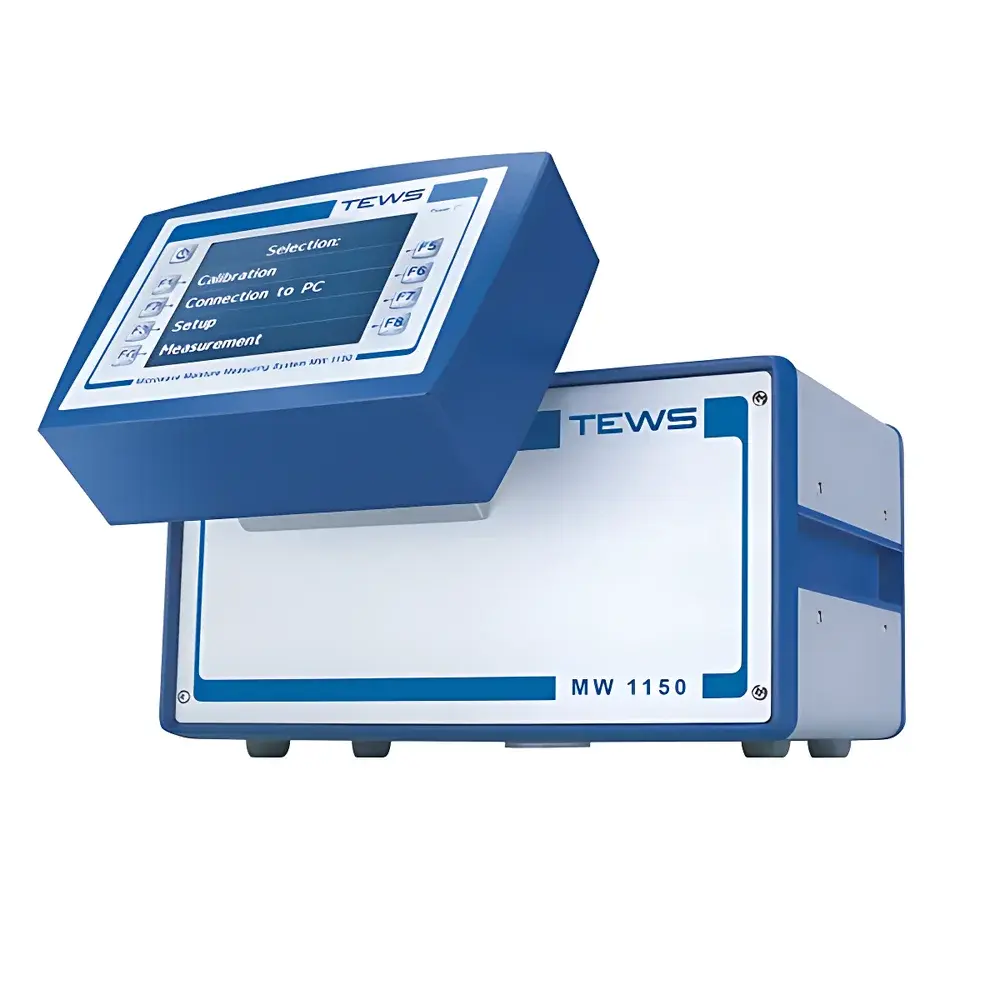
TEWS MW 1150 Microwave Moisture Analyzer
| Brand | TEWS |
|---|---|
| Origin | Germany |
| Model | MW 1150 |
| Repeatability | ±0.5% typical standard deviation (material-dependent) |
| Measurement Time | <1 s |
| Power Supply | 110–230 V AC, 50–60 Hz |
| Operating Sample Temperature Range | 5–60 °C (with optional Pt100 or IR temperature sensor and auto thermal stabilization compensation) |
| Ambient Temperature Range | 0–40 °C |
| Enclosure Rating | IP20 |
| Display | Backlit LCD graphic display (320 × 240 pixels), 5.7-inch diagonal |
| Internal Memory | EEPROM storage for up to 25 product profiles and 250 measurement records |
| Data Interface | USB (PC connectivity) |
| Analog Output | 0(4)–20 mA with current isolation |
| Software Support | TEWS Moisture View Lite © |
Overview
The TEWS MW 1150 Microwave Moisture Analyzer is a compact, high-speed laboratory and inline-capable instrument engineered for non-destructive, real-time moisture quantification in solid and granular materials using microwave dielectric spectroscopy. Unlike traditional loss-on-drying or Karl Fischer titration methods, the MW 1150 employs frequency-modulated continuous-wave (FMCW) microwave transmission at fixed industrial bands (typically 2.45 GHz or 9.3 GHz, depending on material dielectric properties) to measure the attenuation and phase shift of microwaves propagating through the sample. These changes correlate directly with the volumetric water content due to water’s exceptionally high dielectric constant (~80) relative to most dry matrices (e.g., polymers: ~2–4; cereals: ~2–6). The system’s single-sensor architecture—integrating transmitter, receiver, and signal processing electronics into one robust housing—enables rapid (<1 s), operator-independent measurements without sample preparation, heating, or consumables. Its design targets routine QC environments where throughput, repeatability, and long-term stability are critical, including food processing lines, pharmaceutical excipient handling, polymer compounding, and mineral drying operations.
Key Features
- Sub-second measurement cycle time with typical repeatability of ±0.5% standard deviation across 10 consecutive readings—validated per ISO 712 and ASTM D4748 for comparative moisture assessment.
- Integrated backlit graphical LCD (320 × 240 px, 5.7-inch diagonal) mounted directly on the sensor head, eliminating external display cabling and optimizing footprint in space-constrained labs or conveyor-mounted installations.
- Onboard EEPROM memory stores up to 25 customizable product-specific calibration profiles and retains 250 timestamped measurement records with moisture value, date/time stamp, and profile ID.
- Support for optional Pt100 contact or infrared non-contact temperature sensors enables automatic thermal compensation across the full operational sample temperature range (5–60 °C), mitigating drift caused by thermal expansion or dielectric relaxation shifts.
- Industrial-grade analog output (0/4–20 mA, galvanically isolated) facilitates seamless integration into PLC-controlled drying ovens, blenders, or belt conveyors for closed-loop process control.
- USB interface enables firmware updates, data export (CSV), and remote configuration via TEWS Moisture View Lite ©—a Windows-based application supporting GLP-compliant audit trails, user access levels, and electronic signature logging per FDA 21 CFR Part 11 requirements.
Sample Compatibility & Compliance
The MW 1150 is validated for use with homogeneous, low-to-moderate conductivity materials including but not limited to cereal grains, ground coffee, plastic pellets (PP, PE, PET), pharmaceutical powders (lactose, microcrystalline cellulose), foundry sands, and wood chips. It is unsuitable for highly conductive, metallic, or strongly magnetically permeable samples that cause excessive microwave reflection or absorption saturation. Device compliance includes CE marking per EU Machinery Directive 2006/42/EC and EMC Directive 2014/30/EU. Electrical safety conforms to IEC 61010-1. While not a primary reference method, its performance aligns with ISO 13932 (microwave moisture determination in textiles) and supports internal method validation per USP and ICH Q5C for stability-indicating moisture monitoring in regulated manufacturing.
Software & Data Management
TEWS Moisture View Lite © provides secure, traceable data handling for regulated environments. It logs all user actions—including calibration edits, profile modifications, and measurement exports—with immutable timestamps and operator IDs. Audit trail functionality meets GLP/GMP documentation requirements. Data export supports CSV and PDF report generation with embedded metadata (instrument ID, firmware version, calibration date). Firmware updates preserve existing calibration coefficients and memory contents. No cloud dependency: all processing and storage occur locally on the host PC or onboard EEPROM, ensuring data sovereignty and network isolation in classified facilities.
Applications
- Real-time moisture verification during pharmaceutical tablet granulation and drying to prevent over-drying or residual solvent retention.
- In-line monitoring of polymer melt streams prior to extrusion to avoid hydrolysis-induced molecular weight degradation.
- Batch release testing of roasted coffee beans to ensure roast consistency and shelf-life prediction accuracy.
- Quality gate checks for incoming raw materials (e.g., starch, flour, bentonite) in food and ceramics production.
- Process optimization of fluidized-bed dryers by feeding moisture feedback to PID controllers via 4–20 mA loop.
FAQ
Is the MW 1150 suitable for liquid or paste-like samples?
No. It is designed exclusively for free-flowing solids and granules with consistent bulk density. Liquids cause signal saturation; pastes introduce scattering artifacts that violate the plane-wave propagation assumption.
Does the device require daily recalibration?
No. Factory calibration remains stable for ≥12 months under normal operating conditions. Verification against NIST-traceable reference standards is recommended quarterly per ISO/IEC 17025 internal audit protocols.
Can multiple sensors be daisy-chained to one PC?
Yes—via USB hubs—but each MW 1150 requires individual instance launching in Moisture View Lite ©. Synchronized multi-point measurement is not natively supported.
What is the maximum allowable particle size?
Optimal performance is achieved with particles ≤10 mm diameter. Larger fragments risk void fraction variation and localized field distortion; milling to ≤5 mm is advised for heterogeneous feeds.
Is hazardous area certification available?
Not as standard. ATEX or IECEx variants are available upon request with modified enclosure and intrinsic safety barriers—lead time applies.






