
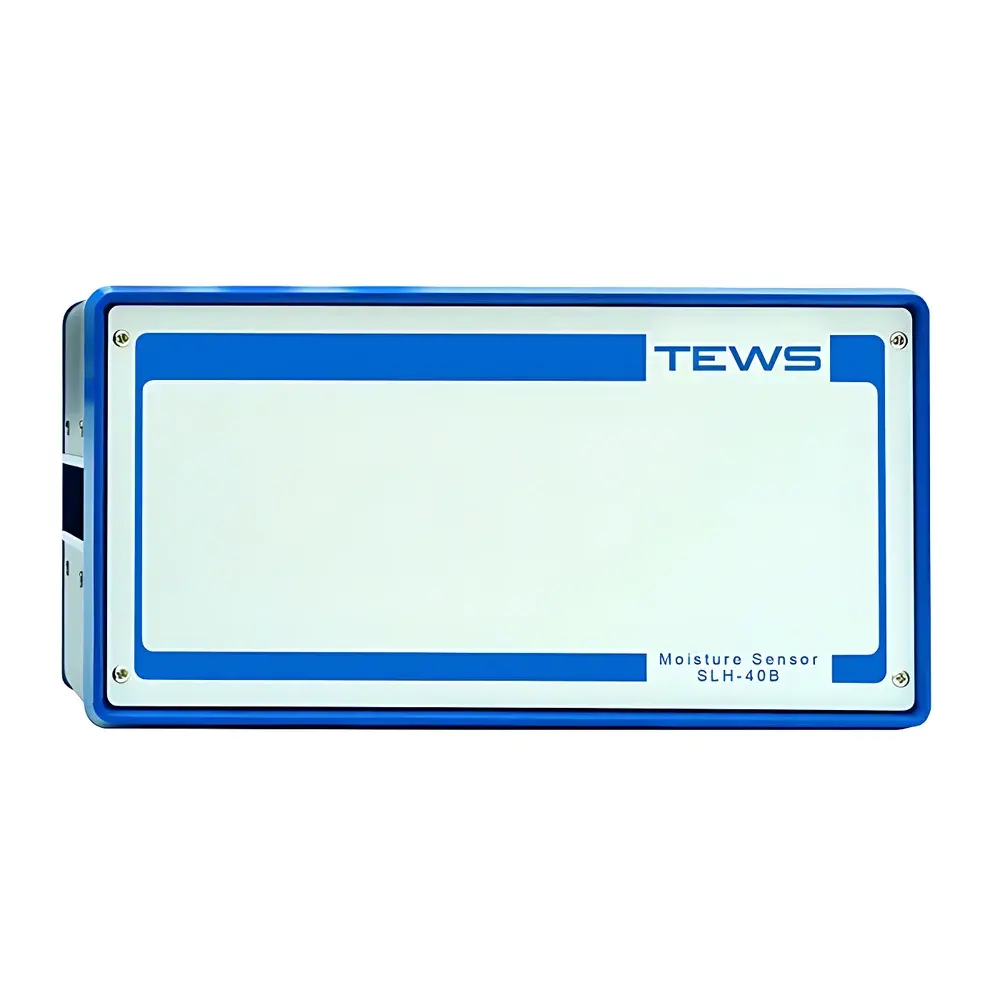
TEWS MW-Sensor Series Microwave Moisture Sensors
| Brand | TEWS |
|---|---|
| Origin | Germany |
| Sensor Types | Tubular, Planar, Fork-Type, TipTop & Custom Configurations |
| Application Scope | Laboratory QC, In-Line Process Monitoring, Batch Sampling |
| Material Compatibility | Powders, Granules, Tablets, Sheets, Fibers, Pellets, Non-Adhesive Bulk Solids |
| Construction | Stainless Steel (AISI 316L) + High-Strength Alumina Ceramic |
| Interface | Analog 4–20 mA / Digital RS-485 / EtherNet/IP (compatible with TEWS MW-E Series Electronics, excluding MW-T) |
| Compliance | CE, RoHS, ATEX Zone 22 (optional), ISO/IEC 17025 traceable calibration support |
Overview
The TEWS MW-Sensor Series comprises a family of industrial-grade microwave moisture sensors engineered for non-contact, real-time dielectric property measurement in solid and bulk materials. Operating on the principle of microwave absorption spectroscopy at fixed frequencies (typically 2.45 GHz or 915 MHz, depending on model and regulatory compliance), these sensors detect changes in the complex permittivity (ε′ and ε″) of the sample—parameters directly correlated with water content due to water’s high dielectric loss factor. Unlike near-infrared (NIR) or Karl Fischer titration methods, microwave sensing is insensitive to surface color, particle size distribution, or minor compositional variations, offering high reproducibility across heterogeneous matrices. The system requires no consumables, sample preparation, or chemical reagents, making it suitable for continuous operation in GMP-compliant manufacturing environments and ISO 17025-accredited laboratories.
Key Features
- Tubular Sensor Configuration: Designed for discrete, single-point moisture quantification of free-flowing powders, granules, and tablets; integrates with gravity-fed hoppers or bypass conveyor chutes for semi-automated batch sampling.
- Planar Sensor Mounting: Enables flush or recessed installation directly onto conveyor belts, silo walls, or process hoppers—optimized for continuous in-line monitoring of bulk solids with full-surface contact.
- Fork-Type Sensor Architecture: Features dual cylindrical electrodes generating a focused microwave field between prongs; ideal for sheet, strip, filament, or extruded profile geometries with consistent cross-sections.
- TipTop & Multi-Point Miniature Sensors: Compact form factor (<10 cm footprint) for localized analysis of small-volume samples (~0.5 cm³); specialized variants support parallel measurement of up to 12 discrete objects per cycle.
- Robust Materials Engineering: Housing constructed from electropolished AISI 316L stainless steel and alumina ceramic (Al₂O₃ ≥96%), ensuring corrosion resistance, mechanical stability under thermal cycling (–20 °C to +70 °C ambient), and compatibility with CIP/SIP protocols.
- Modular Electronics Integration: Fully interoperable with TEWS MW-E series signal processors (e.g., MW-E100, MW-E200) via standardized analog (4–20 mA) and digital (RS-485 Modbus RTU, EtherNet/IP) interfaces—excluding legacy MW-T electronics.
Sample Compatibility & Compliance
The TEWS MW-Sensor Series accommodates a broad spectrum of physical forms—including non-adhesive powders (e.g., lactose, sodium chloride), pharmaceutical granules, food pellets, polymer flakes, and paperboard sheets—provided material density remains within 0.2–2.5 g/cm³ and bulk conductivity does not exceed 5 mS/m. For hygroscopic, staining, or biohazardous substances (e.g., active pharmaceutical ingredients), containment in sealed glass or PTFE-lined vessels prior to tubular sensor insertion ensures operator safety and measurement integrity. All sensors comply with EU Directive 2014/30/EU (EMC), 2011/65/EU (RoHS), and optional ATEX 2014/34/EU certification for dust-explosive environments (Zone 22). Calibration traceability follows ISO/IEC 17025 requirements, with documented uncertainty budgets available upon request for audit readiness under FDA 21 CFR Part 11 and EU Annex 11 frameworks.
Software & Data Management
Data acquisition and configuration are managed via TEWS SensorControl Suite v4.x—a Windows-based application supporting real-time visualization, trend logging, alarm thresholding (min/max moisture deviation), and CSV/Excel export. The software enables multi-sensor synchronization, automatic zero-point drift compensation using reference dry-air purges, and GLP-compliant electronic signatures with user-level access control. When deployed with MW-E200 processors, systems support audit-trail generation compliant with 21 CFR Part 11 (electronic records and signatures), including immutable timestamps, operator ID tagging, and change-history logs. Raw permittivity data (ε′, ε″) and derived moisture values (%w/w) are timestamped and stored with metadata (sensor ID, temperature, humidity, calibration date).
Applications
- Pharmaceutical tablet and capsule moisture verification during stability testing and release QC
- In-line moisture profiling of cereal flakes, pet food kibble, and powdered dairy products on high-speed packaging lines
- Real-time control of fluidized-bed dryer exit moisture in API manufacturing
- Moisture uniformity assessment of polymer extrudates and composite prepregs
- Density-correlated moisture mapping in wood-based panels and recycled fiberboard production
- Research-grade water activity screening in novel biomaterial formulations
FAQ
Can the tubular sensor be used for sticky or cohesive materials?
Yes—but only when contained in sealed, non-metallic vessels (e.g., borosilicate glass or PTFE cups) to prevent clogging and ensure field homogeneity.
Is temperature compensation built into the sensor firmware?
All MW-E-compatible sensors include integrated Pt100 RTD inputs for simultaneous temperature measurement; compensation algorithms are applied in real time within the MW-E processor.
What is the typical measurement repeatability for granular pharmaceutical excipients?
Under controlled lab conditions (±0.5 °C ambient, <5% RH variation), repeatability is ≤ ±0.05 %w/w for samples with nominal moisture content between 0.5–8.0 %w/w.
Do I need separate calibration for each product type?
Yes. While the microwave physics is universal, empirical calibration models must be developed per material matrix using reference oven-dry or Karl Fischer validation data.
Can the fork-type sensor handle continuous web processing?
Yes—when mounted in tension-controlled guide rollers or nip configurations, it supports line speeds up to 30 m/min with sub-second measurement intervals.
Related Products





