
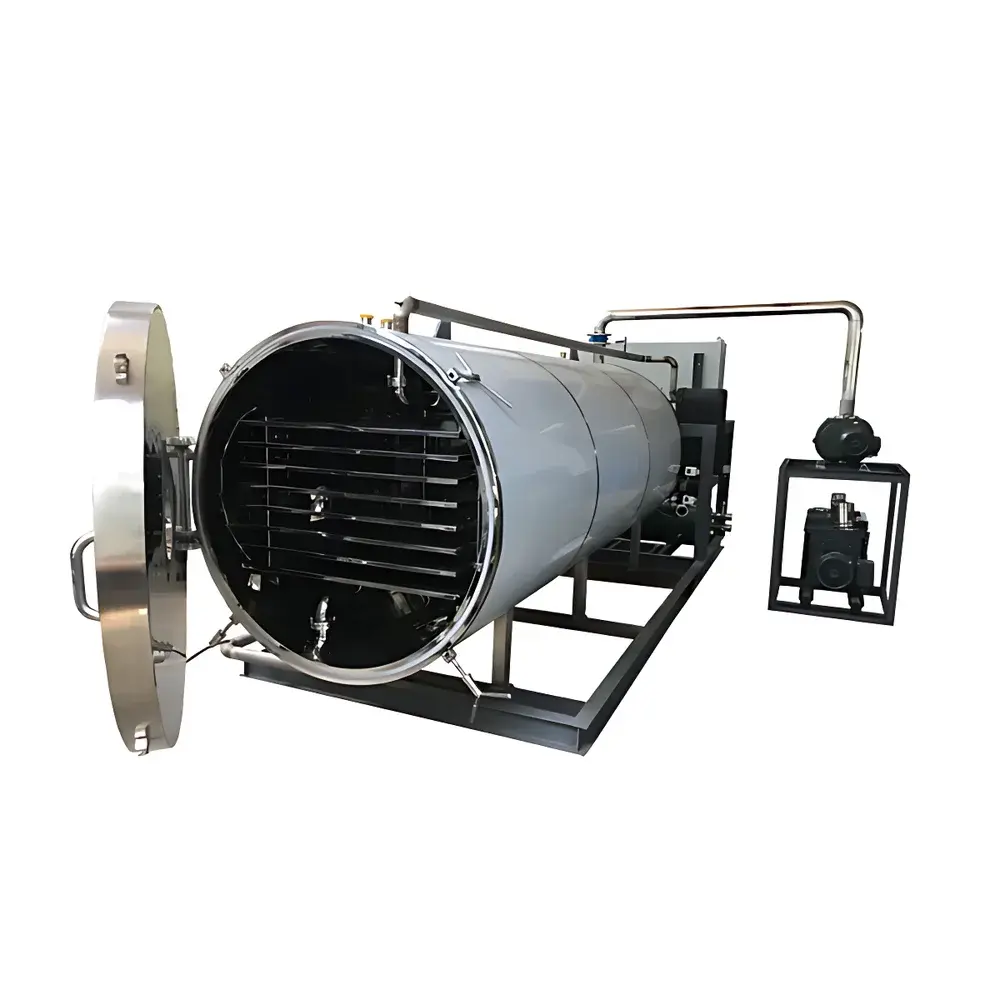
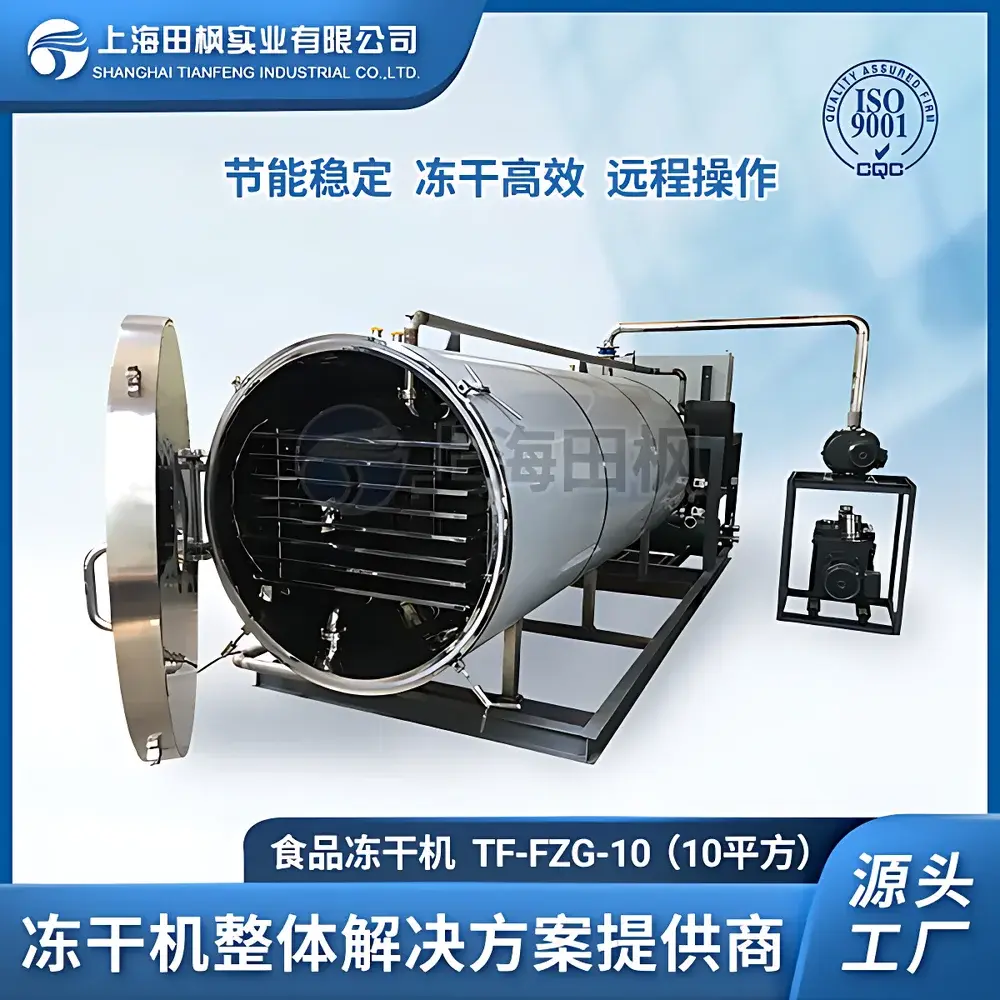
TF-Feng TF-FZG-10 Industrial-Scale In-Situ Freeze Dryer
| Brand | TF-Feng |
|---|---|
| Origin | Shanghai, China |
| Manufacturer Type | Direct Manufacturer |
| Equipment Type | Standard Shelf-Type Freeze Dryer |
| Application Scope | Production-Scale Processing |
| Freeze-Drying Area | 10 m² |
| Ultimate Vacuum | 2.7 Pa |
| Condenser Capacity (24 h) | 200 kg/24 h |
| Condenser Temperature | ≤ −65 °C |
| Chamber Dimensions (W × D) | 900 mm × 1600 mm |
| Control System | PLC with Touchscreen HMI |
| Remote Connectivity | Ethernet-enabled for PC-based monitoring and curve logging |
| Compliance | Designed to support GLP-compliant documentation workflows and meets general requirements for ISO 22000–aligned food processing environments |
Overview
The TF-Feng TF-FZG-10 is an industrial-scale, in-situ freeze dryer engineered for continuous batch processing of heat-sensitive biological and food-grade materials—including root vegetables (e.g., carrots), tropical fruits (e.g., mango), and soil samples requiring structural and compositional integrity preservation. It operates on the fundamental principle of lyophilization: a three-stage process comprising pre-freezing, primary drying (sublimation under vacuum), and secondary drying (desorption of bound water). By maintaining product temperatures well below the eutectic point during sublimation and sustaining vacuum conditions at or below 2.7 Pa, the system enables water removal directly from ice to vapor without passing through the liquid phase—thereby minimizing thermal degradation, enzymatic activity, oxidation, and morphological collapse. This ensures retention of native color, flavor volatiles, enzymatic activity (e.g., peroxidase in carrots), and bioactive compounds (e.g., β-carotene, polyphenols) far more effectively than hot-air drying, spray drying, or sun drying.
Key Features
- In-situ freezing and drying within a single chamber eliminates manual transfer, reducing contamination risk and preserving sample sterility—critical for agricultural soil microbiome studies and GMP-aligned botanical extract production.
- Seven + one adjustable stainless-steel shelves (900 mm × 1600 mm each), spaced at 65 mm intervals, provide uniform heat transfer and accommodate trays up to 100 L total solution load per cycle.
- Circulating fluid-controlled shelf temperature range from −45 °C to +70 °C, with ≤1 °C inter-shelf uniformity—enabling precise control over nucleation, annealing, and desorption kinetics.
- Integrated condenser operating at ≤−65 °C supports high-capacity ice capture (200 kg/24 h), ensuring stable vacuum performance even during large-load cycles typical in carrot puree or mango pulp processing.
- PLC-based control system with 10.4″ resistive touchscreen HMI offers real-time visualization of shelf temperature, chamber pressure, condenser load, and vacuum ramp profiles—with configurable alarm thresholds and event logging.
- Ethernet interface enables remote supervision via standard SCADA platforms; freeze-drying curves (time vs. shelf temp, pressure, condenser temp) are exportable in CSV format for audit-ready data archiving.
Sample Compatibility & Compliance
The TF-FZG-10 accommodates diverse physical forms: bulk vegetable purees (carrot, sweet potato), sliced or diced fruits (mango, apple), granular soil matrices (including clay-loam composites for environmental bioremediation analysis), and aqueous suspensions of microbial cultures. Its design conforms to mechanical safety standards per ISO 12100 and electrical safety per IEC 61000-6-2/6-4. While not certified for pharmaceutical use out-of-the-box, its architecture supports validation protocols aligned with FDA 21 CFR Part 11 (when paired with qualified electronic record systems) and facilitates IQ/OQ documentation for food-grade and academic research applications. Vacuum integrity and temperature uniformity meet baseline criteria referenced in ASTM F2376–22 (Standard Practice for Lyophilization Process Development).
Software & Data Management
The embedded control firmware records all critical process parameters at 1-second intervals and stores ≥10,000 cycles locally. Data export includes timestamped shelf temperature ramps, pressure decay curves, and condenser loading trends—formatted for direct import into statistical process control (SPC) tools or LIMS environments. Optional software add-ons provide automated deviation detection (e.g., vacuum excursion >5 Pa for >30 s), electronic signature support for operator authentication, and PDF report generation compliant with ISO/IEC 17025 documentation expectations. All logs include immutable metadata (cycle ID, operator ID, start/stop timestamps, firmware version) to satisfy traceability requirements in regulated soil science or nutraceutical R&D labs.
Applications
- Production-scale dehydration of carrot roots into nutritionally intact, rehydration-stable powder for functional food fortification and infant formula applications.
- Routine lyophilization of field-collected soil cores for subsequent DNA extraction, metagenomic sequencing, and enzymatic activity assays—preserving microbial community structure and extracellular enzyme conformation.
- Commercial mango crisp manufacturing where low-temperature drying prevents Maillard browning and volatile terpene loss—yielding products with 90% retention of ascorbic acid.
- Stabilization of probiotic suspensions and plant-derived phytochemical extracts prior to encapsulation or tablet compression.
- Method development for freeze-drying of high-moisture, high-sugar matrices where controlled ice nucleation and optimized primary drying rates are essential to avoid melt-back or collapse.
FAQ
What is the maximum allowable load volume per cycle, and how does it affect drying time?
The system supports up to 100 L of aqueous solution or equivalent solid mass (~200 kg wet weight depending on density); drying duration scales non-linearly with layer thickness and solute concentration—typical carrot puree cycles require 22–30 hours to reach ≤2% residual moisture.
Can the unit be validated for GMP compliance?
Yes—the mechanical design, sensor calibration points (RTDs, capacitance manometers), and data logging architecture are compatible with formal IQ/OQ/PQ execution; third-party qualification support documentation is available upon request.
Is nitrogen backfill capability included?
Not standard, but a programmable inert gas (N₂ or argon) purge module can be integrated as a factory-installed option for oxygen-sensitive botanicals or anaerobic soil isolates.
What maintenance intervals are recommended for the vacuum pump and refrigeration system?
Oil-lubricated rotary vane pumps require oil changes every 500 operational hours; the dual-stage cascade refrigeration system undergoes annual performance verification including superheat/subcooling checks and leak testing per ASHRAE Standard 110.
Does the system support automatic recipe recall and repeat processing?
Yes—up to 200 user-defined protocols can be stored with parameter sets for shelf ramp rates, hold durations, vacuum setpoints, and condenser defrost triggers—enabling consistent replication across shifts and operators.



