
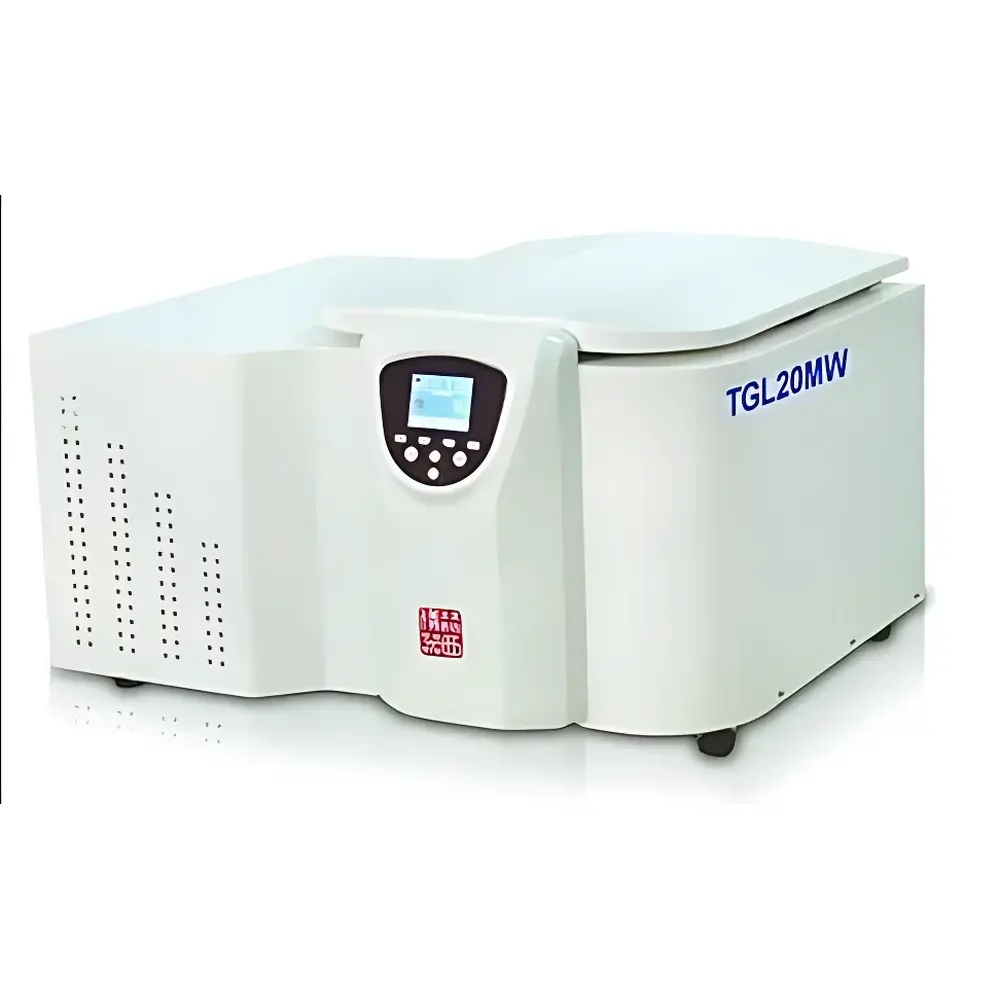
TGL20MW High-Capacity High-Speed Refrigerated Centrifuge
| Origin | Hunan, China |
|---|---|
| Manufacturer Type | Distributor |
| Origin Category | Domestic (China) |
| Model | TGL20MW |
| Price | ¥27,800 |
| Type | High-Speed Refrigerated Centrifuge (10,000–30,000 rpm) |
| Separation Class | Biological Macromolecules |
| Max Capacity | 4 × 300 mL |
| Max Speed | 20,600 rpm |
| Dimensions | 630 × 760 × 400 mm |
| Max RCF | 29,400 × g |
| Temperature Range | −20 °C to +40 °C |
| Temp Control Accuracy | ±1 °C |
| Acceleration/Deceleration | 10 selectable rates |
| Noise Level | ≤65 dB(A) |
| Power | 1.8 kW |
| Timer Range | 0–99 h 59 min |
| Weight | 110 kg |
| Rotor Recognition | Automatic |
| Display | TFT color touch LCD |
| Drive System | Brushless AC frequency-converter motor with dsPIC30F microcontroller and FSBB30CH driver module |
| Safety Features | Overspeed, overtemperature, imbalance, triple-layer steel rotor protection, active standby cooling, mechanical/electronic door interlock |
Overview
The TGL20MW High-Capacity High-Speed Refrigerated Centrifuge is an engineered solution for demanding separation workflows in life science and clinical laboratories. Designed around the principles of sedimentation centrifugation under controlled thermal conditions, it delivers reproducible high-RCF performance for pelleting subcellular organelles, precipitating nucleic acids and proteins, clarifying cell lysates, and concentrating viral particles or exosomes. Its refrigerated architecture maintains sample integrity during prolonged high-speed runs—critical for temperature-sensitive biomolecules such as enzymes, antibodies, and RNA. The unit operates within a certified temperature range of −20 °C to +40 °C, with precision control (±1 °C) enabled by a R404a-free compressor system compliant with international environmental standards. With a maximum rotational speed of 20,600 rpm and peak relative centrifugal force (RCF) of 29,400 × g, the TGL20MW meets routine and advanced requirements for macromolecular isolation across academic, pharmaceutical, diagnostic, and bioprocessing environments.
Key Features
- Brushless high-torque AC frequency-converter motor with dsPIC30F microcontroller-based digital control and FAIRCHILD FSBB30CH intelligent drive module—ensuring long-term operational stability and low electromagnetic interference.
- Triple-layer steel rotor containment housing and integrated mechanical/electronic door lock system conforming to IEC 61010-2-020 safety standards for centrifuge equipment.
- TFT full-color capacitive touch display with real-time dual-parameter view (set vs. actual speed, temperature, time, RCF), intuitive icon-driven navigation, and dedicated RCF calculation key.
- Automatic rotor identification system prevents mismatched rotor operation and enforces speed/temperature limits per rotor geometry—reducing user error and enhancing protocol compliance.
- Programmable operation with up to 20 stored methods; independent control of acceleration and deceleration profiles (10-step grading); “short spin” (pulse) mode for rapid pellet settling.
- Active standby cooling: rotor chamber pre-chills while idling, minimizing thermal lag at run initiation—essential for maintaining cold-chain continuity in GxP-aligned workflows.
- Optimized vibration damping via composite elastomeric suspension and dynamic balancing—achieving ≤65 dB(A) acoustic emission at maximum load and speed.
Sample Compatibility & Compliance
The TGL20MW supports broad sample format compatibility through interchangeable rotors—including fixed-angle, horizontal, and microplate carriers—validated for use with standard tubes (1.5–10 mL), conical centrifuge tubes (15–100 mL), vacuum blood collection tubes (2/5 mL), and deep-well plates (96-well). Its 4 × 300 mL horizontal rotor enables scalable processing of clinical or fermentation-derived samples without compromising resolution. All rotors are certified to ISO 15189 and CLSI EP05-A3 guidelines for repeatability and accuracy. The system’s firmware architecture supports audit trail logging (user ID, timestamp, parameter changes, run completion status), aligning with FDA 21 CFR Part 11 requirements when deployed in regulated QC/QA labs. Structural materials—including stainless-steel chamber, corrosion-resistant aluminum rotors, and non-toxic polymer components—meet EN 61326-1 for electromagnetic compatibility and UL 61010-1 for electrical safety.
Software & Data Management
While the TGL20MW operates as a standalone instrument with embedded firmware, its control interface supports export of run logs (CSV format) via USB port for integration into LIMS or ELN platforms. Parameter sets—including speed, temperature, duration, ramp profiles, and rotor ID—are fully editable and password-protected to enforce SOP adherence. The system records cumulative runtime, total cycles, and thermal history per rotor slot—enabling predictive maintenance scheduling. Optional PC-based configuration utility (available upon request) permits batch method deployment, remote diagnostics, and firmware updates traceable to version-controlled release notes—supporting GLP/GMP documentation practices.
Applications
- Isolation of mitochondria, nuclei, and membrane vesicles from tissue homogenates (e.g., liver, brain, cultured cells).
- High-yield purification of plasmid DNA, genomic DNA, and total RNA using silica-membrane or phenol-chloroform protocols.
- Clinical specimen processing: serum/plasma separation from whole blood; PBMC isolation; platelet-rich plasma (PRP) preparation.
- Biopharmaceutical upstream/downstream support: clarification of CHO or HEK293 lysates; concentration of monoclonal antibodies or viral vectors.
- Food safety testing: pathogen enrichment (e.g., Salmonella, Listeria) from enrichment broths prior to PCR or culture.
- Agricultural research: extraction of plant metabolites, polysaccharides, and chloroplasts under cryogenic stabilization.
FAQ
What is the maximum RCF achievable with the standard 4 × 300 mL horizontal rotor?
The TGL20MW achieves 3,290 × g at 4,000 rpm with the 4 × 250 mL configuration; full 4 × 300 mL loading is rated at 4,000 rpm / 3,290 × g per manufacturer specifications.
Does the centrifuge comply with ISO 22870 or CLIA requirements for clinical laboratories?
While not CE-IVD marked, its mechanical design, temperature uniformity, and rotor certification meet foundational criteria referenced in ISO 22870 Annex B for centrifuge validation in point-of-care and core lab settings.
Can the system be integrated into a networked laboratory environment?
Native Ethernet or Wi-Fi is not supported; however, USB data export and optional PC utility enable offline synchronization with centralized data repositories.
Are rotors individually serialized and traceable?
Yes—each rotor carries a laser-engraved serial number linked to its calibration certificate and lifetime usage log stored in instrument memory.
What refrigerant is used, and does it meet current global phaseout timelines?
R404a is employed in this generation; newer models under development utilize R513A—a low-GWP alternative aligned with EU F-Gas Regulation and EPA SNAP program requirements.



