
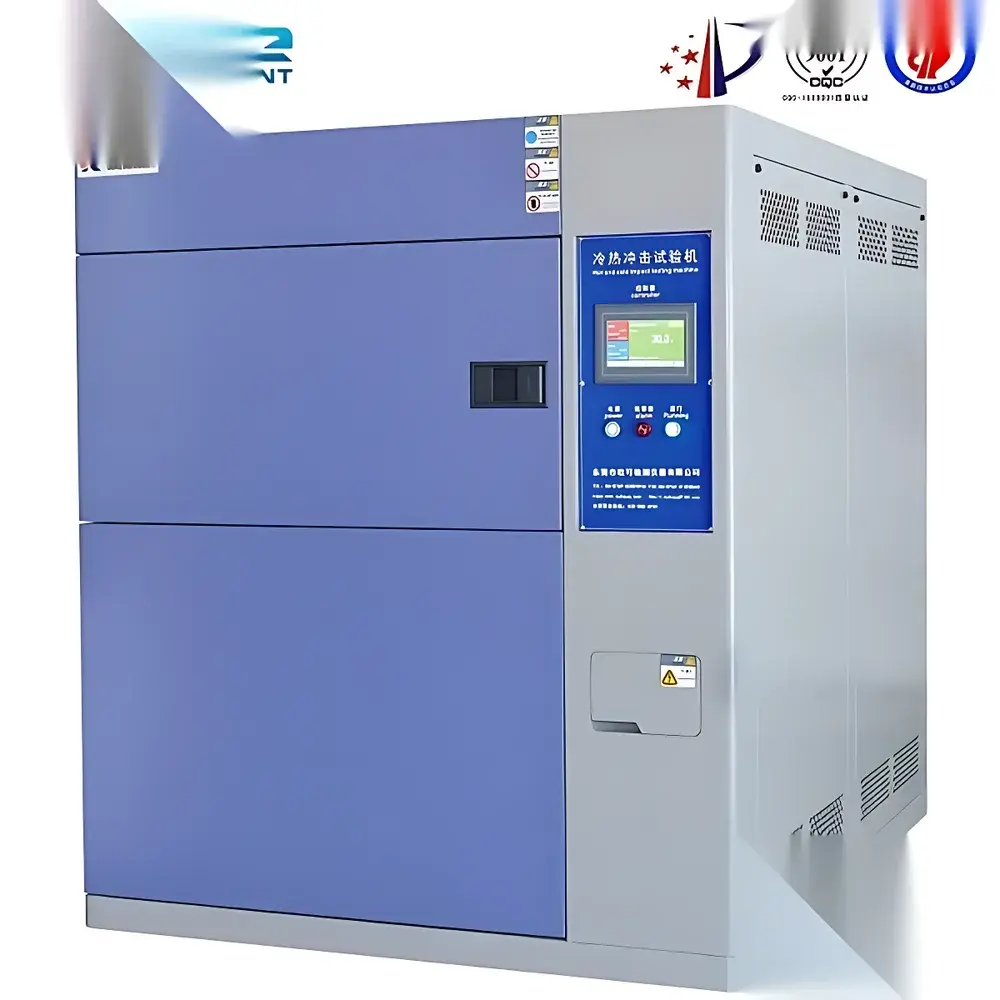
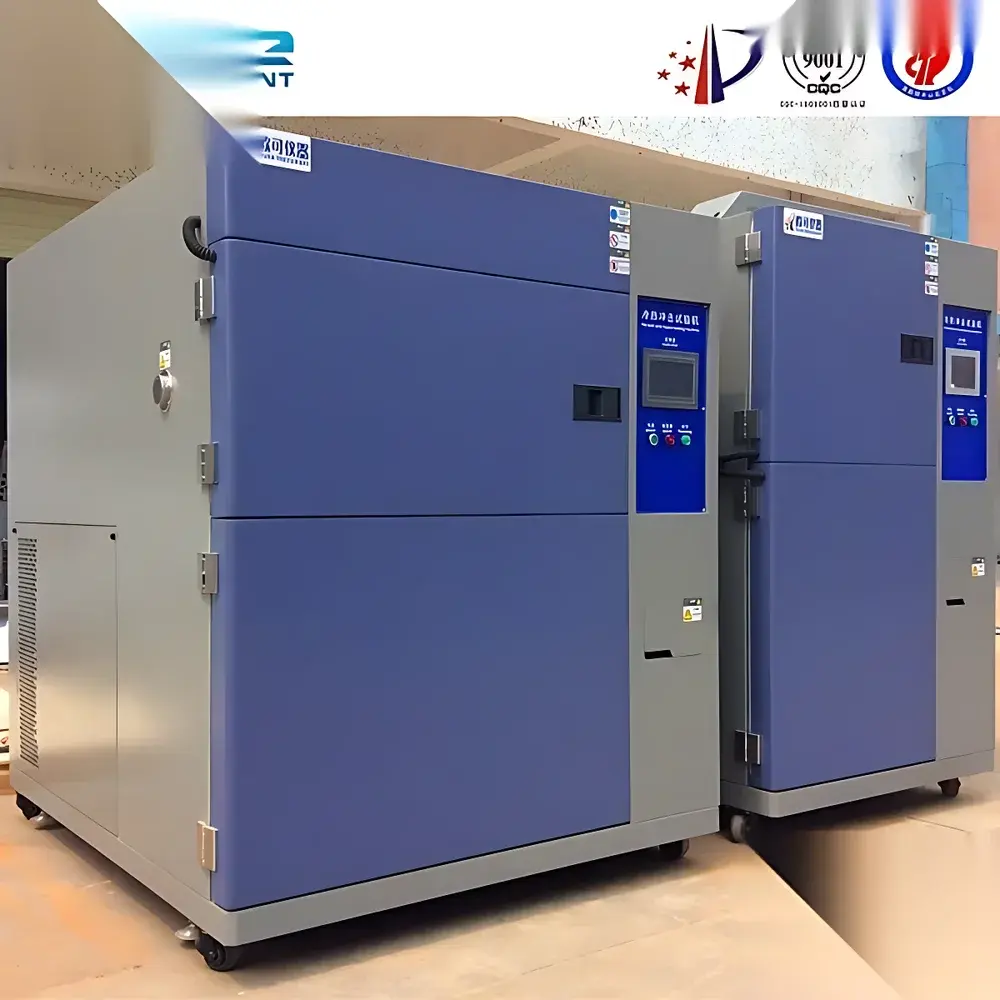
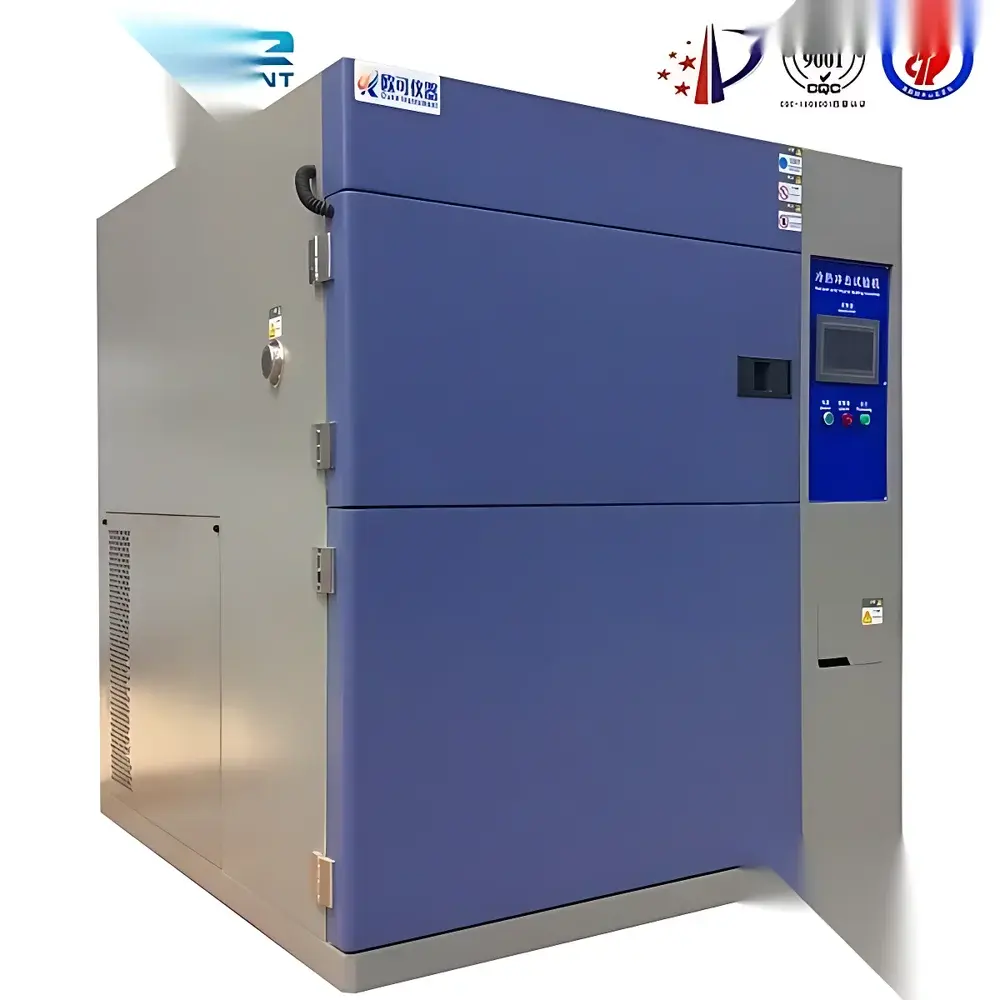
Thermal Shock Test Chamber – Dual-Chamber Rapid Temperature Transition System
| Brand | OEM |
|---|---|
| Origin | Imported |
| Manufacturer Type | Authorized Distributor |
| Price | USD 14,500 (FOB) |
| Chamber Configuration | Two-Zone (Hot/Cold) |
| Temperature Range | −70 °C to +180 °C |
| Transition Time (50 °C to −50 °C or vice versa) | ≤15 s (typical, 10 L load) |
| Internal Volume | 150 L standard |
| Control System | 7″ TFT Color Touchscreen PID Controller with Data Logging |
| Compliance | ASTM D5229/D5229M, ISO 16750-4, MIL-STD-810H Method 503.5, IEC 60068-2-14 |
Overview
The Thermal Shock Test Chamber – Dual-Chamber Rapid Temperature Transition System is an engineered environmental stress screening (ESS) platform designed for accelerated reliability validation of electronic components, automotive ECUs, aerospace avionics, and precision electromechanical assemblies. Unlike single-chamber thermal cycling systems, this dual-zone configuration employs physically isolated hot and cold chambers with rapid pneumatic transfer mechanisms—enabling true step-change thermal shock profiles per IEC 60068-2-14 and MIL-STD-810H Method 503.5. The system subjects test specimens to abrupt transitions between extreme temperature extremes (e.g., +150 °C ↔ −65 °C), inducing thermo-mechanical stress that reveals latent defects such as solder joint fatigue, delamination in multilayer PCBs, sealant cracking, and coefficient-of-thermal-expansion (CTE) mismatch failures. Its architecture minimizes thermal lag and ensures repeatable shock severity across qualification, production lot sampling, and failure analysis workflows.
Key Features
- Dual independent chamber design: Hot zone (max +180 °C) and cold zone (min −70 °C), each equipped with high-efficiency refrigeration and resistive heating systems for stable setpoint maintenance ±0.5 °C.
- Rapid transfer mechanism: Pneumatically actuated lift-and-shift carrier with <15-second transition time between chambers under standard 10-liter load conditions—verified per ASTM D5229 Annex A3.
- Stainless steel interior (SUS304 mirror finish) and powder-coated A3 steel exterior ensure corrosion resistance, cleanroom-compatibility, and long-term dimensional stability.
- 7-inch full-color TFT touchscreen controller with embedded PID algorithm, real-time trend graphing, and programmable ramp/soak profiles—including user-defined dwell times, cycle counts, and automatic restart after power interruption.
- Integrated 50 mm diameter test port (left-side, gasket-sealed) enables real-time signal monitoring or external power feedthrough without compromising chamber integrity.
- Large observation window with embedded heating element prevents condensation and ensures unobstructed visual inspection during operation; LED lighting meets IEC 61000-4-2 ESD-safe requirements.
Sample Compatibility & Compliance
This chamber accommodates test specimens up to 400 mm × 400 mm × 400 mm (W×D×H) within the standard 150 L internal volume. It supports rigid and semi-rigid samples including printed circuit board assemblies (PCBAs), sensors, connectors, battery modules, and encapsulated optoelectronic devices. All operational parameters are traceable to NIST-calibrated reference thermocouples (Class 1, ASTM E230). The system complies with regulatory testing frameworks required for automotive functional safety (ISO 26262), medical device design verification (IEC 60601-1), and aerospace component qualification (SAE AS9100 Rev D). Full audit trail functionality—including operator ID, parameter changes, alarm logs, and timestamped temperature history—is available when configured with optional GLP/GMP-compliant data logging firmware.
Software & Data Management
The embedded controller supports USB export of CSV-formatted temperature/time datasets compatible with MATLAB, JMP, and Minitab for Weibull analysis and acceleration factor modeling. Optional Ethernet connectivity enables remote monitoring via industry-standard Modbus TCP protocol and integration into centralized MES or LIMS platforms. When paired with the optional thermal printer module, hard-copy reports include test ID, start/end timestamps, cycle count, maximum deviation from setpoint, and pass/fail status against predefined acceptance criteria (e.g., IPC-9701A Class 2). Firmware updates are delivered via secure HTTPS download and support cryptographic signature verification to meet FDA 21 CFR Part 11 electronic record requirements.
Applications
- Qualification testing of automotive ADAS radar modules under thermal shock per ISO 16750-4 Clause 4.2.
- Reliability screening of GaN-based power electronics prior to high-volume manufacturing release.
- Failure mode identification in MEMS accelerometers subjected to repeated −55 °C/+125 °C cycling.
- Validation of conformal coating adhesion on flex-rigid hybrid circuits under thermal gradient stress.
- Design verification of satellite payload housings per ECSS-Q-ST-70-08C thermal vacuum shock protocols.
FAQ
What standards does this thermal shock chamber comply with?
ASTM D5229/D5229M, ISO 16750-4, IEC 60068-2-14, MIL-STD-810H Method 503.5, and ECSS-Q-ST-70-08C.
Can the chamber be integrated into an automated test cell?
Yes—Modbus TCP and discrete I/O signals (start/stop, door interlock, alarm) enable seamless integration with PLC-based test automation systems.
Is calibration documentation provided with shipment?
Each unit ships with a factory calibration certificate traceable to NIST standards, covering sensor linearity, temperature uniformity (±1.5 °C across work volume), and transition time verification.
What maintenance intervals are recommended?
Compressor oil and refrigerant filter replacement every 24 months; door gasket inspection and cleaning quarterly; PID controller self-diagnostic check before each qualification run.
Does the system support custom profile scripting beyond preset cycles?
Yes—the controller accepts user-defined multi-segment profiles with variable ramp rates, dwell durations, and conditional branching logic (e.g., “if T > 170 °C for >30 s, trigger alarm and pause”).



