
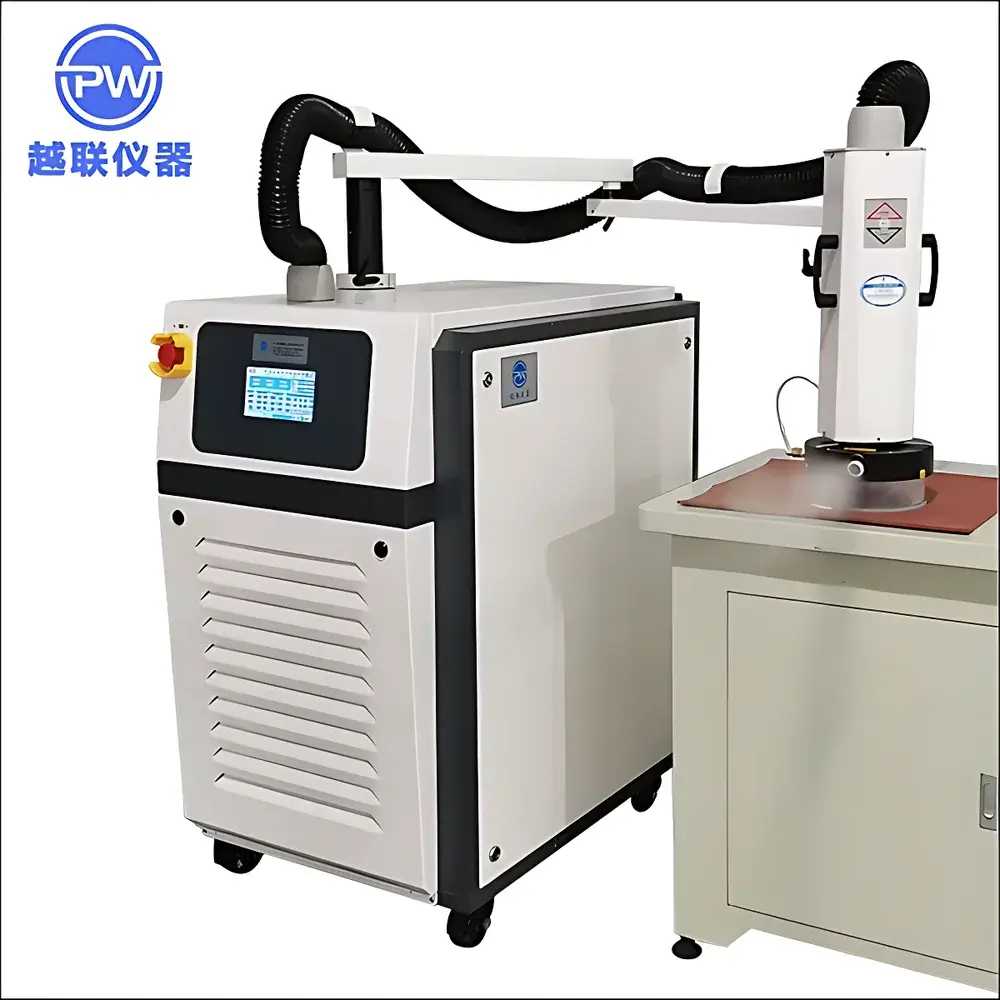
Thermal Shock Tester PW-CTS-80T Service (Brookfield-equivalent Cold-Hot Gas Impulse Testing System)
| Brand | YueLian / PW |
|---|---|
| Origin | Guangdong, China |
| Manufacturer Type | Authorized Distributor |
| Country of Origin | China |
| Model | PW-CTS-80T |
| Pricing | Available Upon Request |
| Temperature Range (Gas Stream) | −80 °C to +220 °C |
| Control Accuracy | ±1.0 °C |
| Setpoint & Display Resolution | 0.1 °C |
| Temperature Overshoot | ≤1 °C |
| Ramp Rate (Empty Nozzle) | −40 °C ↔ +85 °C in ≈10 s / ≈11 s |
| Gas Flow Rate | 5–20 SCFM (adjustable) |
| Gas Input Requirements | N₂ or dry air, dew point ≤10 °C, pressure 0.55–0.78 MPa |
| Power Supply | AC 220 V, 50 Hz, single-phase, ~3 kW |
| External Dimensions | 630 × 1230 × 890 mm (W×H×D) |
| Data Interface | Ethernet, USB, RS485 (Modbus RTU supported), optional GPIB |
| Software Compatibility | LabVIEW™ drivers provided |
| Data Logging | Local USB storage + real-time PC transfer |
| Calibration | Manual traceable procedure |
| Low-Temp Operation | Frost-free continuous operation at −80 °C |
Overview
The PW-CTS-80T Thermal Shock Tester is a high-speed gas impulse thermal cycling system engineered for non-contact, transient thermal stress validation of microelectronic components and assemblies. Unlike conventional chamber-based thermal shock testers, this system delivers rapid temperature transitions via precisely metered, temperature-controlled nitrogen or dry compressed air streams directed through a transparent quartz nozzle onto the device under test (DUT). Its operational principle relies on convective heat transfer acceleration—achieving <11-second bidirectional transitions between −40 °C and +85 °C at the nozzle exit—enabling accelerated reliability assessment of solder joints, die attach integrity, wire bond fatigue, and encapsulant delamination in semiconductor packages. Designed for lab-scale qualification and production-line screening, the PW-CTS-80T supports both programmable multi-step thermal profiles and fixed-point dwell testing, meeting foundational requirements for JEDEC JESD22-A104 (Temperature Cycling) and A106 (Thermal Shock) test methodologies.
Key Features
- Ultra-fast thermal ramping: Achieves −40 °C → +85 °C and reverse transitions in ≤11 seconds (no-load, nozzle outlet), minimizing dwell-induced thermal equilibration artifacts
- Dual-mode temperature control: Switchable regulation between gas stream temperature and real-time DUT surface temperature (via integrated T-type thermocouple)
- Frost-free cryogenic stability: Sustained operation at −80 °C without ice accumulation on internal nozzles or flow paths, enabled by proprietary low-humidity gas conditioning and thermal isolation architecture
- Energy-optimized refrigeration: Closed-loop cascade cooling system with variable-speed compressors reduces power consumption by >30% versus legacy impulse systems of comparable range
- Industrial-grade automation readiness: Equipped with RS485 (Modbus RTU), Ethernet, and USB interfaces; compatible with PLC-triggered batch testing and integration into automated handler platforms
- Traceable metrology framework: Supports manual calibration using NIST-traceable reference probes; all temperature setpoints and sensor readings resolved to 0.1 °C
Sample Compatibility & Compliance
The PW-CTS-80T accommodates bare dies, packaged ICs (QFN, BGA, LGA, WLCSP), optical transceivers, MEMS sensors, and PCB-mounted thermal interface materials (TIMs). Its 15-mm inner-diameter quartz nozzle ensures localized thermal application without mechanical contact, preserving delicate bond wires and fragile substrates. The system meets essential environmental test infrastructure requirements per IEC 60068-2-14 (Change of Temperature) and supports test protocol alignment with automotive AEC-Q100 stress categories. While not certified to ISO/IEC 17025 for accredited calibration, its documented repeatability (<±0.8 °C inter-run variation at steady-state points) enables internal method validation per GLP-compliant QA workflows. All firmware logs include timestamped metadata compliant with FDA 21 CFR Part 11 audit trail prerequisites when paired with validated LabVIEW-based acquisition software.
Software & Data Management
Control and monitoring are executed via a 7-inch capacitive touchscreen HMI running a deterministic real-time OS. Test sequences—whether single-point dwell, linear ramps, or complex multi-segment cycles—are defined using intuitive drag-and-drop profile editors. Raw thermal data (gas temperature, DUT thermocouple voltage, flow rate, time stamps) are logged in CSV format directly to removable USB drives or streamed in real time to host PCs via TCP/IP. Native LabVIEW™ driver libraries (NI-VISA compliant) enable custom script development for statistical process control (SPC) integration, DOE execution, and automated pass/fail evaluation against user-defined thermal excursion thresholds. All data files embed embedded CRC checksums and support SHA-256 hash verification for integrity assurance during regulatory submissions.
Applications
- Qualification of automotive-grade SoCs subjected to under-hood thermal transients
- Early-life failure screening of 5G RF front-end modules exposed to rapid ambient shifts
- Validation of TIM performance degradation after 500+ thermal cycles
- Correlation studies between JEDEC JESD22-A104 cycling and field return root cause analysis
- Process window optimization for reflow soldering of fine-pitch BGAs
- Reliability benchmarking of chiplet-based heterogeneous integration architectures
FAQ
What gas media are supported, and what purity specifications apply?
Standard operation uses instrument-grade nitrogen (ISO 8573-1 Class 2:2:2) or dried compressed air (dew point ≤10 °C). Oxygen-free nitrogen is recommended for oxidation-sensitive optoelectronic devices.
Can the system operate continuously at −80 °C without maintenance interruption?
Yes—the frost-free design eliminates manual defrost cycles; however, periodic verification of desiccant cartridge integrity (every 6 months under continuous use) is required to maintain specified dew point compliance.
Is third-party software integration possible beyond LabVIEW?
Yes—RS485 Modbus RTU register maps and Ethernet TCP command sets are fully documented and available under NDA for Python, MATLAB, or custom SCADA development.
How is temperature uniformity validated across the nozzle outlet cross-section?
Uniformity is characterized during factory acceptance testing using a 5-point thermocouple array; typical radial deviation is <±0.5 °C at nominal flow rates (12 SCFM).
Does the system meet CE or UKCA marking requirements?
The base configuration complies with EU Machinery Directive 2006/42/EC and EMC Directive 2014/30/EU; full CE documentation (including risk assessment and DoC) is supplied with each unit.



