
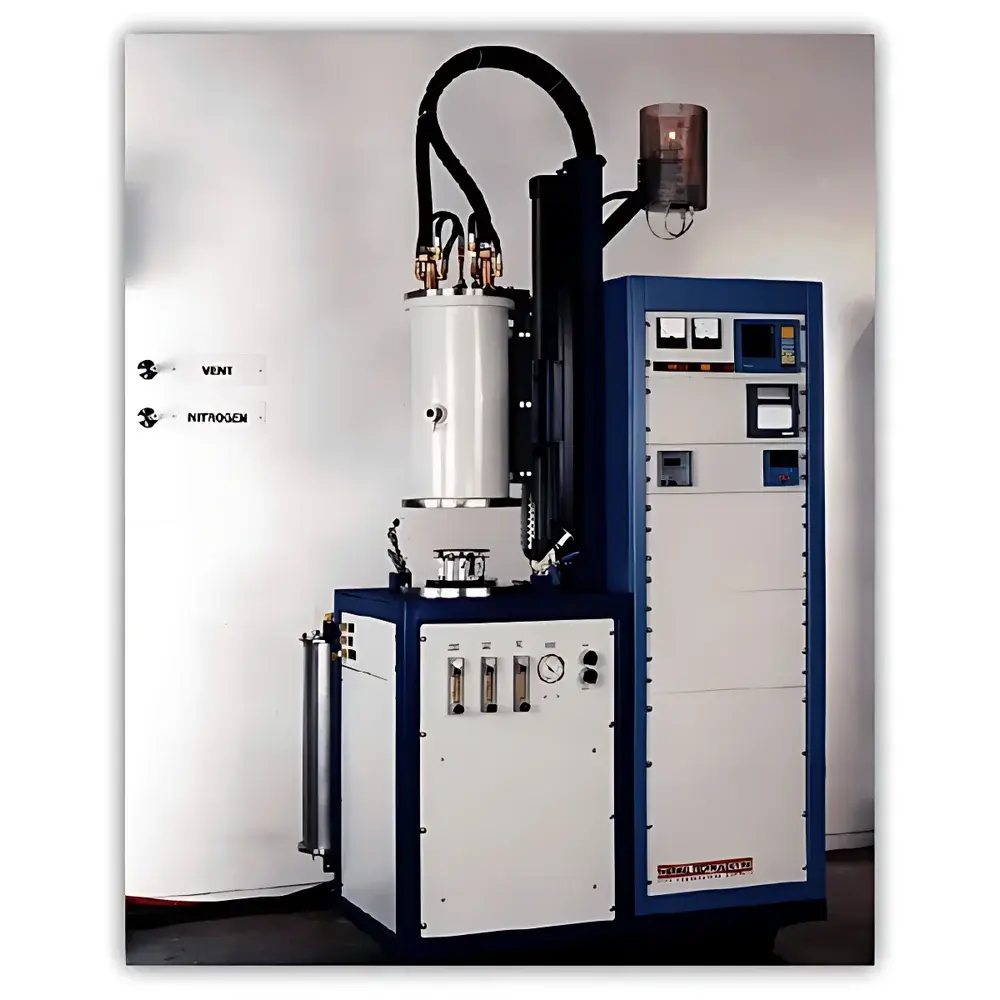
Thermal Technology APF 0925-MM & APF 2036-WW Automatic High-Temperature Processing Furnaces
| Brand | Thermal Technology |
|---|---|
| Origin | USA |
| Type | Horizontal/Vertical Tube Furnace |
| Max Temperature | 2500°C |
| Temperature Uniformity | ±1°C (at 2500°C, full hot zone) |
| Control Accuracy | ±0.1°C |
| Ramp Rate (to max temp) | >100°C/min |
| Cool-down Rate | up to 300°C/min |
| Heating Element | Tungsten Rods |
| Power Rating | 3000 W |
| Atmosphere Options | Vacuum (≤10⁻⁶ Torr), H₂ (wet/dry), NH₃ (dissociated), N₂, Ar, forming gas |
| Chamber Design | Cold-wall, double-jacketed stainless steel |
| Heating Zone Configuration | Multi-layer radiation shields with Mo/W reflective shielding |
| Programmable Controller | Microprocessor-based, 50+ stored recipes, real-time edit capability, alarm logging, RS-485/Ethernet interface |
| Compliance | Designed for GLP/GMP environments |
Overview
The Thermal Technology APF 0925-MM and APF 2036-WW are fully automated, high-temperature processing furnaces engineered for precision thermal treatment of advanced ceramics, refractory metals, and functional composites under controlled vacuum or reactive atmospheres. Based on the fundamental principle of resistive heating via tungsten rod elements within a cold-wall, multi-shielded vacuum chamber, these systems deliver exceptional thermal stability and spatial uniformity—critical for sintering, annealing, brazing, and reactive synthesis processes where contamination sensitivity and stoichiometric control are paramount. Unlike graphite-heated systems, the all-metal hot zone eliminates carbon outgassing and surface reaction risks, making them uniquely suitable for oxygen-sensitive or high-purity ceramic systems such as Al₂O₃–TiN composites, SiC, ZrO₂, and rare-earth doped phosphors. The furnace architecture supports rapid thermal cycling (>100°C/min ramp, up to 300°C/min cool-down), enabling precise kinetic control over phase evolution, grain growth, and interfacial reactions—key parameters documented in peer-reviewed studies including *Materials* (2017, 10, 1348) on Ti-reactive sintering.
Key Features
- High-temperature capability up to 2500°C with tungsten-based heating elements and molybdenum/tungsten radiation shielding
- Cold-wall stainless steel chamber with double-jacketed construction for thermal isolation and operator safety
- Programmable microprocessor controller supporting ≥50 independent thermal profiles with real-time editing, alarm logging, and timestamped event tracking
- Multi-zone atmosphere compatibility: high vacuum (≤10⁻⁶ Torr), dry/wet hydrogen, dissociated ammonia, nitrogen, argon, and forming gas
- Optimized thermal uniformity: ±1°C across full working zone at 2500°C, achieved via symmetric heating geometry and reflective radiation barriers
- Modular mechanical design: front-loading (horizontal) or top/bottom-loading (vertical) configurations with hydraulic lift mechanisms for safe, repeatable sample handling
- Integrated dew-point monitoring and closed-loop atmosphere control for hydrogen and moisture-sensitive processes
- Energy-efficient operation through multi-layer reflective shielding and low-thermal-mass heating element layout
Sample Compatibility & Compliance
These furnaces accommodate diverse sample geometries—from powder compacts and green bodies to machined substrates and metallized ceramic assemblies—within customizable work zones ranging from 0.1 to 17.2 ft³. The metal-only hot zone ensures compatibility with oxygen-scavenging atmospheres and eliminates cross-contamination during sequential processing of dissimilar materials. Systems comply with mechanical safety standards per ANSI Z21.11.2 and electrical safety per UL 61010-1. When paired with validated software platforms, they support regulatory requirements for data integrity and traceability under FDA 21 CFR Part 11, ISO/IEC 17025, and ASTM C1161 (flexural strength of advanced ceramics) test protocols. Vacuum integrity is verified per ASTM E517, and temperature uniformity mapping follows ASTM E220 practices.
Software & Data Management
The embedded controller provides native support for ASCII-based recipe export/import, Ethernet/RS-485 communication, and OPC UA integration for MES/SCADA connectivity. Optional software modules enable full electronic batch records—including temperature vs. time curves, atmosphere composition logs, pressure traces, and alarm histories—with user-level access control and digital signature capability. Audit trails capture operator actions, parameter changes, and system events with immutable timestamps, satisfying GLP and GMP documentation requirements. Data files conform to ASTM E1447-compliant CSV structure for third-party analysis in MATLAB, Python, or statistical process control (SPC) tools.
Applications
- Sintering of ultra-high-purity oxide and non-oxide ceramics (e.g., Al₂O₃, Si₃N₄, SiC, Y₂O₃-stabilized ZrO₂)
- Reactive metal-ceramic co-firing (e.g., Ti–Al₂O₃, Mo–SiC, W–Cu composites)
- Hydrogen-reduction annealing of transition metal oxides for catalyst precursor activation
- Vacuum degassing and outgassing of optical-grade sapphire and laser host crystals
- Thermal aging studies of multilayer ceramic capacitors (MLCCs) and piezoelectric actuators
- Controlled-atmosphere metallization of alumina and aluminum nitride substrates
- Research-scale synthesis of MAX phases and high-entropy ceramics
FAQ
What atmosphere options are supported without external vacuum pump integration?
Systems operate in inert (N₂, Ar) or reducing (forming gas, dry H₂) atmospheres at atmospheric pressure without vacuum pumping. Optional integrated turbo-molecular pumps enable high-vacuum operation down to 10⁻⁶ Torr.
Can the furnace be validated for GMP manufacturing use?
Yes—when configured with IQ/OQ documentation packages, calibrated thermocouples (Type C or S), and compliant software, the APF/CPF series meets equipment qualification requirements for Class 1000 cleanroom-compatible thermal processing.
How is temperature uniformity verified and maintained across the hot zone?
Uniformity is confirmed via multi-point sensor mapping per ASTM E220 and sustained through symmetrical tungsten rod placement, multi-layer molybdenum radiation shields, and active cooling of outer chamber walls.
Is remote monitoring and control available?
Standard Ethernet interface enables secure remote access via browser-based HMI or third-party SCADA systems using Modbus TCP or OPC UA protocols.
What maintenance intervals are recommended for tungsten heating elements at 2500°C?
Under continuous operation at peak temperature, tungsten elements typically require inspection every 200–300 thermal cycles; life extension is achieved through optimized ramp/soak profiles and strict atmosphere purity control.



