
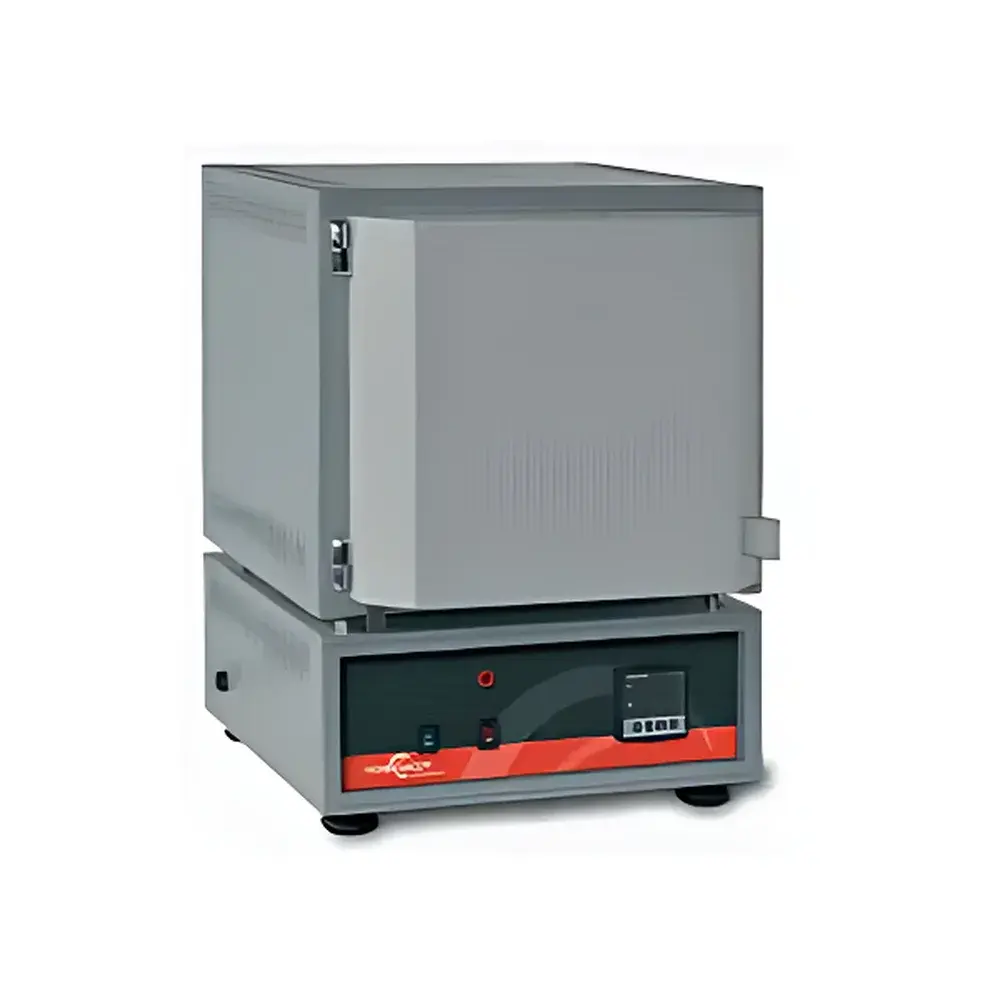
Thermconcept Compact Muffle Furnace
| Brand | Thermconcept |
|---|---|
| Origin | Germany |
| Model | Compact Muffle Furnace |
| Max Operating Temperature | 1000 °C |
| Chamber Lining | Ceramic Fiber Insulation |
| Heating Configuration | Quadrilateral (4-Side) Heating Elements |
| Control System | Silent Solid-State Relay |
| Door Orientation | Side-Opening |
| Exhaust Port | Rear Wall Mounted |
| Safety | EN 60519-2 Compliant Over-Temperature Cut-Off Limiter |
| Accessories Included | Exhaust Chimney, Thermal Safety Limiter |
Overview
The Thermconcept Compact Muffle Furnace is an engineered solution for precise, repeatable high-temperature thermal processing in analytical, quality control, and research laboratories. Designed according to fundamental principles of radiant heat transfer and thermal insulation efficiency, this muffle furnace operates on a resistive heating principle—employing embedded high-grade resistance wire elements positioned on all four internal chamber walls to ensure uniform temperature distribution across the working volume. Its maximum operating temperature of 1000 °C is achieved with minimal thermal lag and high energy efficiency, enabled by low-conductivity ceramic fiber insulation lining the entire cavity. The side-opening door configuration optimizes workflow ergonomics during sample loading/unloading while maintaining structural integrity and thermal containment. As a CE-marked instrument manufactured in Bremen, Germany, it complies with essential EU safety directives including EN 60519-2 for industrial electroheating equipment.
Key Features
- Quadrilateral heating architecture: Four-sided placement of Kanthal® A1 or equivalent high-stability resistance heating elements ensures radial symmetry in heat flux and minimizes axial temperature gradients.
- Ceramic fiber chamber lining (density ~128 kg/m³): Provides exceptional thermal resistance, enabling rapid ramp rates (typical 10–15 °C/min to 1000 °C) and reduced standby power consumption compared to brick-lined alternatives.
- Silent solid-state relay (SSR) control: Eliminates mechanical contactor noise and enhances long-term reliability through zero-cross switching and minimized electrical arcing.
- Integrated rear exhaust port: Facilitates connection to laboratory fume extraction systems for volatile residue removal during ashing, calcination, or loss-on-ignition (LOI) procedures.
- EN 60519-2 certified over-temperature protection: Independent bi-metallic limiter disconnects power when preset threshold (adjustable within safe operational range) is exceeded—functionally redundant to primary PID controller.
- Compact footprint (W × D × H ≈ 420 × 510 × 470 mm): Optimized for benchtop deployment in space-constrained labs without compromising usable chamber volume (~3.2 L).
Sample Compatibility & Compliance
This furnace accommodates standard crucibles (alumina, platinum, quartz, or stainless steel), porcelain boats, and refractory trays up to Ø90 mm × H60 mm. It supports routine applications governed by ASTM E1529 (fire-test-response standards), ISO 1171 (ash content determination), and USP (residue on ignition). The ceramic fiber construction is inert toward most inorganic matrices and compatible with oxidizing atmospheres; however, prolonged exposure to halogen-containing or strongly reducing samples is not recommended without additional atmosphere control. All electrical and thermal safety designs conform to IEC 61000-6-3 (EMC emission limits) and IEC 61000-6-2 (immunity requirements), ensuring stable operation in shared lab environments.
Software & Data Management
The furnace utilizes a front-panel digital controller with dual-display PID interface (setpoint/actual temperature), programmable ramp-soak profiles (up to 8 segments), and real-time deviation monitoring. While standalone operation is standard, optional RS485 Modbus RTU output enables integration into centralized Lab Information Management Systems (LIMS) or SCADA platforms for audit-trail-capable data logging. When configured with compliant firmware, the system supports 21 CFR Part 11–aligned electronic records—including user authentication, change tracking, and non-erasable event logs—meeting GLP and GMP documentation requirements for regulated QC/QA workflows.
Applications
- Gravimetric analysis: Ash content quantification in foodstuffs, pharmaceutical excipients, and environmental solids per AOAC 942.05 and EPA Method 1694.
- Thermal pre-treatment: Conditioning of catalyst supports, ceramic green bodies, and metal oxide precursors prior to sintering or XRD characterization.
- Residue evaluation: Determination of non-volatile residues in solvents, coatings, and polymer formulations under ISO 3251.
- Calibration reference: Stable thermal environment for thermocouple calibration checks at fixed points between 500 °C and 1000 °C.
- Material stability testing: Accelerated aging studies of composites, battery cathode materials, and refractory linings under controlled oxidative conditions.
FAQ
What is the typical time required to reach 1000 °C from ambient?
Under no-load conditions, the furnace achieves 1000 °C in approximately 28–32 minutes, depending on ambient humidity and ventilation rate.
Is the ceramic fiber lining replaceable, and what is its expected service life?
Yes—the liner is modular and field-replaceable using manufacturer-supplied kits; typical service life exceeds 5 years with proper thermal cycling (≤3 cycles/day) and avoidance of mechanical impact or moisture ingress.
Can this furnace be used under inert or reducing atmospheres?
Not without modification: Standard configuration is rated for air atmosphere only; optional quartz tube inserts or gas purge fittings are available upon request for nitrogen or argon compatibility.
Does the unit include calibration documentation traceable to national standards?
Each unit ships with a factory calibration certificate (as-found/as-left data at 3 points: 500 °C, 800 °C, 1000 °C) traceable to PTB (Physikalisch-Technische Bundesanstalt) via accredited subcontractor.
What maintenance intervals are recommended for optimal performance?
Visual inspection of door gasket integrity and element continuity every 6 months; thermocouple verification annually or after 200 thermal cycles—per ISO/IEC 17025 guidelines for in-house calibration labs.



