
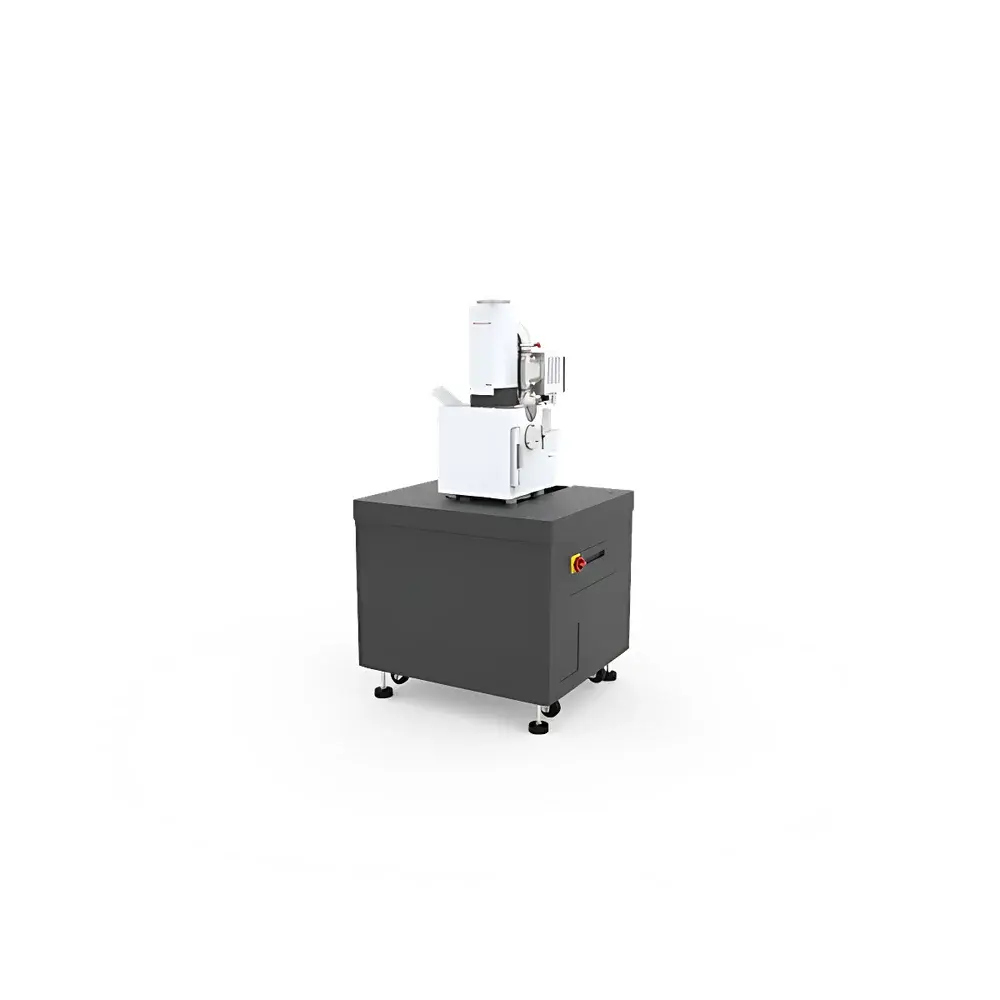
Thermo Fisher Axia ChemiSEM Tungsten-Filament Scanning Electron Microscope
| Brand | Thermo Fisher |
|---|---|
| Origin | Netherlands |
| Manufacturer Type | Original Equipment Manufacturer (OEM) |
| Origin Category | Imported |
| Model | Axia ChemiSEM |
| Instrument Type | Floor-Standing Conventional SEM |
| Electron Source | Tungsten Filament |
| Secondary Electron Resolution | 3 nm @ 30 kV, 8 nm @ 3 kV |
| Accelerating Voltage | 0.2–30 kV |
| Backscattered Electron Imaging Capability | Integrated |
| Elemental Analysis Integration | On-platform EDS (Energy-Dispersive X-ray Spectroscopy) |
| Sample Weight Capacity | Up to 10 kg |
| Automation Level | Fully Automated Beam Alignment, Smart User Guidance, Undo Functionality |
| Compliance | Designed for GLP/GMP environments with audit-trail-ready software architecture |
Overview
The Thermo Fisher Axia ChemiSEM is a floor-standing tungsten-filament scanning electron microscope engineered for robust, routine microstructural characterization and simultaneous elemental analysis in academic research laboratories, industrial quality control facilities, and failure analysis centers. Unlike conventional SEMs requiring separate instrumentation for imaging and composition, the Axia ChemiSEM integrates high-fidelity secondary electron (SE) and backscattered electron (BSE) imaging with real-time energy-dispersive X-ray spectroscopy (EDS) within a single vacuum chamber and unified user interface. Its operational principle relies on thermionic emission from a stable tungsten hairpin filament, generating a focused electron beam scanned across conductive or non-conductive samples—enabled by integrated low-vacuum and charge-compensation modes. With a verified secondary electron resolution of 3 nm at 30 kV and 8 nm at 3 kV, the system delivers consistent topographic contrast across a broad accelerating voltage range (0.2–30 kV), supporting both high-resolution surface inspection and low-kV imaging of beam-sensitive or uncoated specimens.
Key Features
- Integrated EDS platform: Real-time elemental mapping and point/line quantitative analysis synchronized with SE/BSE image acquisition—no manual stage repositioning or session switching required.
- Universal sample compatibility: Accommodates specimens up to 10 kg in mass and 200 mm in diameter; supports insulating materials via variable-pressure mode (up to 130 Pa) without sputter coating.
- Intelligent automation suite: Auto-alignment of condenser and objective lenses ensures optimal probe current and beam convergence without operator intervention; self-calibrating stigmators maintain astigmatism correction across magnifications.
- Context-aware software guidance: Step-by-step workflows for beam optimization, focus, and contrast adjustment—accessible to novice users while preserving full manual control for advanced operators.
- Dual-mode imaging engine: Simultaneous acquisition of SE (surface topology) and BSE (atomic number contrast) signals enables immediate phase discrimination and compositional correlation without signal re-acquisition.
- Audit-ready architecture: Software logs all parameter changes, acquisition timestamps, and user actions in accordance with FDA 21 CFR Part 11 and ISO/IEC 17025 requirements for traceable data integrity.
Sample Compatibility & Compliance
The Axia ChemiSEM is validated for heterogeneous sample classes including metallurgical cross-sections, geological thin sections, polymer composites, electronic packaging substrates, and biological tissue blocks (with appropriate fixation). Its extended chamber geometry and motorized 5-axis eucentric stage permit tilt-free navigation across large-area samples. For regulatory compliance, the system meets IEC 61000-6-3 (EMC emissions) and IEC 61000-6-2 (immunity) standards. All EDS quantification routines adhere to ASTM E1508 and ISO 16700 guidelines for standardless and standard-based ZAF corrections. The embedded software supports electronic signature capture, role-based access control, and configurable audit trails—fully aligned with GLP and GMP documentation frameworks.
Software & Data Management
Acquisition and analysis are executed through Thermo Fisher’s ChemiSEM Suite—a Windows-based application built on .NET Framework with native HDF5 file storage. Each dataset embeds raw detector counts, acquisition metadata (kV, working distance, dwell time, detector bias), and calibrated EDS spectra with dead-time corrected intensity values. Batch processing modules enable automated particle analysis (size, shape, composition) across hundreds of fields of view. Export options include TIFF (8/16-bit), CSV (spectral data), and CMA (Compositional Mapping Archive) format compatible with third-party tools such as DTSA-II and CalcZAF. Data security is enforced via AES-256 encryption for archived sessions and optional integration with enterprise LIMS via RESTful API.
Applications
- Failure analysis of solder joint voids, wire bond lifts, and die attach delamination in semiconductor packages.
- Particle identification and source attribution in pharmaceutical manufacturing environments per USP .
- Phase distribution mapping in additive-manufactured metal alloys (e.g., Ti-6Al-4V, Inconel 718) for porosity and intermetallic verification.
- Coating thickness and uniformity assessment on automotive brake pads and thermal barrier coatings.
- Mineralogical quantification in cementitious materials using BSE-based grayscale segmentation coupled with EDS stoichiometric refinement.
FAQ
Does the Axia ChemiSEM require external cooling water or compressed air?
No—it operates with air-cooling only and has no pneumatic or chiller dependencies, reducing facility infrastructure requirements.
Can EDS spectra be acquired simultaneously with high-magnification imaging?
Yes—full-spectrum EDS collection occurs in parallel with live SE/BSE imaging at all magnifications, with adjustable count-rate limits to preserve spectral fidelity.
Is remote operation supported for multi-site labs?
Yes—via Thermo Fisher’s Secure Remote Access module, enabling supervised instrument control and data review over TLS-encrypted connections.
What vacuum level is maintained during EDS acquisition?
High vacuum mode (≤1 × 10⁻³ Pa) is used for optimal EDS peak resolution; variable-pressure mode (up to 130 Pa) is available for uncoated insulators with minor trade-offs in spectral resolution.
How is calibration traceability maintained for quantitative EDS?
Factory-installed reference standards (Co, Cu, Si, Al) are periodically verified against NIST-traceable certified reference materials (CRMs); software enforces calibration expiry alerts and version-controlled protocol archiving.




