
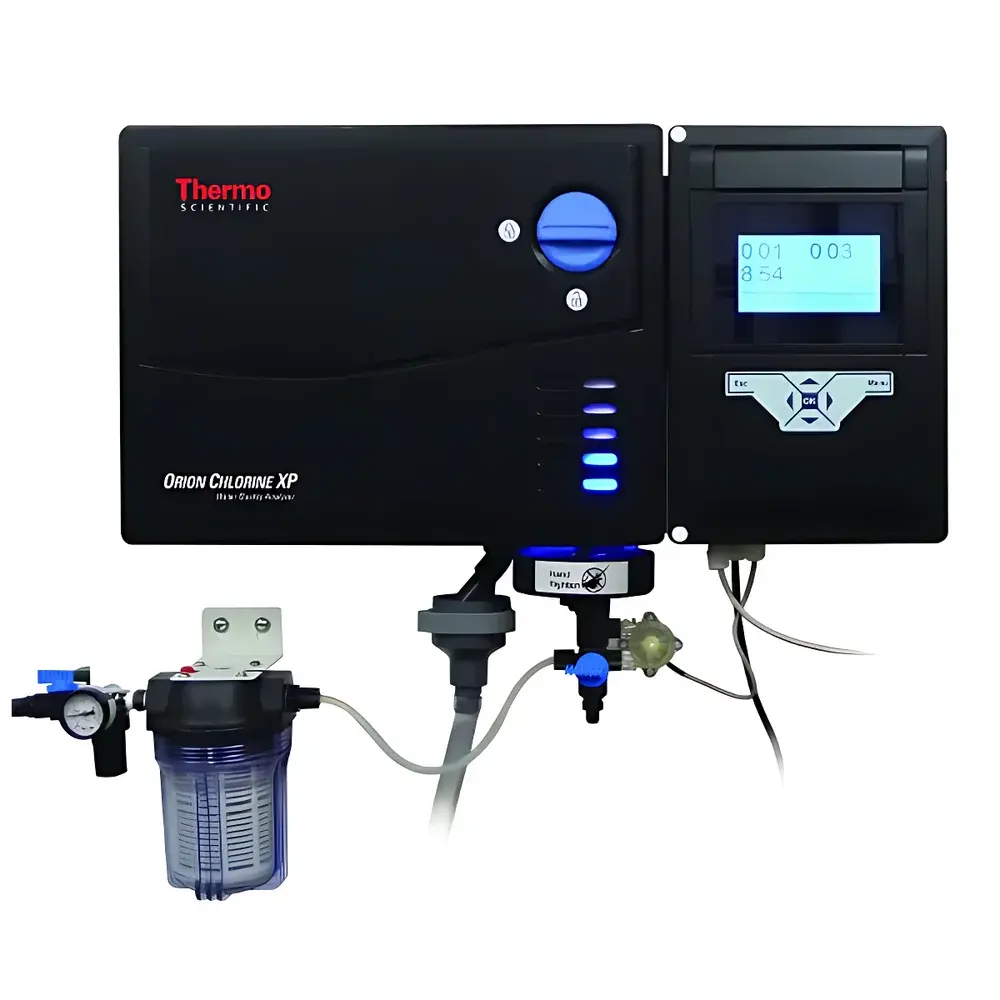
Thermo Fisher Chlorine XP Residual and Total Chlorine Analyzer
| Brand | Thermo Fisher |
|---|---|
| Origin | USA |
| Model | Chlorine XP |
| Instrument Type | Online Analyzer |
| Measurement Principle | DPD Spectrophotometry |
| Measured Parameters | Free Chlorine, Total Chlorine, Combined Chlorine |
| Range | 0.01–10 ppm |
| Accuracy | ±3% of reading |
| Repeatability | ±5% |
| Resolution | 0.01 ppm |
| Detection Limit | 0.01 ppm |
| Reagent Consumption | 0.03 mL per analysis |
| Reagent Shelf Life | 24 months (unopened) |
| Environmental Rating | IP65 (NEMA 4) |
| Communication Interface | RS-485 |
| Certifications | EPA Compliant, CSA Certified, ISO 9001 Certified |
| Operating Temperature Range | Supports sample temperatures down to 4 °C |
Overview
The Thermo Fisher Chlorine XP is an online residual and total chlorine analyzer engineered for continuous, unattended monitoring of disinfectant levels in potable water, wastewater effluent, industrial process streams, and ultrapure water systems. It employs the standardized N,N-diethyl-p-phenylenediamine (DPD) spectrophotometric method—recognized by the U.S. Environmental Protection Agency (EPA), ASTM D1253, and ISO 7393-2—as its core measurement principle. Unlike conventional benchtop or semi-automated DPD analyzers, the Chlorine XP integrates fluidic precision, optical stability, and embedded diagnostics into a single robust architecture designed for 24/7 operation in demanding municipal and industrial environments. Its optical path utilizes stable LED light sources with automatic intensity compensation, minimizing drift and extending service intervals. The system measures free chlorine, total chlorine, and combined chlorine by sequentially introducing reagents and performing timed colorimetric reactions within a quartz flow cell, followed by photometric detection at 515 nm. This approach ensures traceable, repeatable results aligned with regulatory reporting requirements under EPA Method 334.0 and equivalent international standards.
Key Features
- Ultra-low reagent consumption: only 0.03 mL per analysis—lowest in class—reducing operational cost and waste generation
- Automated blank calibration and dynamic LED intensity adjustment prior to each measurement cycle, enhancing long-term photometric stability
- Self-cleaning optical flow cell with programmable purge cycles to prevent biofilm buildup and turbidity interference
- Modular design enables field-replaceable components—including reagent cartridges, pump tubing, and optical modules—without specialized tools or calibration recalibration
- Integrated diagnostic logging: real-time status monitoring of reagent volume, sample flow integrity, lamp output, and valve actuation history
- IP65-rated enclosure (NEMA 4 equivalent) with corrosion-resistant housing suitable for outdoor or wet-location installation
- Supports cold-water sampling down to 4 °C without signal attenuation or reaction delay, validated per EPA guidance for low-temperature distribution systems
Sample Compatibility & Compliance
The Chlorine XP is validated for use with clarified, filtered, and low-turbidity aqueous matrices typical of finished drinking water, membrane permeate, cooling tower make-up, and secondary-treated wastewater effluent. It complies with U.S. EPA requirements for continuous chlorine monitoring in public water systems (40 CFR Part 141.74), meets CSA C22.2 No. 1010.1 safety standards, and conforms to ISO 9001 quality management protocols during manufacturing and software validation. All firmware and data handling routines support audit-trail functionality required under GLP and GMP frameworks. While not FDA 21 CFR Part 11–certified out-of-the-box, the system’s event-logged data export (via Modbus RTU over RS-485) is compatible with validated LIMS and SCADA platforms that implement electronic signature and change-control policies.
Software & Data Management
The analyzer operates on embedded firmware with configurable measurement intervals (1–120 minutes), user-defined alarm thresholds (high/low, maintenance, fault), and local data storage for up to 30 days of 5-minute averaged readings. Raw absorbance values, reagent batch IDs, and diagnostic timestamps are retained internally and exportable via ASCII text files through RS-485 serial communication. Optional integration with Thermo Fisher’s AQUAlink™ cloud platform enables remote configuration, predictive maintenance alerts, and automated report generation compliant with utility annual reporting templates (e.g., EPA Form 3320-1). Firmware updates are delivered via secure HTTPS-based OTA protocol with cryptographic signature verification.
Applications
- Municipal drinking water treatment plants: real-time monitoring at chlorination contact tanks, clearwells, and distribution system entry points
- Food and beverage production facilities: verification of sanitizer residuals on rinse lines and CIP return loops
- Wastewater treatment plants: post-disinfection effluent compliance tracking per NPDES permit limits
- Power generation stations: cooling water biocide control to mitigate microbiologically influenced corrosion (MIC)
- Desalination and RO facilities: feedwater and permeate chlorine breakthrough detection to protect polyamide membranes
- Pharmaceutical water systems: periodic verification of chlorine removal efficiency upstream of distillation or electrodeionization units
FAQ
Does the Chlorine XP require daily manual intervention?
No—once commissioned, it operates autonomously for up to 60 days between reagent cartridge replacements and six months between routine maintenance checks.
Can it distinguish between free chlorine and total chlorine in a single sample stream?
Yes—using sequential DPD-1 (free chlorine) and DPD-3 (total chlorine) reagent injections with controlled reaction timing, enabling simultaneous calculation of combined chlorine concentration.
Is calibration traceable to NIST standards?
Yes—factory calibration is performed using NIST-traceable chlorine standard solutions; users may perform field verification with certified reference materials (CRM) per ASTM D5117.
What happens if sample flow is interrupted?
The system detects zero-flow conditions within 90 seconds, halts reagent delivery, logs the event, and triggers a configurable dry-run alarm to prevent unnecessary reagent depletion.
How is data security ensured during remote access?
Local RS-485 communication is electrically isolated and does not expose the device to network-level threats; cloud connectivity (if enabled) uses TLS 1.2 encryption and role-based API authentication.
Related Products







