
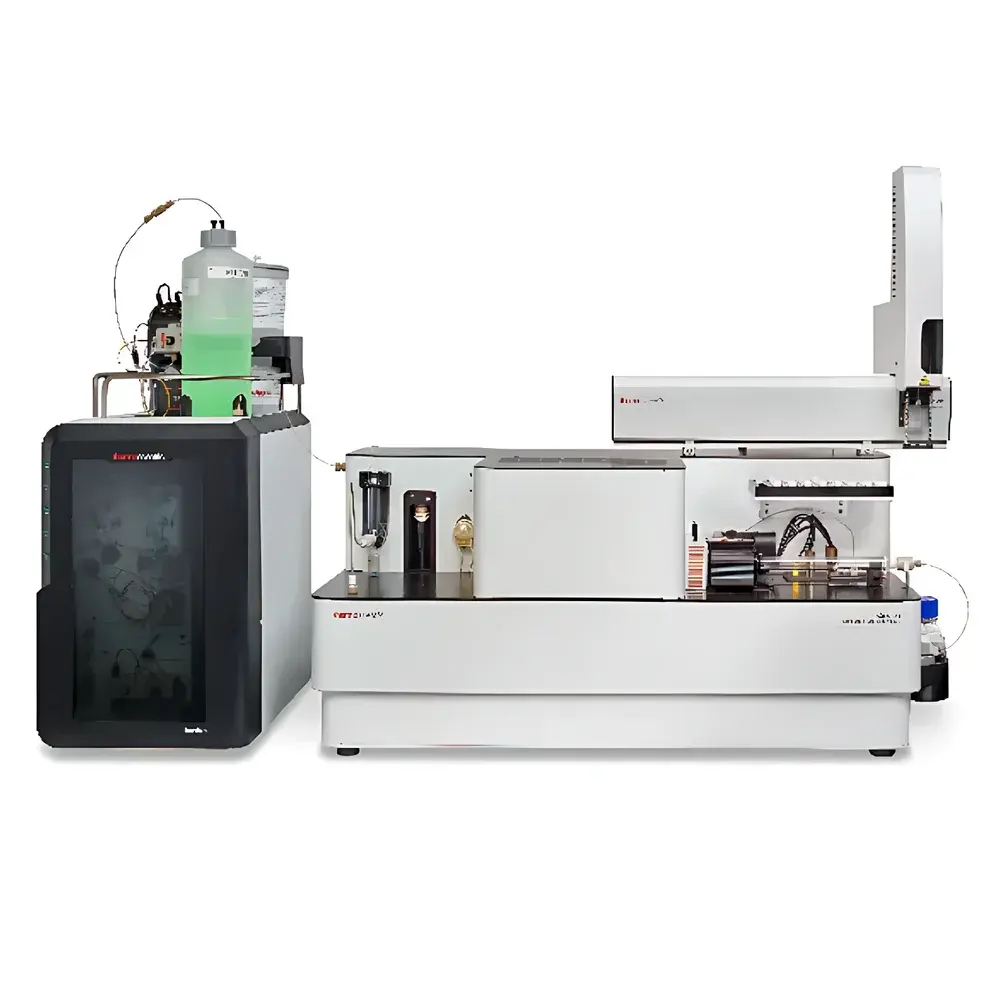
Thermo Fisher Cindion Combustion Ion Chromatography System
| Brand | Thermo Fisher |
|---|---|
| Origin | USA |
| Manufacturer Type | Manufacturer |
| Origin Category | Imported |
| Model | Thermo Fisher Cindion Combustion Ion Chromatography System |
| Price | Upon Request |
| Instrument Type | Laboratory |
| Application Scope | General-Purpose |
| Flow Rate Range | 100–500 mL/min |
| Maximum Operating Pressure | 30–45 psi |
| Operating Temperature Range | 500–1200 °C |
Overview
The Thermo Fisher Cindion Combustion Ion Chromatography (C-IC) System is a fully integrated, high-fidelity analytical platform engineered for the quantitative and qualitative determination of halogens (F⁻, Cl⁻, Br⁻, I⁻) and sulfur species (SO₄²⁻, SO₃²⁻) in complex organic matrices. Unlike conventional ion chromatography, the Cindion system couples high-temperature oxidative combustion (500–1200 °C) with post-combustion absorption and ion chromatographic separation—enabling trace-level detection of total halogen and sulfur content without matrix interference. This principle aligns with standardized combustion-based methodologies such as ASTM D7359 (for total fluorine, chlorine, and sulfur in aromatic hydrocarbons), ASTM D7536 (for organochlorine compounds), and ISO 17353 (for halogen determination in plastics). The system is designed for laboratories requiring regulatory-grade compliance, method robustness, and reproducible quantification across diverse sample types—including polymers, pharmaceutical excipients, electronic materials, lubricants, and environmental solids.
Key Features
- PFAS-conscious fluidic architecture: All wetted components—including combustion tubes, absorption vessels, transfer lines, and IC flow paths—are constructed from PFAS-free materials (e.g., high-purity quartz, inert ceramics, and PFA-free stainless steel alloys), minimizing background contamination and enabling sub-part-per-trillion (ppt) detection limits for halogens.
- Integrated electrolytic suppression and Reagent-Free Ion Chromatography (RFIC™): On-demand generation of high-purity eluents (e.g., KOH or methanesulfonic acid gradients) via electrochemical membrane suppression ensures long-term baseline stability, reduced carryover, and elimination of manual eluent preparation.
- Automated combustion workflow: Programmable temperature ramping (500–1200 °C), precise oxygen flow control (100–500 mL/min), and real-time pressure monitoring (30–45 psi max) ensure complete oxidation of refractory organohalides and sulfonates—even in thermally stable matrices such as polytetrafluoroethylene (PTFE) or sulfonyl-containing APIs.
- Modular detector compatibility: Supports conductivity detection (with digital signal processing), suppressed conductivity, and optional UV/Vis or mass spectrometric detection for speciation confirmation when coupled to orthogonal systems.
- Regulatory-ready hardware design: Complies with mechanical and electrical safety standards (UL/CSA 61010-1), includes NIST-traceable calibration protocols, and supports audit trails aligned with FDA 21 CFR Part 11 and EU Annex 11 requirements.
Sample Compatibility & Compliance
The Cindion system accommodates solid, liquid, and viscous samples—including powders, films, resins, oils, and slurries—via programmable autosampler injection (0.1–100 mg solid or 1–100 µL liquid). Sample introduction is compatible with quartz boat, ceramic crucible, and microcombustion capsule formats. The system meets critical industry compliance frameworks: ASTM D7359 and D7536 for petrochemicals; IEC 61249-2-21 and IPC TM-650 2.3.35 for halogen-free electronics; USP / for elemental impurities in pharmaceuticals; and RoHS 2.0 Annex II restrictions on Br/Cl content. All combustion and IC modules are validated per GLP/GMP guidelines, with documented IQ/OQ/PQ protocols available.
Software & Data Management
ChromQuest™ C-IC Edition software provides end-to-end workflow control—from method setup and combustion parameter scheduling to peak integration, speciation mapping, and report generation. Built-in tools support multi-point calibration curves (linear/nonlinear), internal standard correction (e.g., using ⁸¹Br or ³⁴S isotopic spikes), and automated pass/fail evaluation against user-defined specification limits. Data files adhere to ASTM E1985 and ASTM E2524 metadata standards, and raw data archives include full instrument state logs, pressure/temperature profiles, and suppression current traces—ensuring full traceability for regulatory submissions and internal audits.
Applications
- Halogen screening in polymer manufacturing to verify RoHS/REACH compliance and prevent catalyst poisoning during recycling.
- Quantitative sulfur analysis in jet fuels and lubricants per ASTM D5453 and D2622.
- PFAS precursor identification and total oxidizable precursor (TOP) assay development in environmental soil and water extracts.
- Residual halogen quantification in active pharmaceutical ingredients (APIs) and drug product intermediates per ICH Q3D guidance.
- Failure analysis of printed circuit boards (PCBs) where chloride-induced electrochemical migration causes field failures.
FAQ
What sample types require pre-treatment prior to Cindion analysis?
Solid samples with high carbon load (>50% w/w) may require dilution with inert filler (e.g., quartz wool) to ensure complete combustion; viscous liquids should be spiked into low-volatility carriers (e.g., glycerol) to avoid splattering.
Can the system quantify individual organohalide species (e.g., chlorobenzene vs. chloroform)?
No—the Cindion system measures total halogen/sulfur content after combustion. For molecular speciation, coupling with GC-MS or LC-MS/MS prior to combustion is recommended.
Is the RFIC eluent generator compatible with carbonate/bicarbonate eluents?
Yes—electrolytic generation of Na₂CO₃/NaHCO₃ gradients is supported for high-capacity anion separation, including polyhalogenated carboxylates.
How often must the combustion tube be replaced?
Under routine use (≤10 samples/day), quartz combustion tubes last ≥6 months; lifetime is extended by avoiding samples with high metal ash content (e.g., pigments, catalysts).
Does the system support 21 CFR Part 11-compliant electronic signatures?
Yes—ChromQuest C-IC Edition includes role-based access control, biometric or PKI-enabled e-signature workflows, and immutable audit trail export in PDF/A-2 format.




