
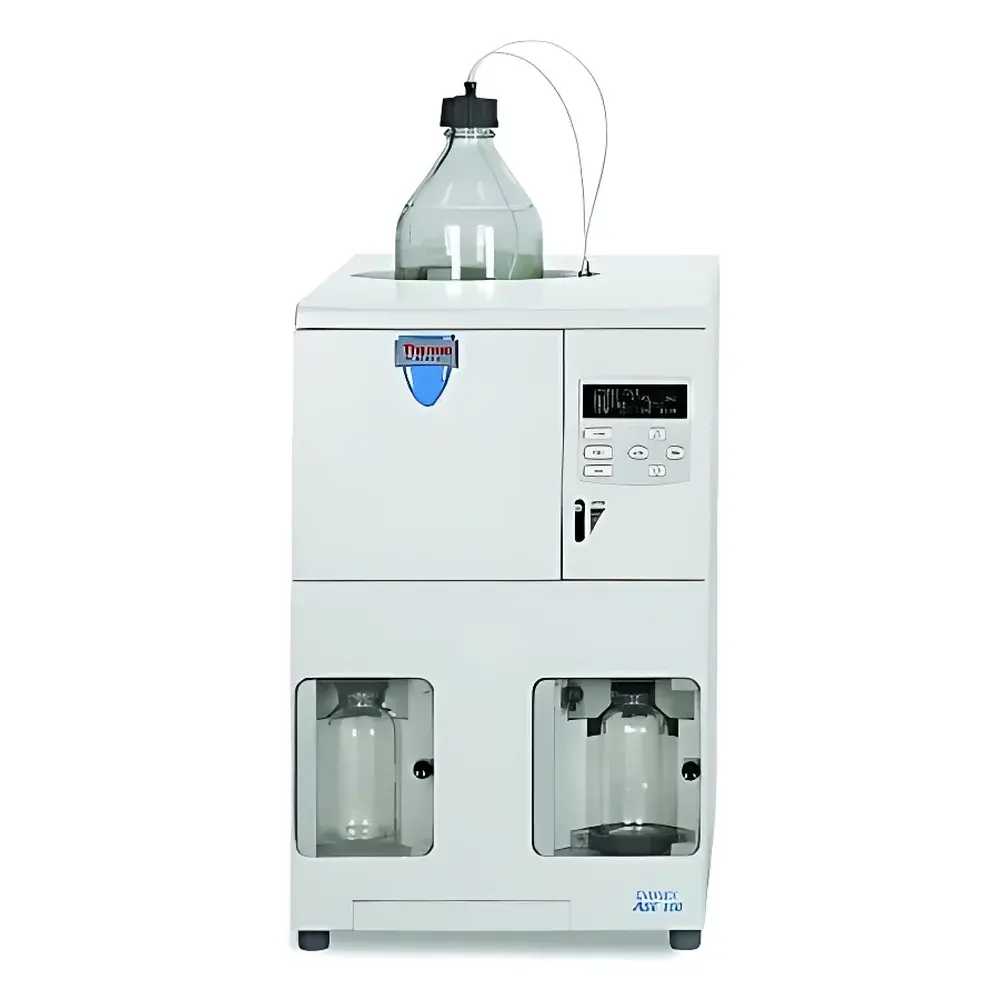
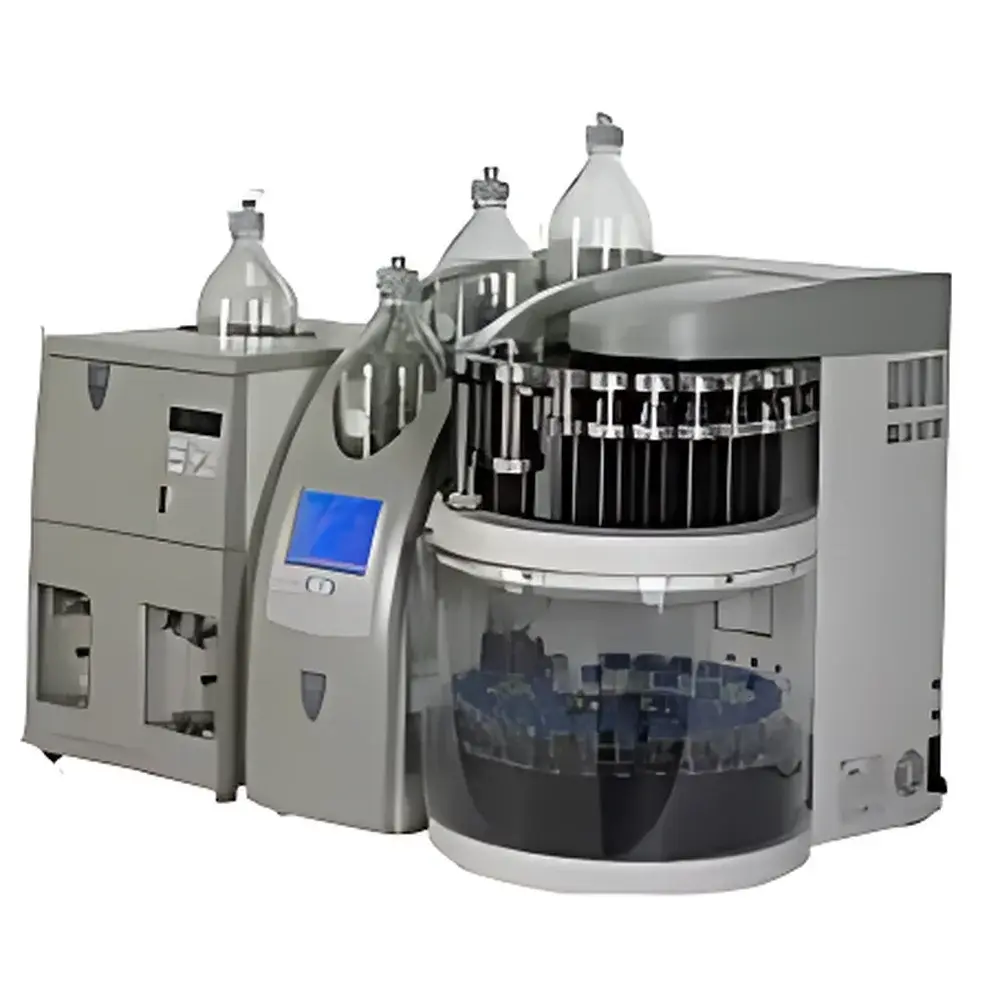
Thermo Fisher Dionex ASE 150 Accelerated Solvent Extractor
| Brand | Thermo Fisher |
|---|---|
| Origin | USA |
| Manufacturer Type | Original Equipment Manufacturer (OEM) |
| Origin Category | Imported |
| Model | ASE 150 |
| Instrument Type | Solid-Phase Extraction System (ASE) |
| Operating Temperature Range | Up to 200 °C |
| Maximum Pressure | 1500 psi |
| Pump Flow Rate | 70 mL/min |
| Sample Capacity | 1–100 g |
| Extraction Cell Volumes | 1, 5, 10, 22, 34, 66, and 100 mL |
| Solvent Consumption Reduction | 50–90% vs. Soxhlet or Ultrasonic Extraction |
| Fluid Path Material | Dionium™ (chemically inert, acid- and base-resistant) |
| Integrated Filtration | On-line filtration and in-cell cleaning capability |
Overview
The Thermo Fisher Dionex ASE 150 Accelerated Solvent Extractor is an automated solid-phase extraction platform engineered for precision, reproducibility, and regulatory compliance in analytical laboratories. It employs accelerated solvent extraction (ASE®) technology—a pressurized, elevated-temperature technique grounded in thermodynamic solubility enhancement and mass transfer acceleration. By applying controlled pressure (up to 1500 psi) and programmable heating (up to 200 °C), the ASE 150 rapidly disrupts matrix–analyte interactions, significantly increasing analyte solubility while minimizing thermal degradation. Unlike conventional Soxhlet or ultrasonic methods, ASE operates under sealed-cell conditions, eliminating solvent evaporation losses and enabling quantitative recovery of volatile, semi-volatile, and thermally labile compounds—including PAHs, PCBs, pesticides, pharmaceutical residues, and environmental contaminants—from complex solid and semi-solid matrices (e.g., soil, sediment, tissue, sludge, polymer, and food).
Key Features
- Automated, walk-away operation for single-sample extraction, filtration, and cell rinsing—reducing manual intervention and inter-operator variability.
- Seven interchangeable extraction cell sizes (1, 5, 10, 22, 34, 66, and 100 mL) accommodate sample masses from 1 g to 100 g, supporting method scalability from screening to validation.
- Dionium™-lined fluid path ensures chemical inertness across pH 0–14, permitting direct use of aggressive solvents (e.g., HCl-methanol, NaOH-acetonitrile) without corrosion or leaching—critical for acidic soils, alkaline pharmaceutical powders, or oxidizing environmental digests.
- High-speed solvent delivery (70 mL/min) combined with precise oven temperature control (±1 °C stability) delivers consistent extraction kinetics and high method reproducibility (RSD < 5% for replicate extractions).
- On-line filtration via fritted stainless-steel filters and integrated cell-flushing cycles minimize cross-contamination and eliminate manual filter replacement between runs.
- Reduced solvent consumption—typically <50 mL per 20 g sample—lowers operational costs, waste disposal burden, and exposure risk, aligning with green chemistry principles (EPA Method 3545A, ASTM D7689).
Sample Compatibility & Compliance
The ASE 150 is validated for use with heterogeneous, high-fat, high-humid, and particulate-laden samples including agricultural soils, municipal biosolids, animal tissues, herbal matrices, and industrial polymers. Its robust architecture supports method development compliant with U.S. EPA SW-846 Methods 3545A (Accelerated Solvent Extraction) and 3546 (Microwave-Assisted Extraction), as well as ISO 14507 (Soil quality — Determination of polycyclic aromatic hydrocarbons), and EN 16630 (Soil characterization — Extraction of organic compounds). The system’s hardware design and firmware architecture are compatible with laboratory-wide GLP/GMP documentation workflows; when paired with LIMS-integrated data systems, it supports audit trails, electronic signatures, and 21 CFR Part 11–compliant record retention.
Software & Data Management
Controlled via Thermo Scientific Chromeleon™ CDS or standalone ASE Console software, the ASE 150 enables method storage, sequence scheduling, real-time pressure/temperature monitoring, and event logging. All method parameters—including static time, flush volume, purge time, and number of cycles—are fully programmable and exportable in CSV or XML format. Audit-ready reports include timestamped run logs, calibration verification records, and error codes traceable to specific extraction cells and solvent batches. Optional integration with Thermo Fisher’s SampleManager LIMS allows automatic ingestion of extraction metadata into sample lifecycle tracking pipelines.
Applications
- Environmental analysis: Extraction of organochlorine pesticides, dioxins/furans, and petroleum hydrocarbons from contaminated soils and sediments.
- Food safety: Recovery of mycotoxins (e.g., aflatoxin B1), veterinary drug residues, and plasticizers (e.g., phthalates) from cereals, meat, and packaging materials.
- Pharmaceutical QC: Isolation of active pharmaceutical ingredients (APIs) and genotoxic impurities from excipient-rich formulations prior to HPLC-MS/MS quantification.
- Forensic toxicology: Efficient isolation of synthetic cannabinoids and novel psychoactive substances (NPS) from hair and biological tissues.
- Materials science: Leachate analysis of flame retardants (e.g., PBDEs) and stabilizers from recycled plastics and composites.
FAQ
What sample types are compatible with the ASE 150?
Solid and semi-solid matrices including soils, sediments, sludges, plant tissues, animal tissues, food products, polymers, and pharmaceutical tablets—provided they can be homogenized and loaded into standard ASE cells.
Can the ASE 150 be used for method development under GLP or ISO 17025?
Yes—the instrument’s deterministic operation, full parameter logging, and compatibility with electronic signature-capable software support formal validation protocols required by GLP, ISO/IEC 17025, and FDA-regulated environments.
Is ASE 150 compatible with downstream concentration systems?
Yes—its standardized eluate volume and solvent composition are optimized for seamless integration with Thermo Scientific Rocket Evaporator, TurboVap®, or other nitrogen-based concentrators meeting EPA Method 3545A workflow requirements.
How does ASE compare to microwave-assisted extraction (MAE) for thermally sensitive analytes?
ASE applies uniform conductive heating and maintains sub-boiling solvent conditions under pressure, avoiding localized superheating and hot-spot formation common in MAE—resulting in higher recovery of thermally labile compounds such as certain antibiotics and prostaglandins.
What maintenance is required to ensure long-term performance?
Routine maintenance includes quarterly verification of pressure transducer calibration, biannual replacement of O-rings and frits, and annual inspection of pump seals and oven insulation—all documented in the instrument’s built-in service log and supported by Thermo Fisher Field Service Engineers globally.



