
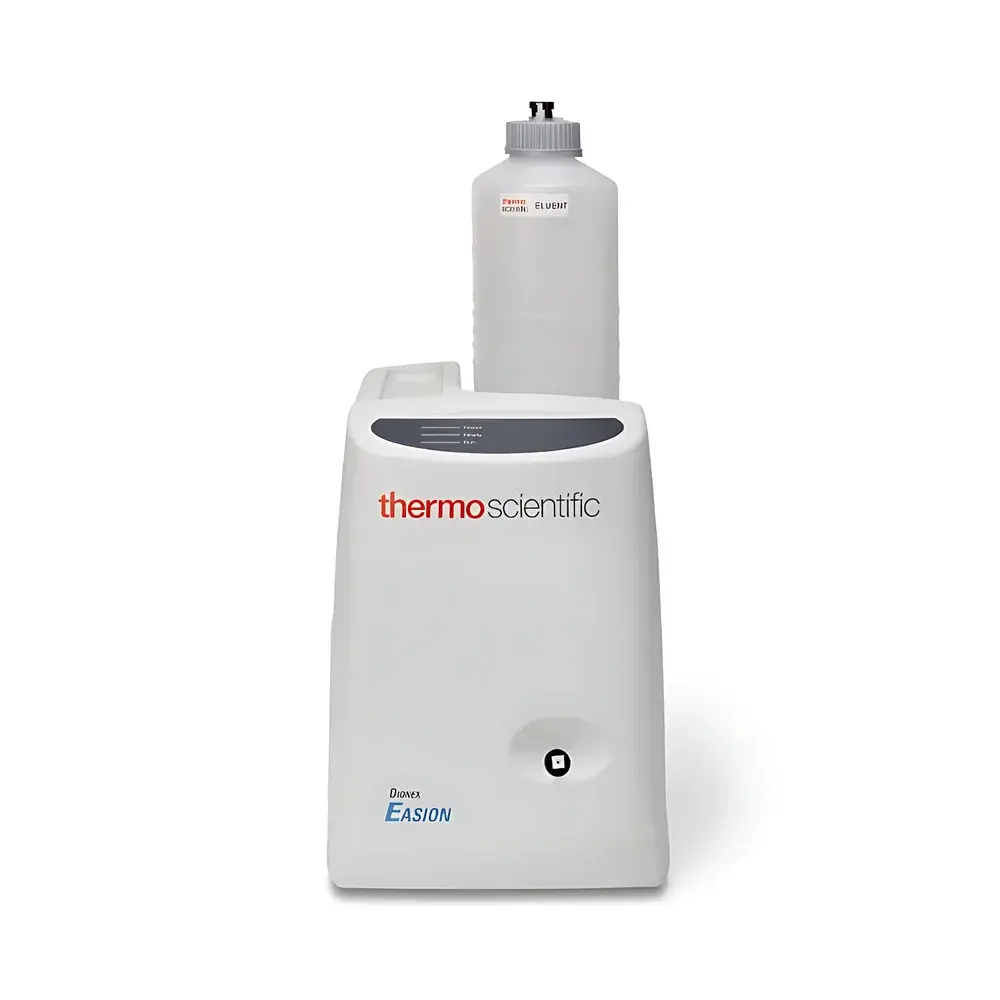
Thermo Fisher Dionex Easion Ion Chromatography System
| Brand | Thermo Fisher |
|---|---|
| Origin | Jiangsu, China |
| Manufacturer Type | Original Equipment Manufacturer (OEM) |
| Regional Classification | Domestic (PRC-manufactured) |
| Model | Dionex Easion Ion Chromatography System |
| Instrument Type | Laboratory Benchtop IC System |
| Application Scope | General-Purpose Anion/Cation Analysis |
| Pump Pressure Range | 0–35 MPa |
| Flow Rate Range | 0.00–5.00 mL/min (single-pump-head design) |
| Maximum Operating Pressure | 10 MPa |
Overview
The Thermo Fisher Dionex Easion Ion Chromatography System is a compact, integrated, isocratic dual-piston ion chromatograph engineered for routine anion and cation analysis in regulated and non-regulated laboratory environments. It operates on the fundamental principle of ion exchange chromatography—where analyte ions are separated on a high-capacity, low-backpressure ion-exchange column based on their charge density, hydrated radius, and affinity for functionalized stationary phases. The system employs suppressed conductivity detection, leveraging a membrane-based chemical suppressor to convert high-conductivity eluent ions into low-conductivity species (e.g., H2O from KOH or HNO3), thereby amplifying analyte signal-to-noise ratio and enabling sub-ppb detection sensitivity for common inorganic anions (F−, Cl−, NO2−, Br−, NO3−, PO43−, SO42−) and cations (Li+, Na+, NH4+, K+, Mg2+, Ca2+). Designed for robustness and operational simplicity, the Easion IC system features full PEEK (polyether ether ketone) fluidic pathways—including pump heads, valves, tubing, and detector cells—to ensure long-term compatibility with aggressive eluents (e.g., KOH, methanesulfonic acid) and eliminate metal-induced contamination or catalytic degradation of labile species.
Key Features
- Integrated dual-piston PEEK pump with pressure capability up to 35 MPa and stable flow delivery across 0.00–5.00 mL/min—no pump head swapping required for method changes.
- Pre-configured, application-ready IC starter kits including analytical column, electrolytic membrane suppressor, eluent concentrate, and regenerant solution—enabling system commissioning within ~90 minutes.
- Chemically inert, all-PEEK fluidic architecture ensuring compatibility with strong alkaline (KOH) and acidic (MSA) eluents and preventing leaching or adsorption artifacts.
- Modular design with front-accessible components (pump, suppressor, detector, injector) facilitating rapid maintenance and minimizing instrument downtime.
- Native compatibility with Thermo Scientific Dionex AS-DV and AS-AP autosamplers—AS-DV provides programmable sample filtration, dilution, and multi-loop injection for unattended operation.
Sample Compatibility & Compliance
The Dionex Eason IC System supports aqueous samples across diverse matrices—including drinking water, wastewater, pharmaceutical excipients, food extracts, and battery electrolytes—provided they are filtered (≤0.22 µm) and free of particulates or high-molecular-weight organics that could foul the column or suppressor. Its hardware and software architecture align with foundational regulatory expectations for data integrity and traceability: the Chromeleon CDS supports user-level access control, electronic signatures, audit trails per FDA 21 CFR Part 11, and GLP/GMP-compliant reporting workflows. While not pre-certified for specific pharmacopeial methods, the system meets instrumental performance criteria outlined in ISO 10304-1 (water quality—determination of dissolved anions), ASTM D4327 (anion analysis in water), and USP (conductivity of purified water).
Software & Data Management
The system ships with Thermo Scientific Chromeleon Chromatography Data System (CDS) v7.3 or later—a client-server platform supporting centralized method deployment, remote instrument monitoring, and role-based permissions. Chromeleon enables sequence-driven acquisition, peak integration using customizable baselines and retention time windows, and automated report generation compliant with ISO/IEC 17025 documentation requirements. Built-in electronic logbooks record all method modifications, calibration events, and system suitability tests. Data files (.cdf) are stored in a relational database with version-controlled backups, and raw data remain immutable post-acquisition—ensuring forensic audit readiness.
Applications
- Environmental monitoring: Quantification of regulated anions in EPA Method 300.1 (drinking water) and Method 317.1 (low-level anions).
- Pharmaceutical quality control: Testing for residual chloride, acetate, or sulfate counterions in APIs and sterile injectables per ICH Q5C and USP general chapters.
- Food & beverage safety: Nitrate/nitrite profiling in processed meats and dairy products; bromide and iodide analysis in infant formula.
- Electrochemical materials: Trace anion impurity screening (F−, Cl−, SO42−) in lithium-ion battery electrolytes per ASTM D7232.
- Industrial process water: Monitoring of corrosion inhibitors (e.g., molybdate, silicate) and scaling ions (Ca2+, Mg2+, SO42−) in boiler feedwater and cooling circuits.
FAQ
Is the Dionex Easion IC system suitable for gradient elution?
No—it is configured exclusively for isocratic operation. Gradient capability requires upgrade to the Dionex ICS-6000 or ICS-5000+ platforms.
What suppressor technology does it use?
It includes a membrane-based electrolytic chemical suppressor (e.g., SRS 300 or AERS 500), eliminating the need for external regenerant solutions and providing stable baseline performance over extended run times.
Can it be validated for GxP environments?
Yes—when deployed with Chromeleon CDS in validated configuration (including IQ/OQ/PQ protocols, change control, and periodic requalification), it supports compliance with FDA 21 CFR Part 11, EU Annex 11, and ISO/IEC 17025 requirements.
What column chemistries are supported out-of-the-box?
Standard configurations include Thermo Scientific Dionex IonPac AS23 (for oxyhalides and halides) and CS12A (for alkali and alkaline earth metals); additional columns can be installed without hardware modification.
Does it support conductivity detection only, or are other detectors available?
The base system integrates a high-sensitivity, temperature-stabilized conductivity detector. UV/Vis and mass spectrometric detection require external interfacing and are not natively supported.





