
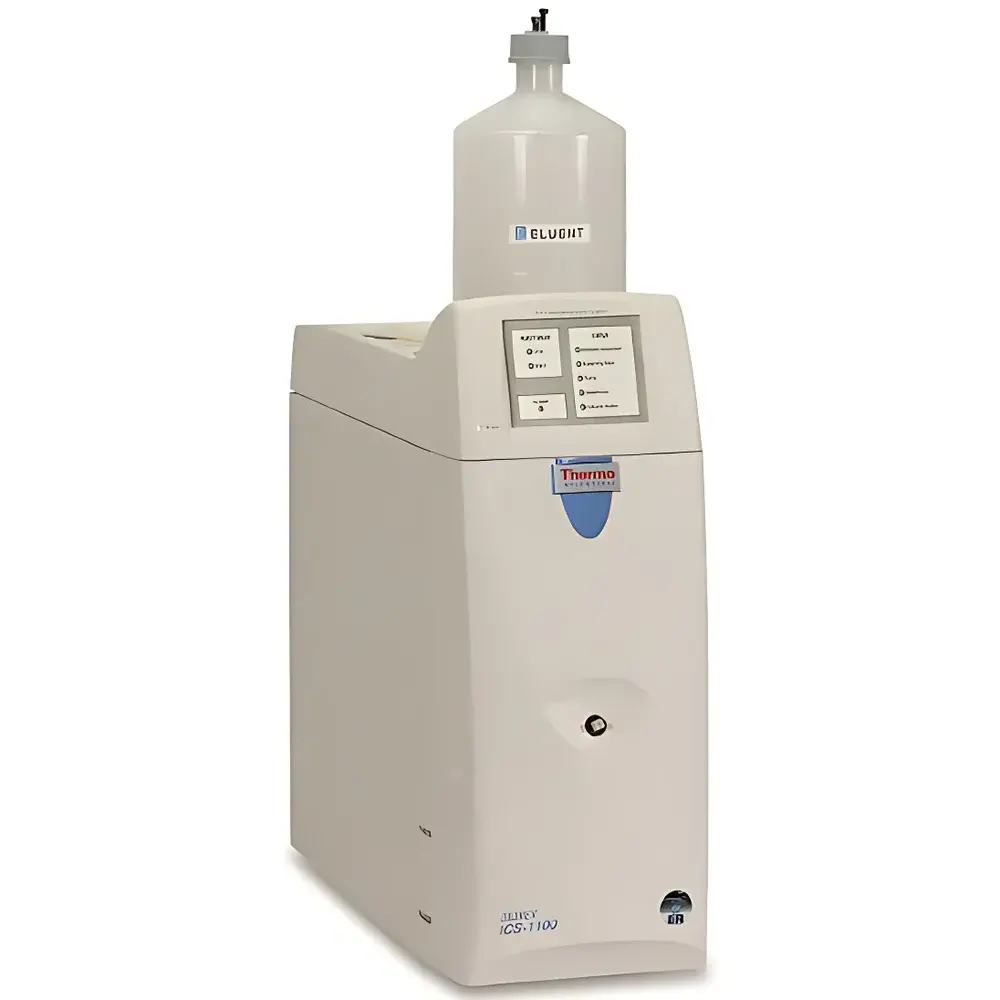
Thermo Fisher Dionex ICS-1100 Ion Chromatography System
| Brand | Thermo Fisher |
|---|---|
| Origin | USA |
| Manufacturer Type | Original Equipment Manufacturer (OEM) |
| Product Origin | Imported |
| Model | ICS-1100 |
| Instrument Type | Laboratory Benchtop System |
| Maximum Pump Pressure | 6000 psi |
| Operating Pressure Range | Up to 5000 psi |
| Column Oven Temperature Range | 4–40 °C |
| Eluent Concentration Range | 0–100 mM (KOH), adjustable per eluent chemistry |
Overview
The Thermo Fisher Dionex ICS-1100 Ion Chromatography System is a high-performance, modular benchtop instrument engineered for precise, reproducible anion and cation analysis in regulated and research laboratories. Based on suppressed conductivity detection and robust eluent generation architecture, the ICS-1100 operates on the fundamental principles of ion exchange chromatography—where analyte ions are separated on high-capacity, chemically stable stationary phases under controlled eluent ionic strength and pH. Its design centers on Thermo Fisher’s proprietary Reagent-Free Ion Chromatography (RFIC™) technology, eliminating manual eluent preparation and enabling long-term unattended operation. The system integrates dual-piston PEEK-compatible high-pressure pumping, digitally stabilized electrochemical suppression, and thermally regulated column compartmenting to ensure retention time stability, baseline integrity, and quantitative accuracy across diverse sample matrices—from environmental waters and pharmaceutical excipients to food extracts and semiconductor process chemicals.
Key Features
- RFIC-enabled operation: Supports both isocratic and gradient elution via optional RFC-30 Electrolytic Eluent Generator—producing KOH, NaOH, MSA, or carbonate/bicarbonate eluents from deionized water only.
- High-pressure dual-piston pump: Delivers pulse-free flow with <0.1% RSD over 0.1–5.0 mL/min; fully PEEK-wetted path ensures compatibility with acidic, basic, and organic-modified eluents (e.g., methanol up to 25%).
- Precision column oven: Maintains temperature stability within ±0.2 °C across 4–40 °C range; minimizes retention drift and backpressure fluctuations during extended runs.
- AutoSuppression® electrolytic micro-membrane suppressor: Zero chemical regeneration required; achieves >99.9% suppression efficiency with rapid equilibration (100 µeq), and resistance to particulate fouling.
- Digital conductivity cell: Low-dead-volume (1.1 µL), thermostatically controlled cell with real-time temperature compensation and automatic range switching (0.01–15,000 µS/cm) for simultaneous trace and major ion quantification.
- Integrated eluent regeneration: Optional RFIC-ER module enables continuous 28-day operation without eluent replenishment—ideal for routine QC labs requiring minimal intervention and consistent calibration validity.
Sample Compatibility & Compliance
The ICS-1100 accommodates aqueous samples with total dissolved solids (TDS) ≤100 ppm and particulate load <0.45 µm (pre-filtered). It supports direct injection of drinking water, wastewater, acid digests, biological fluids, and leachates—especially when coupled with the AS-DV autosampler’s integrated 0.2 µm inline filtration and valve-switched online preconcentration. Method validation complies with ASTM D4327 (anions in water), ISO 14911 (cation analysis), USP , and EPA Methods 300.0, 300.1, and 317.0. All hardware and software components meet IEC 61000-4 electromagnetic compatibility standards; data acquisition and audit trails conform to FDA 21 CFR Part 11 requirements when used with compliant Chameleon Software configurations.
Software & Data Management
Controlled exclusively by Thermo Scientific™ Chromeleon™ Chromatography Data System (CDS) v7.3 or later, the ICS-1100 provides full instrument diagnostics, method development wizards, peak integration with customizable baselines, and automated system suitability testing (SST). Chromeleon supports multi-user role-based access control, electronic signatures, and secure database archiving. Raw data files (.cdf) are stored with embedded metadata—including pressure logs, temperature profiles, and suppression current traces—for full traceability. Batch processing, report templating (PDF/Excel), and LIMS integration via ASTM E1394 or OPC UA protocols ensure seamless alignment with GLP/GMP workflows.
Applications
- Environmental monitoring: Quantification of F⁻, Cl⁻, NO₂⁻, Br⁻, NO₃⁻, PO₄³⁻, SO₄²⁻, and AsO₄³⁻ in surface, ground, and drinking water per EPA compliance mandates.
- Pharmaceutical quality control: Counter-ion profiling (Na⁺, K⁺, Ca²⁺, Mg²⁺, acetate, citrate) in APIs and injectables; residual chloride/sulfate testing in lyophilized products.
- Food & beverage safety: Nitrate/nitrite in cured meats; phosphate additives in dairy; sulfite preservatives in wines; bromate in baked goods.
- Electronics-grade chemical analysis: Trace anions (Cl⁻, SO₄²⁻, NO₃⁻) in ultrapure water and photoresist solvents at sub-pptr levels.
- Academic & method development labs: Platform for developing novel eluent gradients, column selectivity screening, and coupling with IC-ICP-MS interfaces.
FAQ
Does the ICS-1100 require external gas supply or chemical regenerants for suppression?
No. The AutoSuppression® electrolytic suppressor uses on-board electrolysis to regenerate the suppression membrane continuously—no external acids, bases, or gas cylinders are needed.
Can the system run overnight without operator intervention?
Yes. With RFIC-ER installed and calibrated, the ICS-1100 sustains uninterrupted analysis for up to 28 days using a single eluent reservoir and one initial calibration curve.
Is Chromeleon software validated for 21 CFR Part 11 compliance?
Chromeleon CDS v7.3+ includes configurable audit trail, electronic signature, and user permission modules—fully deployable in validated environments when implemented per Thermo Fisher’s IQ/OQ/PQ documentation packages.
What column chemistries are supported?
All Thermo Fisher Dionex™ high-capacity columns—including IonPac™ AS23, AS26, CS19, CS20—and legacy columns with compatible 4 mm or 2 mm ID formats and standard 10-32 threaded fittings.
How does the RFC-30 generator improve detection limits?
By eliminating batch-to-batch eluent variability and reducing background conductivity through ultra-high-purity water-derived eluents, RFC-30 lowers baseline noise by up to 40% versus manually prepared solutions—enhancing signal-to-noise ratio and method LODs.




