
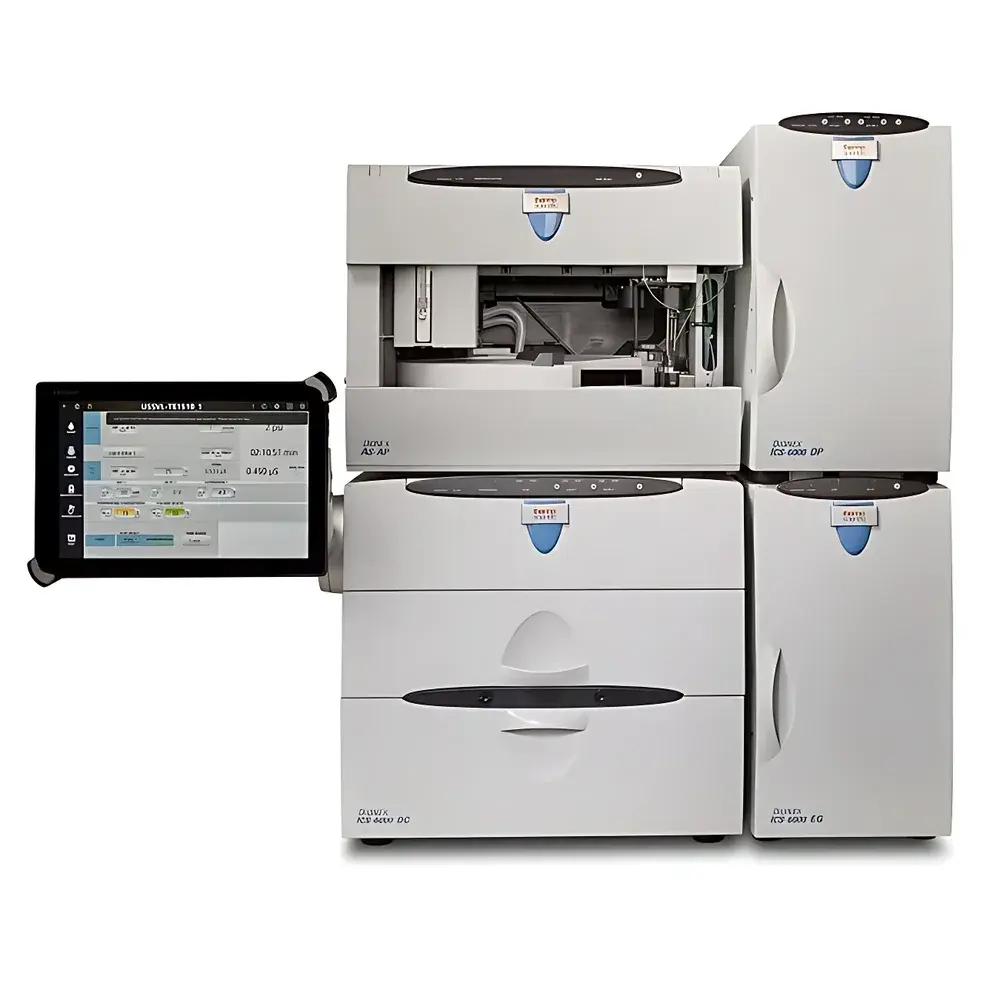
Thermo Fisher Dionex ICS-6000 High-Pressure Ion Chromatography System
| Brand | Thermo Fisher |
|---|---|
| Origin | USA |
| Manufacturer Type | Original Equipment Manufacturer (OEM) |
| Product Category | Imported Instrument |
| Model | ICS-6000 |
| Pump Pressure Rating | 6000 psi |
| Flow Rate Range | 0.001–22.4 mL/min |
| Eluent Flow Rate Range | 0.001–22.4 mL/min |
| Maximum Operating Pressure | 10 MPa |
| Operating Temperature Range | 10°C–70°C |
| Temperature Reproducibility | ±0.05°C |
| Eluent Concentration Range | 0.1–200 mM |
Overview
The Thermo Fisher Dionex ICS-6000 High-Pressure Ion Chromatography System is an engineered platform for high-resolution, high-sensitivity anion and cation analysis in demanding laboratory environments. Built upon suppressed conductivity detection and Reagent-Free Ion Chromatography (RFIC™) architecture, the ICS-6000 leverages electrochemical eluent generation to eliminate manual preparation of chemical eluents—reducing variability, improving baseline stability, and enhancing long-term reproducibility. Its high-pressure capability (up to 10 MPa / 6000 psi) enables use of sub-5 µm particle-packed columns—including the proprietary 4 µm Dionex IonPac™ columns—supporting faster separations without sacrificing resolution. The system operates across a wide temperature range (10–70°C) with thermal control precision of ±0.05°C, critical for retention time stability in regulated workflows such as environmental monitoring, pharmaceutical impurity profiling, and food safety testing.
Key Features
- High-pressure dual-pump configuration (Standard Pump SP or Dual Pump DP) delivering precise flow control from 0.001 to 22.4 mL/min with <0.1% RSD flow precision—essential for gradient robustness and method transferability.
- Dionex EG (Eluent Generator) module enabling on-demand, electrolytically generated eluents at concentrations spanning 0.1–200 mM; eliminates batch-to-batch eluent variability and supports isocratic or multi-step electrolytic gradients.
- Integrated column compartment with active temperature control (10–70°C), ensuring retention time reproducibility ≤0.05% RSD over 24-hour runs—validated per ASTM D4327 and ISO 14911 requirements.
- Modular architecture supporting analytical-scale (1–3 mm i.d.) and capillary-scale (0.4–0.5 mm i.d.) configurations, with full compatibility with Thermo Scientific™ Dionex™ IonPac™ standard-bore, microbore, and capillary columns.
- RFIC-enabled auto-samplers (AS-AP, AS-DV, or CAP series) with programmable needle wash, dilution, and derivatization capabilities—designed for unattended operation under GLP/GMP-compliant audit trails.
Sample Compatibility & Compliance
The ICS-6000 accommodates aqueous matrices including drinking water, wastewater, biological fluids (serum, urine), food extracts, and pharmaceutical formulations. It complies with key regulatory frameworks including EPA Methods 300.0, 300.1, and 317.0 for anion analysis; USP for water conductivity testing; and ISO/IEC 17025 requirements for accredited laboratories. All hardware modules meet IEC 61000-4 electromagnetic compatibility standards, and the system supports 21 CFR Part 11–compliant electronic records and signatures when deployed with Chromeleon 7.3 or later in validated environments.
Software & Data Management
Controlled exclusively via Thermo Scientific™ Dionex™ Chromeleon™ Chromatography Data System (CDS) v7.3+, the ICS-6000 integrates method development, acquisition, processing, reporting, and audit trail management within a single validated software environment. Chromeleon supports multi-user role-based access control, electronic signature workflows, and automated report generation compliant with ALCOA+ principles (Attributable, Legible, Contemporaneous, Original, Accurate, Complete, Consistent, Enduring, Available). Raw data files (.cdf) are stored in vendor-neutral formats compatible with third-party statistical packages and LIMS interfaces via OPC UA or ODBC protocols.
Applications
- Environmental: Quantification of trace anions (F⁻, Cl⁻, NO₂⁻, Br⁻, NO₃⁻, PO₄³⁻, SO₄²⁻) and cations (Li⁺, Na⁺, NH₄⁺, K⁺, Mg²⁺, Ca²⁺) in surface water, groundwater, and industrial effluents per EPA and ISO standards.
- Pharmaceutical: Counter-ion analysis in APIs, residual acetate/formate in biologics, and organic acid profiling in fermentation broths under ICH Q5 and Q6 guidelines.
- Food & Beverage: Nitrate/nitrite monitoring in processed meats, sulfite determination in wines, and phosphate additives in dairy products per FDA and EFSA regulations.
- Power Generation: Chloride and sulfate detection in ultrapure boiler feedwater to prevent corrosion—aligned with ASTM D4582 and VGB-R 450-L guidelines.
- Academic Research: Speciation analysis of transition metals (e.g., Cr(III)/Cr(VI)) using post-column reaction with UV/Vis or ICP-MS coupling.
FAQ
What column formats are supported by the ICS-6000?
It supports analytical columns (1–3 mm i.d.), microbore columns (3–7 mm i.d.), and capillary columns (0.4–0.5 mm i.d.), including all Dionex IonPac™ 4 µm particle columns (e.g., AS26, CS19, AS18-Fast).
Can the ICS-6000 be coupled to mass spectrometry?
Yes—via a dedicated interface module, it supports hyphenated analysis with ICP-MS for elemental speciation or ESI-MS for organic ion characterization, subject to flow-splitting and desolvation optimization.
Is Chromeleon CDS qualified for GxP environments?
Chromeleon 7.3+ is pre-validated for 21 CFR Part 11 compliance; site-specific IQ/OQ/PQ documentation and risk-based validation support are available through Thermo Fisher Scientific’s Professional Services group.
What maintenance intervals are recommended for the EG module?
The EG cartridge requires replacement every 6–12 months depending on usage frequency and eluent concentration; system diagnostics automatically log cartridge lifetime and trigger alerts prior to end-of-life.
Does the ICS-6000 support unattended overnight operation?
Yes—when configured with an AS-AP autosampler and temperature-controlled column oven, it supports up to 110 sample positions with integrated needle wash, dilution, and internal standard addition sequences.





