
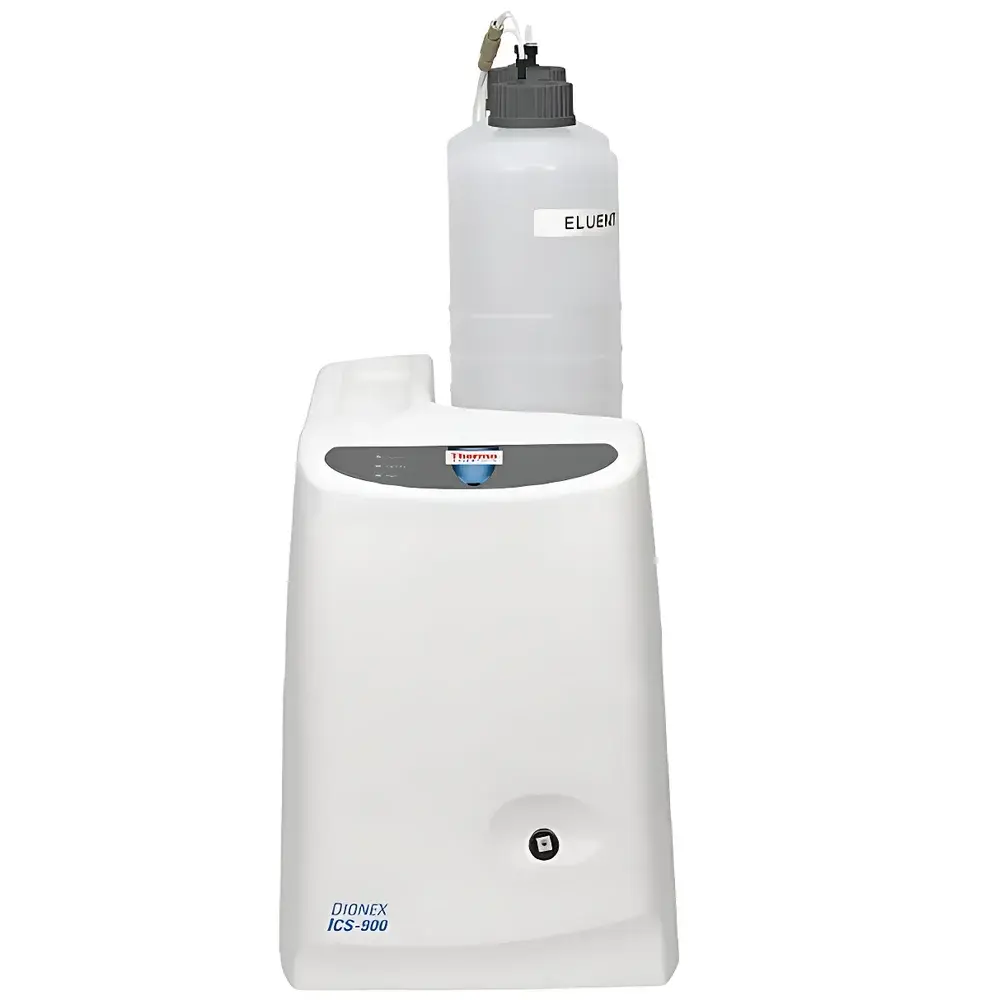
Thermo Fisher Dionex ICS-900 Starter Line Ion Chromatograph
| Brand | Thermo Fisher |
|---|---|
| Origin | USA |
| Manufacturer Type | Original Equipment Manufacturer (OEM) |
| Origin Category | Imported |
| Model | ICS-900 Starter Line IC System |
| Pump Pressure Rating | 6000 psi |
| Maximum Operating Pressure | 5000 psi |
| Operating Temperature Range | 4–40 °C |
| Eluent Concentration Range | 0–100 mM (KOH), dependent on eluent chemistry |
Overview
The Thermo Fisher Dionex ICS-900 Starter Line Ion Chromatograph is a compact, robust benchtop system engineered for routine anion and cation analysis in environmental, pharmaceutical, food & beverage, and industrial quality control laboratories. Based on suppressed conductivity detection and high-efficiency ion exchange chromatography, the ICS-900 employs a dual-piston isocratic pump, PEEK-fluidic architecture, and digital conductivity detection to deliver reproducible, low-noise quantification of inorganic and small organic ions—including F⁻, Cl⁻, NO₂⁻, Br⁻, NO₃⁻, PO₄³⁻, SO₄²⁻, Li⁺, Na⁺, NH₄⁺, K⁺, Mg²⁺, and Ca²⁺—in aqueous matrices. Its design reflects over four decades of Thermo Fisher’s leadership in ion chromatography innovation, beginning with the world’s first commercial membrane suppressor in 1975. The system operates under ambient or thermostatically controlled conditions (4–40 °C), enabling stable retention time alignment and baseline performance across diverse sample types and daily workloads.
Key Features
- Dual-piston isocratic pump with pulse-dampened flow delivery; flow rate range: 0.01–5.00 mL/min; pressure capability up to 5000 psi (345 bar); engineered for long-term stability and minimal maintenance.
- Digital conductivity detector with auto-ranging, temperature-compensated electronics and <1.0 nS resolution; optimized for low-drift operation and linear response over five orders of magnitude.
- MMS™ 300 MicroMembrane Suppressor utilizing Dual Continuous Regeneration (DCR) technology—eliminates chemical regenerant consumption, reduces baseline drift, and enables rapid equilibration (<15 min after startup).
- Full-PEEK fluidic path from pump inlet to detector cell—chemically inert across pH 0–14, compatible with strong acids, bases (e.g., KOH up to 100 mM), and organic modifiers (e.g., methanol, acetonitrile).
- USB 2.0 high-speed interface with plug-and-play recognition of Chromeleon CDS software, optional AS-DV autosampler, and auxiliary modules (e.g., electrolytic eluent generators, column ovens).
- Factory-installed IQ/OQ/PQ documentation package compliant with GLP, GMP, and FDA 21 CFR Part 11 requirements—includes traceable calibration certificates, system suitability test protocols, and audit-ready electronic records.
Sample Compatibility & Compliance
The ICS-900 accommodates direct injection of clarified aqueous samples (e.g., drinking water, wastewater, process streams, biological extracts, and dissolution media). When coupled with the optional AS-DV autosampler and Thermo Fisher’s SpectraChrome™ online pre-concentration or solid-phase extraction (SPE) cartridges, it supports automated dilution, filtration (via integrated filter-cap vials), matrix removal (e.g., humic acids, heavy metals), and trace-level enrichment (sub-ppb detection). All components meet ISO 9001-certified manufacturing standards. The system supports compliance with ASTM D4327 (anions in water), EPA Method 300.0/300.1 (drinking water), USP (conductivity of purified water), and ISO 14911 (determination of anions in soils and sediments).
Software & Data Management
Controlled exclusively via Thermo Fisher Chromeleon Chromatography Data System (CDS) 7.x or later, the ICS-900 provides full method development, sequence management, real-time monitoring, and report generation. Chromeleon supports 21 CFR Part 11-compliant user access levels, electronic signatures, audit trails (with timestamped event logging), and secure data archiving. Integration with LIMS is enabled through ODBC and XML export. Sequence-based instrument diagnostics—including pressure monitoring, leak detection, and suppressor efficiency trending—are logged automatically and can trigger alerts or shutdown protocols.
Applications
- Environmental monitoring: Quantification of regulated anions/cations in surface water, groundwater, and wastewater per EPA and EU directives.
- Pharmaceutical QC: Testing of counterions in APIs, residual chloride in injectables, and conductivity of Water for Injection (WFI) and Purified Water (PW).
- Food safety: Nitrate/nitrite in cured meats, sulfite in wines, phosphate additives in dairy products, and bromide in bakery flour.
- Power generation: Monitoring of chloride and sulfate in boiler feedwater and steam condensate to prevent corrosion and turbine fouling.
- Electronics manufacturing: Trace halide analysis in ultrapure rinse water and etchant solutions (e.g., TMAH).
FAQ
Does the ICS-900 support gradient elution?
No—the ICS-900 is configured as an isocratic system. Gradient capability requires upgrade to the ICS-5000+ or ICS-6000 platform with quaternary pump and eluent generator integration.
Can the MMS™ 300 suppressor be used for both anion and cation analysis?
The MMS™ 300 is designed specifically for anion analysis. For cation applications, the system supports the CSRS™ 300 or ERS™ 500 series electrolytic cation suppressors, which are fully compatible with the same hardware interface and Chromeleon control logic.
Is post-run column regeneration required?
No—Thermo Fisher’s high-capacity, self-regenerating suppressors eliminate the need for manual regeneration cycles. Column cleaning protocols (e.g., acid/base flushes) are defined in application notes and executed via Chromeleon method steps.
What is the typical system equilibration time after startup?
With MMS™ 300 and KOH eluent, baseline stabilization is typically achieved within 10–15 minutes; retention time RSD remains ≤0.15% over 24-hour continuous operation when ambient temperature fluctuations are controlled ±1 °C.




