
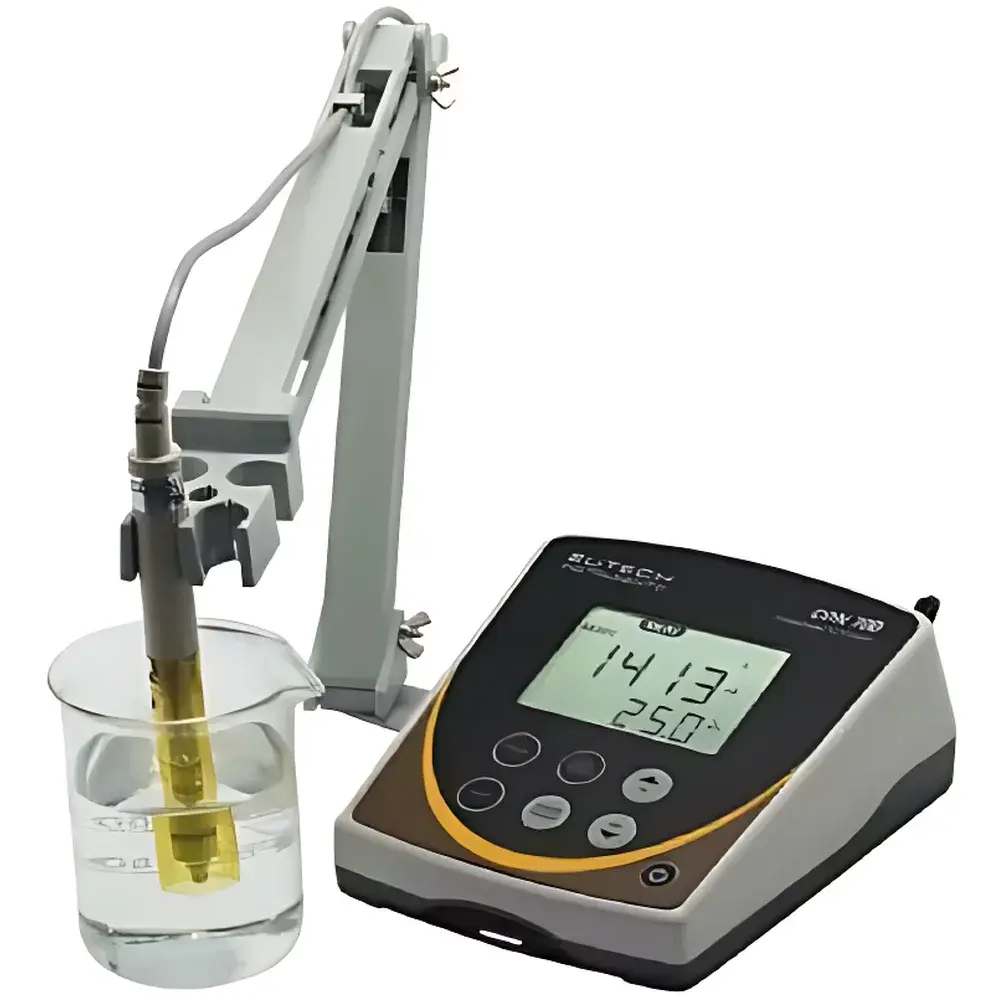
Thermo Fisher Eutech CON700 Benchtop Conductivity / TDS / Temperature Meter
| Brand | Thermo Fisher |
|---|---|
| Origin | Singapore |
| Manufacturer | Thermo Fisher Scientific |
| Product Type | Imported Benchtop Conductivity Meter |
| Model | Eutech CON700 |
| Measurement Parameters | Conductivity, TDS, Temperature |
| Conductivity Range | 0 μS/cm to 200.0 mS/cm |
| TDS Range | 0–100 ppt (TDS factor 0.5) |
| Temperature Range | 0.0–100.0 °C |
| Accuracy | ±1% of full scale |
| Resolution | 0.01 / 0.1 / 1 μS/cm |
| Temperature Accuracy | ±0.5 °C |
| Temperature Resolution | 0.1 °C |
| Calibration Points | Up to 5-point conductivity/TDS calibration |
| Data Storage | 100 measurement records |
| Electrode Compatibility | 2-cell or 4-cell conductivity cells (K = 0.1, 1.0, 10.0 cm⁻¹) |
| Auto-Endpoint Detection | Yes |
| Temperature Compensation | Automatic or manual (linear, 0.00–10.00%/°C) |
| Reference Temperature | 15.0–30.0 °C |
| Display | Dual-line LCD (5.6 × 7.5 cm), large-font numeric readout |
| Power Supply | 9 V DC regulated adapter (100–240 VAC, SMPS) |
| Dimensions (H×W×D) | 17.5 × 15.5 × 6.9 cm |
| Weight | 650 g (instrument only) |
Overview
The Thermo Fisher Eutech CON700 is a precision benchtop conductivity, total dissolved solids (TDS), and temperature meter engineered for reproducible, GLP-compliant measurements in environmental monitoring, water quality laboratories, pharmaceutical process control, and academic research settings. It operates on the principle of conductometric measurement—applying an alternating current across a conductivity cell and quantifying the resulting current flow to determine solution conductivity. The instrument supports both two-electrode and four-electrode (tetrapolar) conductivity cells, enabling accurate measurement across wide dynamic ranges—from ultrapure water (low μS/cm) to highly concentrated brines (up to 200.0 mS/cm)—without manual range switching. Its automatic range selection, auto-endpoint detection, and programmable temperature compensation ensure consistent data acquisition under variable sample conditions.
Key Features
- Triple-parameter measurement: Simultaneous display of conductivity (μS/cm or mS/cm), TDS (ppm or ppt), and temperature (°C) with real-time electrode status feedback.
- Five selectable electrode constants (K = 0.1, 1.0, 10.0 cm⁻¹) and up to five-point conductivity calibration—supporting multi-point standardization per ASTM D1125 and ISO 7888.
- Dual-line LCD (5.6 × 7.5 cm) with high-contrast, large-font numerics optimized for ambient-lit lab environments and extended operator use.
- Automatic temperature compensation (ATC) with adjustable β coefficient (0.00–10.00 %/°C) and user-selectable reference temperature (15.0–30.0 °C) for compliance with USP and EPA Method 120.1.
- Stable endpoint recognition algorithm minimizes subjective interpretation—ideal for routine QC testing where repeatability is governed by internal SOPs or ISO/IEC 17025 requirements.
- Benchtop form factor with integrated electrode stand, robust ABS housing, and regulated 9 V DC power supply—designed for continuous operation in controlled laboratory environments (5–45 °C).
Sample Compatibility & Compliance
The CON700 accommodates standard DIN 8-pin (2-electrode) and custom tetrapolar conductivity probes, supporting applications ranging from deionized water resistivity verification (via inverse conductivity calculation) to industrial wastewater characterization. Its ±1% full-scale conductivity accuracy and 0.1 °C temperature resolution meet minimum performance thresholds outlined in ASTM D5391 (Standard Test Method for Electrical Conductivity of Water) and ISO 15839 (Water quality — Guidelines for conductivity measurement). While not natively 21 CFR Part 11 compliant, its 100-entry data log—with embedded timestamps, calibration history, and electrode constant—supports traceability required under GLP and GMP-aligned workflows when paired with documented procedural controls.
Software & Data Management
Data are stored internally with date/time stamps, electrode constant, calibration points, and measured values. Though the CON700 lacks USB or Bluetooth connectivity, its non-volatile memory retains all 100 records during power cycling. Export is performed manually via visual transcription or optional third-party logging systems interfaced through analog output (not provided). For regulated environments, users implement supplemental documentation protocols—including audit trails for calibration events and record review logs—to satisfy FDA, EMA, or ISO 17025 documentation expectations. Firmware does not support remote updates; calibration and configuration are performed directly via front-panel keypad.
Applications
- Environmental labs: Monitoring freshwater, seawater, and effluent conductivity per EPA NPDES permit requirements.
- Pharmaceutical manufacturing: Verification of purified water (PW) and water-for-injection (WFI) conductivity against USP limits at 25 °C.
- Food & beverage QA: Batch consistency checks for brine solutions, syrup dilutions, and cleaning-in-place (CIP) rinse water.
- Academic teaching labs: Demonstrating ionic strength effects, temperature dependence of electrolyte mobility, and TDS conversion algorithms.
- Power generation: Boiler feedwater purity surveillance and condensate leak detection in steam cycles.
FAQ
Does the CON700 support GLP-compliant data recording?
It stores 100 measurement entries with timestamps and calibration metadata, but lacks electronic signature capability or audit-trail automation required for full 21 CFR Part 11 compliance.
Can I use a 4-ring conductivity cell with this meter?
Yes—the CON700 accepts both 2-electrode and 4-electrode (tetrapolar) cells via its 8-pin DIN connector, enabling high-accuracy measurement in high-conductivity or polarizable samples.
What TDS conversion factors are supported?
User-selectable TDS factors of 0.4–1.0 are programmable; default presets include 0.5 (for natural waters) and 1.0 (for NaCl-standardized solutions), aligning with ASTM D1125 Annex A1.
Is temperature compensation linear or non-linear?
Compensation follows a linear model (β coefficient), configurable between 0.00–10.00 %/°C—suitable for most aqueous electrolytes within 0–100 °C.
How often should I calibrate the instrument?
Calibration frequency depends on usage intensity and regulatory context; daily calibration is recommended for QC-critical applications, while weekly calibration suffices for routine environmental monitoring per ISO 5667-3 guidance.




