
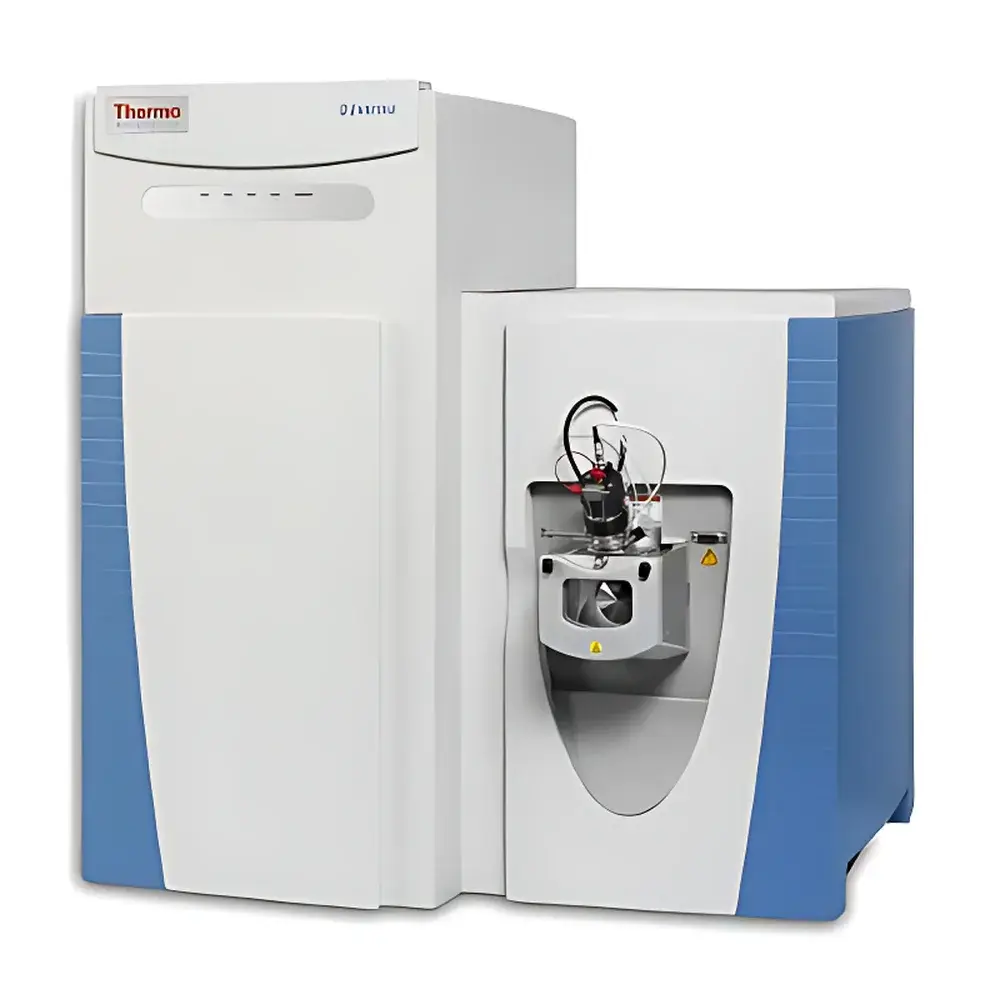
Thermo Fisher Q Exactive Orbitrap LC-MS/MS System
| Brand | Thermo Fisher |
|---|---|
| Origin | USA |
| Manufacturer Type | Original Equipment Manufacturer (OEM) |
| Origin Category | Imported |
| Model | Q Exactive Orbitrap LCMSMS |
| Instrument Type | Orbitrap Hybrid Quadrupole–Orbitrap Mass Spectrometer |
| Price Range | USD 650,000 – 980,000 (FOB USA) |
Overview
The Thermo Fisher Q Exactive Orbitrap LC-MS/MS System is a high-performance hybrid quadrupole–Orbitrap mass spectrometer engineered for simultaneous high-resolution, accurate-mass (HR/AM) qualitative identification and quantitative analysis in liquid chromatography–mass spectrometry workflows. Built upon the foundational Orbitrap mass analyzer technology—capable of resolving power up to 140,000 FWHM at m/z 200—the system integrates a robust front-end quadrupole mass filter with advanced ion optics, a higher-energy collisional dissociation (HCD) cell, and a C-Trap ion accumulation interface. This architecture enables selective precursor ion isolation, efficient fragmentation, and ultra-high mass accuracy (<2 ppm RMS error) and resolution across broad dynamic ranges. Unlike conventional triple quadrupole or time-of-flight platforms, the Q Exactive delivers structural confirmation and quantitation in a single acquisition cycle without compromising sensitivity, reproducibility, or duty cycle efficiency—making it especially suited for untargeted screening, semi-targeted metabolomics, proteomics, and regulated bioanalysis.
Key Features
- Hybrid Quadrupole–Orbitrap Architecture: Combines quadrupole-based precursor selection with Orbitrap HR/AM detection, enabling both targeted and data-dependent acquisition (DDA) modes with consistent mass accuracy and resolution.
- HR/AM Quanfirmation™ Workflow: A proprietary acquisition strategy that embeds quantitative extraction (e.g., extracted ion chromatograms), spectral matching, and fragment ion confirmation into one seamless LC-MS/MS run—fully compliant with ICH M10 and FDA Bioanalytical Method Validation guidance.
- Enhanced HCD Cell & C-Trap Optics: Optimized for rapid ion transfer and improved transmission of low-m/z fragments (e.g., reporter ions in TMT/iTRAQ experiments), supporting high-sensitivity isobaric labeling workflows.
- Multiplexed Detection Capability: Enables parallel accumulation–serial fragmentation (PASEF)-adjacent logic via intelligent precursor scheduling, increasing peak capacity and compatibility with sub-2-minute UHPLC gradients.
- Robust Vacuum & Thermal Management: Dual-stage differential pumping and active temperature stabilization ensure long-term mass calibration stability and minimal drift during extended overnight acquisitions.
Sample Compatibility & Compliance
The Q Exactive system supports diverse sample introduction methods—including electrospray ionization (ESI), heated electrospray ionization (H-ESI), and atmospheric pressure chemical ionization (APCI)—and is routinely deployed for biological fluids (plasma, urine), tissue extracts, food matrices, environmental water/sludge digests, and forensic toxicology specimens. It meets essential regulatory requirements for GLP and GMP environments: full audit trail support per 21 CFR Part 11, electronic signature capability, method version control, and raw data immutability. Instrument qualification documentation aligns with ASTM E2687, ISO/IEC 17025:2017 (for testing laboratories), and USP <1225> validation principles for analytical procedures.
Software & Data Management
Controlled by Thermo Scientific™ Tune™ and Xcalibur™ 4.x software, the system supports real-time instrument monitoring, automated calibration, and method-driven acquisition optimization. Data processing leverages Compound Discoverer™ for untargeted feature detection, alignment, and annotation; Proteome Discoverer™ for bottom-up proteomics; and TraceFinder™ for targeted quantitative workflows. All software modules enforce ALCOA+ (Attributable, Legible, Contemporaneous, Original, Accurate, Complete, Consistent, Enduring, Available) data integrity standards. Raw files (.raw) are stored in vendor-neutral formats compatible with open-source tools such as OpenMS and Skyline, facilitating third-party reprocessing and cross-platform reproducibility verification.
Applications
- Clinical Metabolomics: Identification and relative quantification of endogenous small molecules in serum or CSF under physiological and pathological conditions.
- Food Safety Screening: Multi-residue detection of pesticides, mycotoxins, veterinary drugs, and adulterants at EU-MRL and FDA action limit levels.
- Environmental Monitoring: Non-targeted discovery of emerging contaminants (e.g., PFAS, pharmaceutical residues) in wastewater influent and effluent.
- Forensic Toxicology: Broad-spectrum drug screening in blood and hair samples with retrospective data mining capabilities.
- Biopharmaceutical Characterization: Peptide mapping, deamidation/oxidation site localization, and glycoform profiling of monoclonal antibodies and biosimilars.
FAQ
What distinguishes the Q Exactive from a standard triple quadrupole MS system?
The Q Exactive provides high-resolution, accurate-mass spectra for both precursor and fragment ions—enabling confident compound identification via elemental composition assignment—whereas triple quadrupoles deliver unit-resolution SRM/MRM transitions without inherent mass accuracy or full-scan identification capability.
Is the system compatible with existing LC hardware and columns?
Yes—it interfaces seamlessly with all major UHPLC systems (including Thermo Vanquish, Waters Acquity, Agilent 1290) via standard ESI/APCI sources and accepts standard 2.1 mm ID columns packed with sub-2 µm particles.
Does it support quantitative analysis under regulated conditions?
Yes—full 21 CFR Part 11 compliance is enabled through Xcalibur’s secure user authentication, electronic signatures, and immutable audit trails, satisfying requirements for FDA submissions and ISO 17025 accreditation.
Can raw data be reprocessed years after acquisition?
Absolutely—the .raw file format preserves all acquisition parameters, calibration coefficients, and raw transients, allowing retrospective re-extraction, library searching, or algorithm updates without re-running samples.
What maintenance intervals are recommended for routine operation?
Daily vacuum check and source cleaning; monthly mass calibration and detector gain optimization; annual ion optic alignment and HCD cell inspection—per Thermo’s Preventive Maintenance Schedule v3.2.
Related Products






