
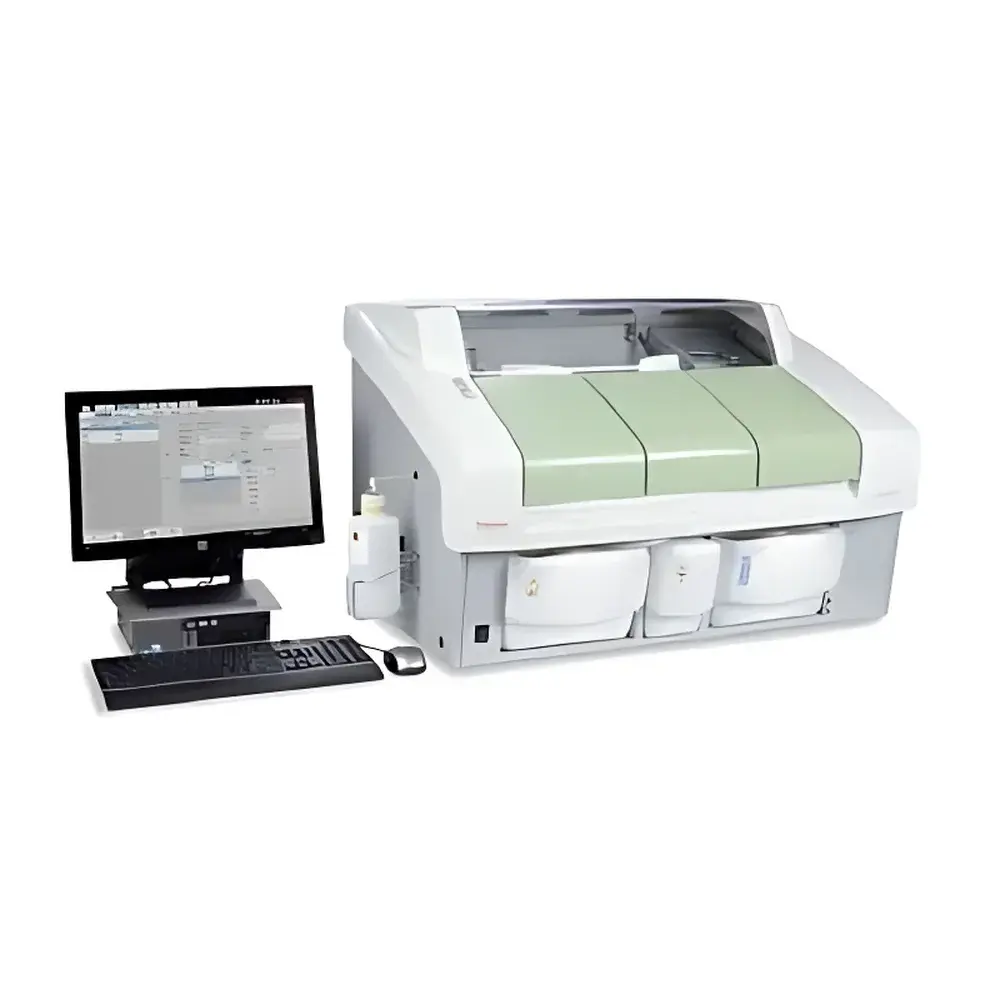
Thermo Fisher Gallery Plus Beermaster Automated Beer Analyzer
| Brand | Thermo Fisher |
|---|---|
| Origin | Finland |
| Manufacturer | Thermo Fisher Scientific |
| Product Type | Imported Instrument |
| Model | Gallery Beermaster |
| Instrument Category | Alcoholic Beverage and Beverage Analyzer |
| Detection Principle | Photometric (Colorimetric), Enzymatic, and Iso-Alpha Acid Extraction-Based Bitterness (IBU) Analysis |
| Wavelength Range | 275–775 nm |
| Reaction Volume | Microliter-scale (≤100 µL total per assay) |
| Sample Throughput | Random-access, high-volume batch processing |
| Cell Type | Disposable, multi-cuvette, discrete cuvettes |
| Dilution Capability | Automated primary and secondary dilution |
| Blank Correction | Multiple built-in blank reading modes (reagent blank, sample blank, dual-blank) |
| Software Compliance | Audit trail, user access control, method versioning — supports GLP/GMP documentation requirements |
Overview
The Thermo Fisher Gallery Plus Beermaster Automated Beer Analyzer is a dedicated, benchtop clinical-grade analyzer engineered for high-throughput, standardized quality control in brewing and beverage R&D laboratories. It integrates three complementary analytical modalities—photometric (colorimetric) assays, enzymatic kinetics, and standardized iso-alpha acid extraction for International Bitterness Units (IBU)—within a single, unified platform. Unlike general-purpose spectrophotometers or manual extraction workflows, the Beermaster implements a validated, end-to-end analytical chain: from barcode-driven sample/reagent loading, through automated pre-dilution and matrix-adapted blank correction, to column-based IBU quantification using UV absorbance at 275 nm. Its optical system covers 275–775 nm with high photometric stability and low stray light, enabling precise measurement of color (EBC/SRM), alcohol content (via enzymatic ADH assay), pH, dissolved CO₂, original extract (°Plato), real extract, attenuation, and bitterness—all traceable to internationally recognized reference methods (e.g., EBC Analytica, ASBC Methods of Analysis, ISO 13183).
Key Features
- Benchtop modular architecture designed for ISO 17025-compliant QC labs—no external ventilation, minimal footprint (65 × 55 × 45 cm), and CE/UL certification.
- Integrated BCM (Bitterness Control Module): A fully automated, column-based IBU quantification system eliminating manual iso-octane liquid-liquid extraction—replacing hazardous solvent handling with disposable SPE cartridges and aqueous-based eluents.
- Microliter-scale reaction volume (typically 20–80 µL sample + reagent per assay), reducing consumables cost by >60% versus conventional macro-scale methods.
- Disposable, pre-sterilized, multi-cuvette strips (12-position) ensure zero carryover between samples—validated per CLSI EP26-A guidelines for cross-contamination assessment.
- Intelligent dilution engine: Supports up to 2-stage automated dilution (1:2 to 1:1000) with real-time concentration feedback; dynamically adjusts based on initial absorbance readings to maintain linearity within assay dynamic ranges.
- Multi-mode blank compensation: Reagent blank, sample blank, and dual-blank subtraction algorithms mitigate matrix effects common in hopped wort, dry-hopped beers, and non-alcoholic malt beverages.
- Barcode-driven workflow: All samples, reagents, calibration standards, and method files are registered via 2D DataMatrix codes—enabling full traceability and automatic method selection.
Sample Compatibility & Compliance
The Beermaster accepts undiluted beer, wort, fermenting broth, and post-filtration samples in standard 13-mm or 16-mm diameter tubes (5–50 mL volume). It accommodates turbid, highly colored, and carbonated matrices without centrifugation or filtration—leveraging kinetic background subtraction and wavelength optimization. Method libraries comply with EBC Monograph 9 (Bitterness), ASBC Beer-23 (IBU), AOAC 989.10 (alcohol), and ISO 13183-1:2015 (spectrophotometric color). The system meets FDA 21 CFR Part 11 requirements for electronic records and signatures when configured with Thermo Fisher’s optional compliance pack—including role-based access control, immutable audit trails, and electronic signature capture.
Software & Data Management
Powered by Thermo Fisher’s Gallery Suite v5.x, the Beermaster features a browser-based interface (HTML5) accessible via local network or secure remote session. Each assay generates structured data compliant with ASTM E1384 (Laboratory Information Management Systems) and HL7 LIS integration protocols. Raw absorbance spectra, chromatographic-like elution profiles (for BCM), and calculated results (IBU, %ABV, EBC units, etc.) are exported in CSV, PDF, or XML formats. All method changes, calibration events, and instrument maintenance logs are timestamped and digitally signed. Data retention policies support configurable archiving aligned with ISO/IEC 17025 clause 7.5.2.
Applications
- Routine QC of finished beer across IBU, color, alcohol, pH, and residual sugars in production environments (≥200 samples/day).
- Process monitoring during fermentation and dry-hopping—quantifying hop compound degradation kinetics and alpha-acid isomerization efficiency.
- Raw material qualification: Malt extract potential, hop pellet alpha-acid content, yeast viability metrics (via enzymatic ATP assay).
- Regulatory submission support: Generating auditable datasets for FSSC 22000, BRCGS Food Safety Issue 9, and EU Regulation (EC) No 1169/2011 labeling compliance.
- Research applications: Correlating sensory bitterness scores with instrumental IBU values; evaluating novel hop varieties and biotransformation pathways.
FAQ
What regulatory standards does the Gallery Plus Beermaster support?
It natively supports EBC, ASBC, ISO, and AOAC reference methods; with optional configuration, it meets 21 CFR Part 11, ISO/IEC 17025, and GLP audit requirements.
Can the BCM module be used for non-beer samples such as soft drinks or plant extracts?
The BCM is validated exclusively for beer and wort matrices per ASBC Beer-23; alternative matrices require method revalidation and may require custom column chemistry.
Is routine maintenance required for the optical system?
No lamp replacement or alignment is needed—the xenon flash lamp has a rated lifetime of ≥1×10⁹ flashes; daily cleaning is limited to fluidic path rinsing and waste container emptying.
How is calibration verified across batches?
Each run includes NIST-traceable photometric standards (neutral density filters) and certified reference materials (CRM) for IBU and alcohol; calibration drift is auto-flagged if deviation exceeds ±1.5% of target value.
Does the system integrate with existing LIMS or ERP platforms?
Yes—via HL7 v2.5.1, ASTM E1384-compliant API, or flat-file SFTP push; Thermo Fisher provides documented interface specifications and validation templates.






