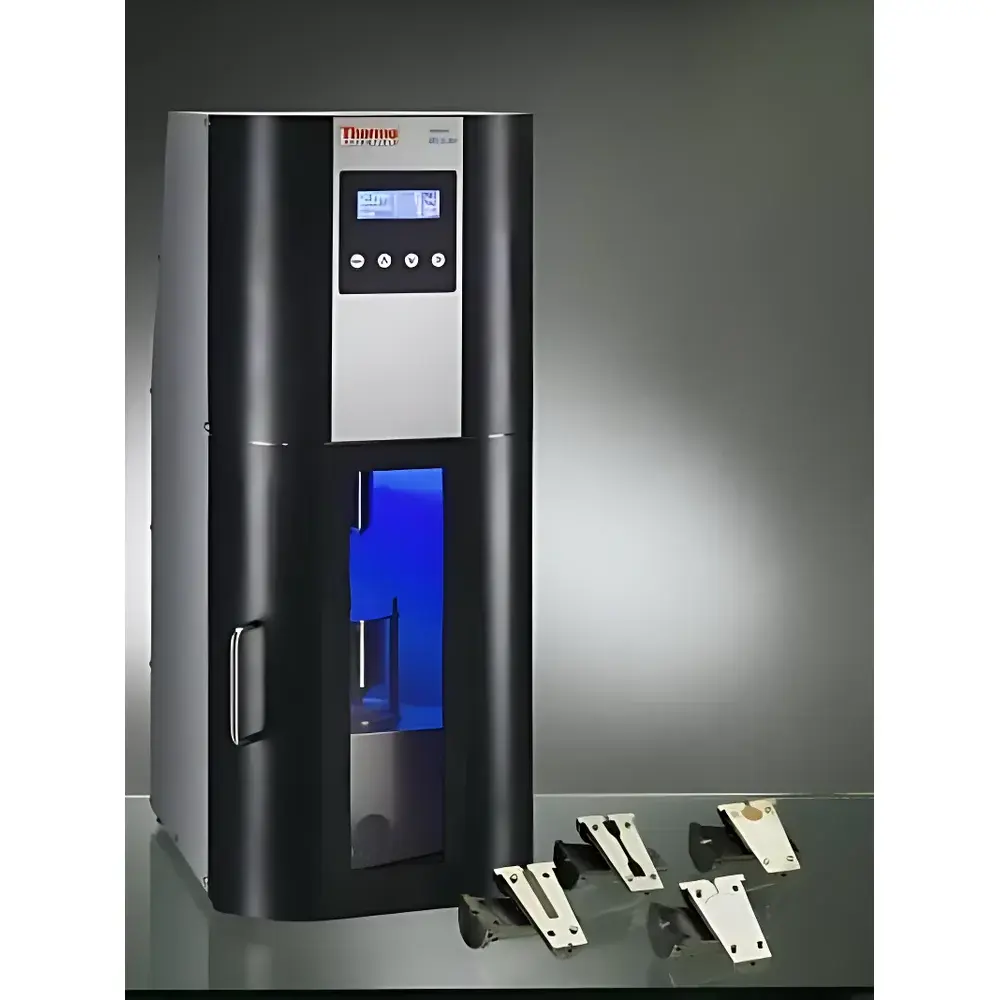
Thermo Fisher HAAKE MiniJet Pro Micro Injection Molding System
| Brand | Thermo Fisher |
|---|---|
| Origin | Germany |
| Manufacturer | Thermo Fisher Scientific |
| Type | Imported Instrument |
| Model | MiniJet Pro |
| Maximum Injection Pressure | 1200 bar |
| Compressed Air Supply Pressure (Max) | 10 bar |
| Barrel Temperature Range | Up to 400 °C |
| Mold Temperature Range | Up to 250 °C |
| Sample Mass Capacity | 3–5 g per shot |
| Control Interface | Digital LCD Controller with Parameter Storage |
Overview
The Thermo Fisher HAAKE MiniJet Pro is a precision-engineered micro injection molding system designed for laboratory-scale polymer processing and material development. Operating on the same fundamental principles as industrial-scale injection molding—namely, controlled melt plastication, high-pressure cavity filling, and thermally regulated mold cooling—the MiniJet Pro enables reproducible fabrication of standardized test specimens (e.g., ISO 527 tensile bars, ISO 179 Charpy impact samples, ASTM D638 dogbones) from as little as 3–5 g of thermoplastic polymer per cycle. Its vertically oriented architecture optimizes gravitational feeding, simplifies manual loading of granules or pellets, and minimizes operator-induced variability during sample preparation. The system integrates seamlessly into a modular lab workflow, serving as the final processing step in a complete small-scale polymer characterization chain that may include the HAAKE MiniLab II micro compounder and the HAAKE Process 11 micro twin-screw extruder.
Key Features
- Vertical injection unit with ergonomic feed throat and integrated safety interlocks for operator protection during manual loading and mold clamping.
- Digital LCD controller with non-volatile memory for storing up to 20 user-defined process protocols—including barrel zone temperatures, injection speed profiles, holding pressure duration, and mold temperature setpoints.
- High-precision hydraulic injection system delivering up to 1200 bar peak pressure, enabling full cavity fill even with highly filled or high-viscosity engineering thermoplastics (e.g., PEEK, LCP, glass- or carbon-fiber-reinforced PA66).
- Four-zone independently controlled barrel heating (up to 400 °C), supporting broad polymer compatibility—from commodity resins (PP, PE) to high-performance thermoplastics and liquid crystal polymers.
- Electrically heated mold platens with active cooling channels, maintaining stable mold surface temperatures from ambient to 250 °C with ±1 °C uniformity across the cavity face.
- Compressed air-assisted ejection system (max 10 bar supply) for consistent part release without thermal shock or surface marking.
Sample Compatibility & Compliance
The MiniJet Pro accommodates standard ISO and ASTM-compliant mold inserts (e.g., 80 × 10 × 4 mm tensile bars, 60 × 15 × 10 mm impact specimens), as well as custom-designed cavities for application-specific geometries. It supports all major thermoplastic families—including polyolefins, styrenics, polyesters, polyamides, polyacetals, fluoropolymers, and high-temperature thermoplastics—provided melt viscosity remains within the system’s shear-rate and pressure envelope. The instrument complies with CE machinery directive 2006/42/EC and meets essential requirements of ISO 13850 (emergency stop) and ISO 12100 (risk assessment). Process data logs generated via the controller support GLP-aligned documentation; when used in conjunction with Thermo Fisher’s optional data export module, audit trails meet FDA 21 CFR Part 11 requirements for electronic records and signatures.
Software & Data Management
While the MiniJet Pro operates via its embedded digital controller, it supports external data capture through RS232 and USB interfaces. Optional Thermo Fisher Connect software enables remote parameter configuration, real-time monitoring of temperature and pressure transients, and export of time-stamped process logs (CSV format) for statistical analysis in JMP, Minitab, or Python-based quality control workflows. All stored protocols are timestamped and user-ID tagged, facilitating traceability across development batches and supporting internal SOPs aligned with ISO/IEC 17025 accreditation criteria for testing laboratories.
Applications
- Rapid prototyping of formulation variants during polymer compounding R&D—enabling direct mechanical property correlation between melt rheology (from MiniLab II) and solid-state performance (tensile, impact, flexural).
- Qualification of recycled or bio-based resin blends where material availability is limited and traditional pilot-line trials are impractical.
- Validation of processing windows for novel additives (nanofillers, flame retardants, nucleating agents) under controlled thermal and shear histories.
- Education and training in polymer processing fundamentals, including gate freeze-off timing, weld line formation, and crystallinity development under constrained cooling conditions.
- Pre-certification specimen production for third-party testing labs requiring ISO/ASTM-conforming samples prior to full-scale qualification.
FAQ
What is the minimum recommended sample mass for reliable cavity filling?
A minimum of 3 g is required for standard tensile bar molds; however, optimal repeatability is achieved at 4–5 g to ensure consistent melt homogeneity and minimize shot-to-shot variation in volumetric displacement.
Can the MiniJet Pro process thermosetting polymers or reactive systems?
No—it is engineered exclusively for thermoplastic materials. The absence of in-mold curing capability and lack of chemical resistance in standard steel mold inserts preclude use with epoxy, phenolic, or PU systems.
Is mold changeover tooling included with the base system?
Yes—standard delivery includes a universal mold base plate compatible with ISO-standard cavity inserts, along with one set of tensile bar (ISO 527) and impact bar (ISO 179) inserts. Additional cavity sets are available as configurable options.
Does the system support vacuum venting for moisture-sensitive resins?
No built-in vacuum port is provided; however, users may integrate external vacuum lines via custom mold modifications, subject to validation of seal integrity and thermal management at the vent interface.
How is temperature calibration verified during routine maintenance?
Thermo Fisher recommends annual verification using NIST-traceable thermocouple probes inserted directly into barrel zones and mold platens, following procedures outlined in the system’s Maintenance Manual (Document No. MJPRO-MNT-EN-Rev4.2).