
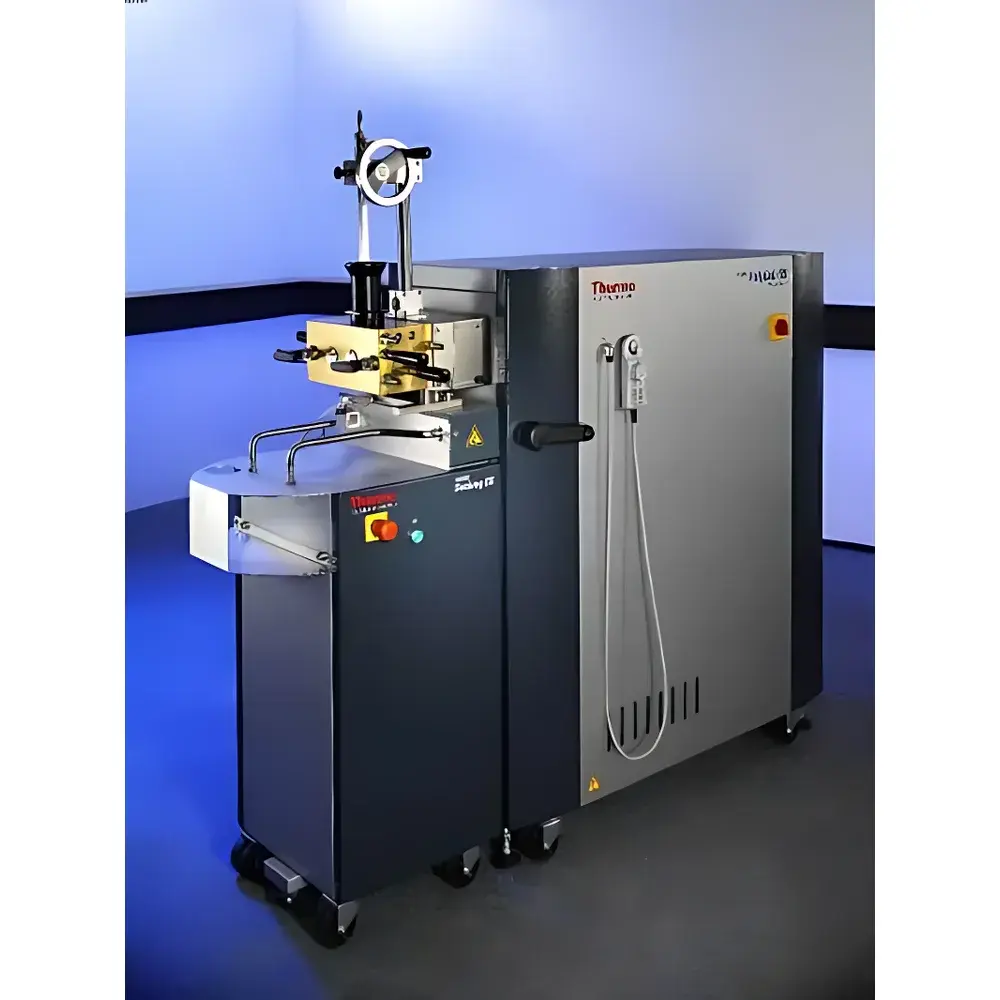
Thermo Fisher HAAKE PolyLab OS Torque Rheometer
| Brand | Thermo Fisher |
|---|---|
| Origin | Germany |
| Manufacturer | Thermo Fisher Scientific |
| Product Type | Torque Rheometer |
| Model | PolyLab OS |
| Motor Bearing | Screw-driven |
| Minimum Speed | 1 rpm |
| Frequency Range | 0.1–115 rad/s |
| Maximum Speed | 250 rpm (up to 1100 rpm optional) |
| Maximum Torque | 120 mNm (dual-range: 120/400 Nm) |
| Torque Resolution | 0.01 / 0.1 Nm |
| Temperature Range | Up to 400 °C (optional 450–500 °C) |
| Heating/Cooling | Electric heating + compressed air cooling |
| Control Zones | 7–10 independent temperature zones |
| Pressure Capability | Up to 700 bar |
| Barrel Design | Modular, horizontally split |
| Screw Configurations | Single-screw (Ø19.05 mm), Conical counter-rotating twin-screw (Ø31.8/20 mm), Parallel co-rotating twin-screw (Ø16/24 mm), Banbury-type mixer (120/625 cm³ chamber volume) |
| Power Supply | 7 kW / 16 kW |
| L/D Ratios | 10:1, 25:1, 33:1 (single-screw) |
| 25 | 1 to 40:1 (twin-screw) |
| Extrusion Capacity | ~5 kg/h (polymer-dependent) |
| Compliance | DIN 1.4301 stainless steel (mixer), DIN 1.8550 nitrided steel (screws/barrels) |
Overview
The Thermo Fisher HAAKE PolyLab OS Torque Rheometer is an industrial-grade, modular torque rheometry platform engineered for comprehensive process simulation and material characterization in polymer compounding, extrusion, and reactive processing. Unlike conventional viscometers or rotational rheometers, the PolyLab OS operates on the principle of controlled mechanical energy input—measuring torque, temperature, pressure, and rotational dynamics under realistic shear and extensional deformation conditions. Its “OS” designation signifies an Open Solutions architecture: built on open industrial communication protocols (e.g., EtherCAT, OPC UA), it supports real-time integration of third-party sensors—including inline FTIR, NIR, laser microrheology, and high-speed imaging systems—enabling simultaneous multi-parameter monitoring of melt behavior during dynamic processing.
Key Features
- Modular Process Simulation Platform: Configurable with interchangeable modules—Banbury-type internal mixer (120 cm³ or 625 cm³), single-screw extruder (L/D 10–33), conical counter-rotating twin-screw, and parallel co-rotating twin-screw—each with independently controlled temperature zones (7–10), precision torque sensing (dual-range: 120/400 Nm), and pressure transducers (up to 700 bar).
- High-Fidelity Drive System: Servo-motor with screw-driven transmission and selectable gear ratios (3:2 standard, 2:3 optional); speed range from 1 rpm to 250 rpm (extendable to 1100 rpm); angular frequency sweep capability from 0.1 to 115 rad/s for dynamic oscillatory testing.
- Thermal Management Architecture: Electric cartridge heaters combined with regulated compressed-air cooling ensure rapid thermal response (<1.5 K/min ramp rate) and stability (±0.5 °C across 400 °C operating range; optional 450–500 °C configurations available).
- Open Industrial Interface: Native support for IEC 61131-3 programming environments and real-time data streaming via Ethernet/IP and MQTT; enables remote operation, predictive diagnostics, and synchronized acquisition with external lab systems (e.g., DSC, TGA, GPC).
- Robust Mechanical Construction: Mixer housings and barrels fabricated from DIN 1.4301 austenitic stainless steel; screws and wear surfaces hardened using nitrogen-based surface treatment (DIN 1.8550), ensuring longevity under abrasive filler or reactive monomer conditions.
Sample Compatibility & Compliance
The PolyLab OS accommodates thermoplastics (PP, PE, PC, PA), thermosets (epoxy, phenolic), elastomers (EPDM, TPU), filled composites (glass/carbon fiber, nanocellulose), and reactive systems (polyurethane prepolymers, silicone hydrosilylation). All modules comply with ISO 6721-10 (dynamic mechanical thermal analysis), ASTM D3835 (extrusion rheometry), and ISO 25577 (torque rheometry for polymer melts). The system supports full GLP/GMP traceability: audit trails, electronic signatures, and 21 CFR Part 11–compliant software options are available upon configuration. Temperature and torque calibration procedures follow ISO/IEC 17025–accredited protocols, with documented uncertainty budgets for all primary measurements.
Software & Data Management
HAAKE RheoWin OS software provides unified control, real-time visualization, and post-processing for all PolyLab OS configurations. It features synchronized time-stamped acquisition across torque, temperature, pressure, motor current, and optional spectral or imaging channels. Raw data export is supported in HDF5, CSV, and universal ASAM MDF4 formats for integration with MATLAB, Python (via h5py/pandas), or LIMS platforms. Advanced analysis modules include Payne effect quantification, transient viscosity modeling (Carreau-Yasuda, Cross), residence time distribution (RTD) calculation from tracer experiments, and melt fracture onset detection via high-speed video correlation. Data integrity safeguards include cyclic redundancy checks (CRC32), automatic backup to network storage, and configurable retention policies aligned with ISO 15189 requirements.
Applications
- Formulation development for filled thermoplastics and reactive blends
- Process window mapping for twin-screw extrusion (screw design validation, barrel temperature profiling)
- Thermal stability assessment of heat-sensitive biopolymers under shear
- In-line rheological fingerprinting of melt homogeneity during compounding
- Reaction kinetics monitoring in reactive extrusion (e.g., grafting, transesterification)
- Quality-by-Design (QbD) studies supporting FDA submissions for pharmaceutical polymer carriers
- Validation of constitutive models (e.g., Giesekus, PTT) using transient torque and pressure waveforms
FAQ
What distinguishes the PolyLab OS from legacy torque rheometers?
It replaces proprietary bus architectures with open industrial standards (EtherCAT, OPC UA), enabling vendor-agnostic sensor integration and deterministic real-time control—critical for closed-loop process optimization.
Can the system perform both batch mixing and continuous extrusion in one setup?
Yes: the modular design allows rapid reconfiguration between Banbury mixer, single-screw, and twin-screw modes without recalibration; tooling changes are mechanically indexed and software-recognized.
Is torque resolution consistent across the full 120/400 Nm dual range?
Torque resolution is 0.01 Nm in the low range (0–120 Nm) and 0.1 Nm in the high range (0–400 Nm), with linearity maintained per ISO 20783-2 Annex B.
How is temperature uniformity validated across the barrel zones?
Each zone includes dual Pt100 sensors (redundant measurement); uniformity is verified per ASTM E220 using NIST-traceable micro-probe thermocouples inserted at axial and radial positions.
Does the system support automated method transfer between R&D and pilot-scale production lines?
Yes: RheoWin OS exports process recipes as XML-based SOPs compatible with Siemens SIMATIC PCS 7 and Emerson DeltaV DCS environments, facilitating scale-up fidelity assessment.
Related Products



