
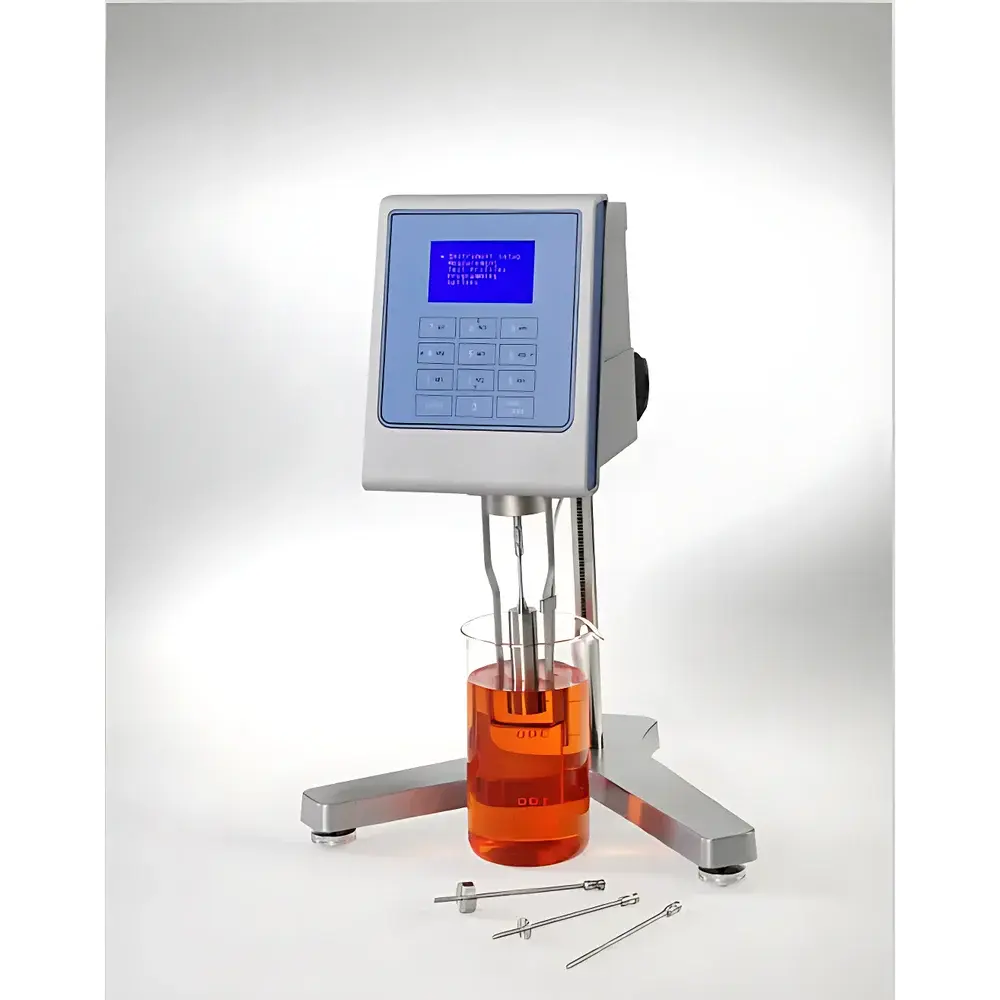
Thermo Fisher HAAKE Viscotester D Rotational Viscometer
| Brand | Thermo Fisher |
|---|---|
| Origin | Germany |
| Manufacturer | Thermo Fisher Scientific |
| Instrument Type | Rotational Viscometer |
| Model | HAAKE Viscotester D |
| Viscosity Range | 15 – 40,000,000 mPa·s |
| Compliance | ISO 2555 |
| Rotor Geometry | Standard Spindle (e.g., LV, RV, HA, HB series) |
| Shear Rate Range | Dependent on spindle geometry and rotational speed (typically 0.1–1000 s⁻¹) |
| Accuracy | ±1% of full scale (per ISO 2555 calibration requirements) |
Overview
The Thermo Fisher HAAKE Viscotester D is a precision-engineered rotational viscometer designed for routine quality control, comparative viscosity assessment, and standardized material characterization in industrial and laboratory environments. Operating on the fundamental principle of Couette flow rheology, the instrument measures the torque required to rotate a defined geometry (spindle) at a controlled angular velocity within a sample. This mechanical resistance—directly proportional to the fluid’s internal friction—is converted into dynamic viscosity (mPa·s) using calibrated spindle constants and rotational parameters. The HAAKE Viscotester D adheres strictly to ISO 2555, which specifies geometric tolerances for spindles, torque measurement accuracy, rotational speed stability, and temperature control requirements for rotational viscometers used in comparative testing. Its robust electromechanical architecture ensures high reproducibility across shifts and operators, making it suitable for long-term monitoring of batch-to-batch consistency in paints, coatings, adhesives, pharmaceutical suspensions, food emulsions, and polymer melts.
Key Features
- Compliance with ISO 2555 for standardized rotational viscosity measurement, enabling traceable inter-laboratory comparisons
- Dual-range torque sensor system supporting extended dynamic range from 15 mPa·s to 40 × 10⁶ mPa·s—covering low-viscosity solvents through highly structured gels and pastes
- Interchangeable spindle set (LV, RV, HA, HB types) with documented geometry coefficients for accurate shear rate estimation per ASTM D2196 and ISO 3219
- Motor-driven speed control with digital feedback loop ensuring stable rotational speeds from 0.1 to 200 rpm (depending on spindle configuration)
- Integrated temperature compensation algorithm for ambient-temperature-dependent viscosity corrections (when used with external bath or Peltier stage)
- Compact benchtop footprint with ergonomic sample cup design facilitating rapid cleaning and minimal sample volume requirements (as low as 15 mL for standard spindles)
Sample Compatibility & Compliance
The HAAKE Viscotester D accommodates Newtonian and mildly non-Newtonian fluids under steady-shear conditions. It is routinely deployed for QC testing of industrial formulations including latex dispersions, ink vehicles, cosmetic bases, and edible oils. While not intended for full rheological profiling (e.g., yield stress or time-dependent thixotropy), its compliance with ISO 2555 ensures data alignment with Brookfield-type instruments when identical spindle geometries and test protocols are applied. For regulated environments, the instrument supports GLP-compliant documentation workflows when paired with optional HAAKE RheoWin software and audit-trail-enabled PCs compliant with FDA 21 CFR Part 11 requirements. Calibration verification follows ISO/IEC 17025 principles using certified mineral oil standards traceable to NIST or PTB reference materials.
Software & Data Management
The HAAKE Viscotester D operates in standalone mode via front-panel controls or integrates seamlessly with Thermo Fisher’s HAAKE RheoWin software suite (v4.x or later). RheoWin enables automated test sequences, real-time viscosity vs. time/speed plots, statistical reporting (mean, SD, CV%), and export to CSV, PDF, or LIMS-compatible XML formats. All measurement metadata—including spindle ID, rotational speed, temperature (if monitored), operator ID, and timestamp—is embedded in raw data files. Software configurations can be locked down via user-level permissions to meet internal SOPs and external audit requirements. Optional data archiving modules support version-controlled method storage and electronic signature capture for regulated applications.
Applications
- Batch release testing of polymer solutions and resin systems in composites manufacturing
- Stability screening of suspension-based pharmaceutical products per USP
- Viscosity grading of lubricating oils and greases in accordance with ASTM D445
- Process optimization of food processing lines (e.g., ketchup, mayonnaise, dairy concentrates)
- Raw material qualification for paint and coating suppliers under ISO 2555 and DIN 53019
- Educational labs requiring ISO-aligned instrumentation for teaching rheological fundamentals
FAQ
Is the HAAKE Viscotester D suitable for yield stress measurement?
No—it is a steady-shear rotational viscometer optimized for viscosity determination under defined shear rates. Yield stress quantification requires controlled-stress or oscillatory rheometry (e.g., HAAKE MARS series).
Can it be used with non-standard spindles or custom geometries?
Only certified HAAKE spindle sets (LV/RV/HA/HB) are validated for ISO 2555 compliance; third-party or modified spindles invalidate traceability and calibration integrity.
Does it support temperature-controlled measurements?
The base unit does not include integrated temperature control; however, it is fully compatible with external thermostatted baths or HAAKE TC80 temperature controllers when equipped with a jacketed sample cup.
How frequently should calibration verification be performed?
Per ISO/IEC 17025 and internal QA protocols, daily verification with a reference standard oil is recommended before critical measurements; full recalibration by an accredited service provider is advised annually or after mechanical impact.
Is data export compatible with LIMS integration?
Yes—RheoWin supports configurable ASCII/CSV output and OPC UA connectivity for direct ingestion into enterprise LIMS platforms meeting ASTM E1482 or ISO/IEC 17025 data integrity criteria.
Related Products



