
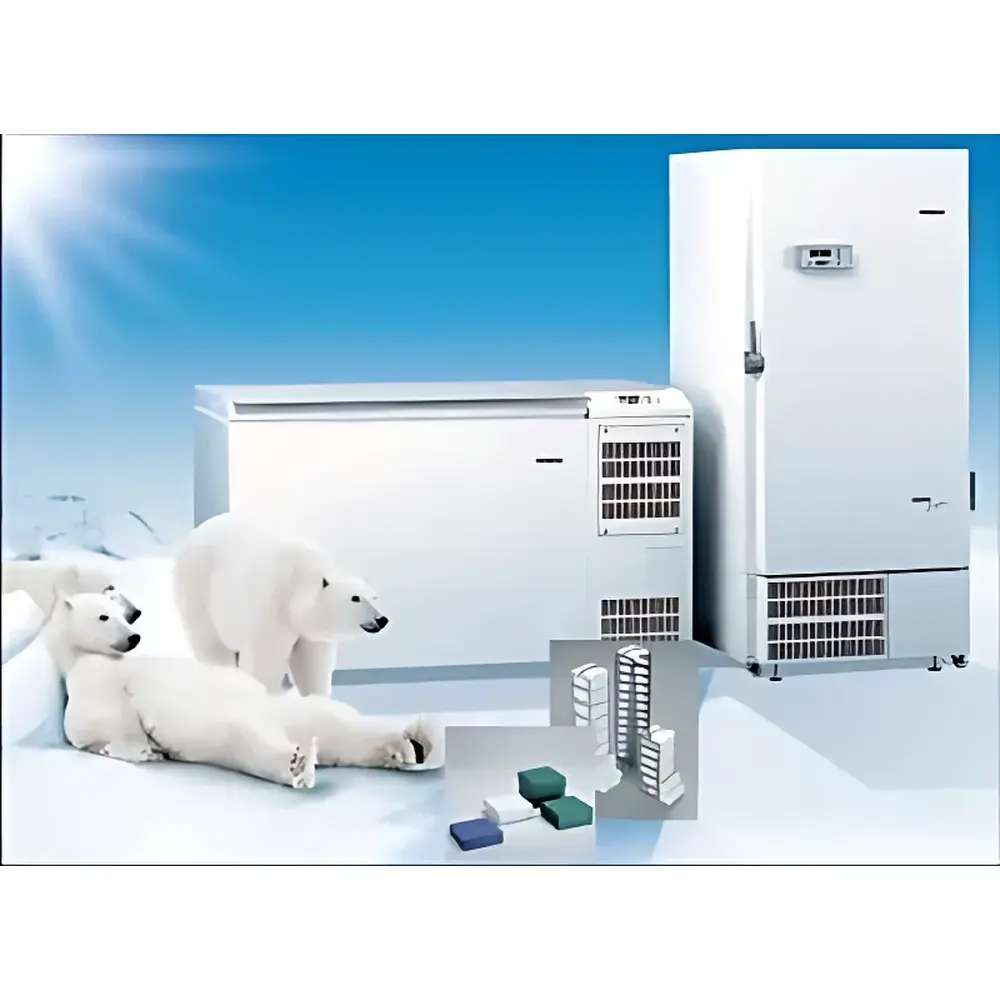
Thermo Fisher HERAfreeze Ultra Low Temperature Freezer
| Brand | Thermo Fisher |
|---|---|
| Origin | Germany |
| Model | HERAfreeze (HFU & HFC Series) |
| Configuration | Upright & Horizontal |
| Temperature Range | –50 °C to –86 °C |
| Capacities | 220–630 L |
| Internal Insulation | 150 mm Polyurethane Foam |
| Control Precision | ±2.5 K |
| Sample Temperature Stability | <±0.1 K |
| Power Consumption | 11.2–18.8 kWh/24h |
| Noise Level | <56 dB(A) |
| Door Seal | Dual-layer Magnetic Silicone + PVC with Anti-condensation Heating |
| Optional Systems | CO₂ Backup Cooling, Water-Cooled Condenser |
Overview
The Thermo Fisher HERAfreeze Ultra Low Temperature Freezer is an engineered solution for long-term cryogenic storage of biologically sensitive materials in regulated research and clinical environments. Designed and manufactured in Germany, it operates on a dual-compressor Alliance refrigeration architecture—combining high-efficiency cascade cooling with environmentally compliant refrigerants (R290/R170 blend)—to achieve and maintain stable operating temperatures from –50 °C to –86 °C. Its thermodynamic design prioritizes thermal inertia and recovery performance: the 150 mm thick in-situ foamed polyurethane insulation, combined with a heated magnetic silicone/PVC door seal, minimizes cold leakage and prevents frost accumulation or door adhesion—even under ambient conditions up to 31 °C. The system delivers sample temperature stability of <±0.1 K under steady-state operation, meeting foundational requirements for ISO 13485-compliant biobanking, GLP-aligned preclinical studies, and USP guidance for cryopreserved cellular therapies.
Key Features
- Two platform configurations: upright (HFU series: 400–630 L) and horizontal (HFC series: 220–525 L), optimized for space-constrained labs or high-throughput specimen access
- Alliance dual-compressor refrigeration system with intelligent load-balancing and adaptive defrost cycles to extend compressor service life and reduce thermal cycling stress on samples
- Microprocessor-based controller with real-time monitoring of cabinet temperature, condenser status, door-open duration, and alarm history—logging timestamps with UTC synchronization
- Energy-optimized architecture: average power consumption reduced by ~60% versus legacy ULT freezers of comparable capacity, verified per IEC 62304 Annex C test protocols
- Structural integrity: stainless steel interior chamber with reinforced floor pan; external casing rated for Class II cleanroom-compatible surface finish (Ra ≤ 0.8 µm)
- Modular internal organization: standardized rack slots compatible with ANSI/SLAS-format 55 mm and 80 mm cryoboxes; configurable drawer systems with color-coded labeling zones
Sample Compatibility & Compliance
The HERAfreeze supports validated storage of primary human tissues, peripheral blood mononuclear cells (PBMCs), induced pluripotent stem cell (iPSC) lines, viral vectors (AAV, lentivirus), mRNA-LNPs, monoclonal antibodies, and lyophilized reagents. Its thermal performance profile complies with key international standards including ISO 14644-1 (Class 7 cleanroom compatibility), ASTM F2697-22 (cryogenic storage device qualification), and EU MDR Annex I §10.1.2 for temperature-controlled medical device storage. Optional CO₂ backup cooling—integrated with pressure-regulated triple-cylinder manifold, CO₂ concentration sensor, and fail-safe venting—enables maintenance of –30 °C to –70 °C during extended power outages, satisfying CAP-accredited biorepository continuity-of-care requirements. Water-cooled condenser variants eliminate sensible heat rejection into lab air, enabling installation in ISO Class 5–7 cleanrooms without additional HVAC compensation.
Software & Data Management
- Embedded controller supports optional Thermo Fisher Connect™ integration for remote monitoring via secure TLS 1.2–encrypted web interface
- Alarm logging includes timestamped events (e.g., door open >30 s, temperature deviation >±3 K), with configurable email/SMS alerts and local SD card archival (12-month retention)
- Compliant with FDA 21 CFR Part 11 when paired with Thermo Fisher’s validated IQ/OQ documentation package—providing electronic signature support, audit trail generation, and role-based access control
- Data export formats: CSV and PDF reports compatible with LIMS systems (e.g., LabWare, STARLIMS) via USB or Ethernet port
Applications
The HERAfreeze serves as a core infrastructure asset across translational research workflows: biobank repositories storing genomic DNA/RNA libraries; contract development and manufacturing organizations (CDMOs) maintaining master cell banks under GMP Annex 1 conditions; academic core facilities supporting single-cell sequencing sample prep; and vaccine development labs preserving ultra-cold chain formulations (e.g., mRNA vaccines requiring –70 °C storage). Its low-vibration platform and uniform vertical/horizontal temperature distribution (±1.2 K max deviation across chamber volume, per ISO 10551 mapping protocol) make it suitable for cryo-EM grid storage and time-resolved structural biology workflows where thermal drift compromises resolution.
FAQ
What temperature uniformity can be expected across the chamber volume?
Temperature mapping per ISO 10551 confirms ≤±1.2 K spatial variation at steady state (–80 °C setpoint), measured at 15 defined points across three vertical planes.
Is the CO₂ backup system certified for use in accredited biorepositories?
Yes—the CO₂ system is validated per AABB Standard 5.12.1 and meets NIST-traceable calibration requirements for emergency cooling duration testing.
Can the freezer be integrated into a centralized laboratory environmental monitoring system (EMS)?
Fully supported via Modbus TCP or BACnet/IP protocol; Thermo Fisher provides EMS integration guides compliant with ISPE GAMP 5 Category 3 software classification.
What validation documentation is supplied with the unit?
Factory-applied IQ/OQ protocols, temperature mapping reports, refrigerant charge certificates, and material compliance declarations (REACH, RoHS, PFAS-free elastomers) are included in the shipping dossier.
How does the water-cooled variant impact facility utility requirements?
It requires deionized water supply at 10–30 °C inlet temperature, 2–4 bar pressure, and flow rate of 1.2–2.8 L/min—eliminating need for dedicated condenser exhaust ducting or supplemental room cooling capacity.




