
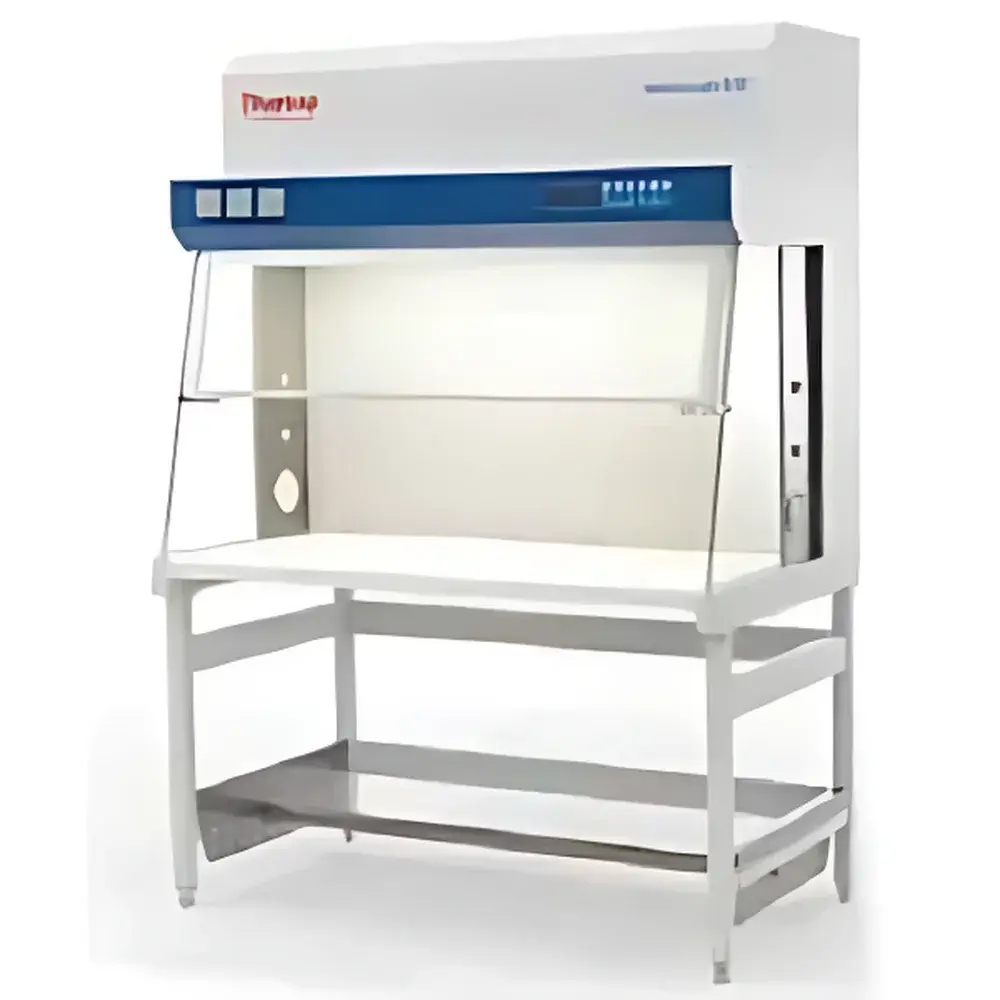
Thermo Fisher Heraguard™ ECO Vertical Laminar Flow Clean Bench
| Brand | Thermo Fisher |
|---|---|
| Origin | USA |
| Model | ECO 0.9 |
| Airflow Type | Vertical Laminar Flow |
| Cleanliness Class | ISO Class 5 (100-level) |
| Noise Level | <55 dB(A) |
| Rated User Capacity | 2 operators |
| Pre-filter | EN779 G3 coarse-to-medium dust filter |
| HEPA Filter | EN1822 H14 (≥99.995% @ 0.3 µm) |
| Work Surface Options | Melamine or 316 stainless steel |
| UV Lamp | Optional |
| Illumination | >1000 lx |
| Power Consumption | 270 W |
| Air Velocity Range | 0.15–0.25 m/s (low mode), 0.36–0.45 m/s (high mode) |
| Compliance | CE marked per 2006/95/EC (LVD), 2004/108/EC (EMC), 2011/65/EC (RoHS), 2006/121/EC (REACH) |
| EN 61010-1 | 2011, EN 61326:2006 |
| Certifications | GOST-R certified for CIS markets |
Overview
The Thermo Fisher Heraguard™ ECO Vertical Laminar Flow Clean Bench is an ISO Class 5 (100-level) laboratory containment system engineered to provide unidirectional, particle-free airflow over the work surface—ensuring protection of sensitive samples from ambient airborne contamination. Unlike horizontal flow hoods, this vertical laminar flow design directs HEPA-filtered air downward—from ceiling-mounted plenum through a uniform diffuser—across the work area and into a front grille, minimizing turbulence and cross-contamination risks. It is not intended for personnel or environmental protection; rather, it serves as a critical engineering control in applications requiring sterile sample handling, such as cell culture preparation, microbiological assay setup, pharmaceutical aseptic weighing, and precision electronics assembly. The ECO 0.9 model is optimized for dual-operator workflows within compact laboratory footprints, delivering consistent airflow velocity (0.15–0.25 m/s low mode; 0.36–0.45 m/s high mode) across its 920 mm wide × 645 mm high × 585 mm deep work envelope.
Key Features
- Tool-free maintenance architecture: Front-access HEPA filter replacement eliminates need for disassembly or wall-mount removal—reducing downtime and service labor costs.
- SmartPort integrated utility pass-through: Patented side-wall conduit system enables secure, sealed routing of vacuum lines, power cables, and gas tubing without compromising laminar integrity or introducing leakage paths.
- Optimized ergonomics & visibility: Full-height side panels fabricated from single-piece tempered safety glass enhance peripheral visibility and reduce operator fatigue during extended procedures.
- Modular pre-filter system: G3-class pre-filter installed at intake is manually replaceable without tools, extending main HEPA service life and lowering long-term operating cost.
- Dual-surface workbench options: Standard white melamine surface resists common lab reagents; optional 316 stainless steel cladding provides corrosion resistance for aggressive solvents or high-humidity environments.
- Configurable illumination and sterilization: Integrated LED lighting delivers >1000 lx uniformity across work surface; optional UV-C lamp (254 nm) supports periodic decontamination of interior surfaces—activated only when sash is fully closed and interlocked.
Sample Compatibility & Compliance
The Heraguard ECO series complies with international safety and electromagnetic compatibility standards essential for regulated laboratory environments: EN 61010-1:2011 (safety requirements for electrical equipment), EN 61326:2006 (EMC for measurement/control devices), and EU directives including Low Voltage Directive (2006/95/EC), EMC Directive (2004/108/EC), RoHS (2011/65/EC), and REACH (2006/121/EC). It carries CE marking and GOST-R certification for deployment in Russia and Eurasian Economic Union member states. While not classified as a biological safety cabinet (BSC), its laminar flow performance aligns with ISO 14644-1 Class 5 requirements for cleanroom-associated equipment. The unit does not meet NSF/ANSI 49 or EN 12469 for personnel protection and must not be used for handling biohazards above BSL-1.
Software & Data Management
The Heraguard ECO 0.9 operates via a dedicated microprocessor-based control panel featuring real-time display of airflow status, UV lamp cycle counter, and filter life estimation based on cumulative runtime and pressure differential monitoring. No external software or network connectivity is required—consistent with IEC 62304 Class A medical device software principles and FDA 21 CFR Part 11 considerations for audit-trail-free operation. All operational parameters—including fan speed selection, UV timer settings, and alarm thresholds—are stored in non-volatile memory. For laboratories implementing GLP or GMP frameworks, optional calibration documentation packages are available upon request, including traceable airflow velocity verification reports compliant with ISO 14644-3 Annex B.
Applications
- Aseptic preparation of mammalian and insect cell cultures in academic and biotech research labs
- Weighing and dispensing of potent active pharmaceutical ingredients (APIs) under cGMP-compliant environments
<liAssembly and testing of microelectromechanical systems (MEMS) and optical components requiring particulate-free handling
<liPreparation of PCR master mixes and nucleic acid templates to prevent amplicon carryover contamination
<liSterile packaging validation studies where environmental monitoring requires controlled background particle counts
<liQuality control testing of medical devices prior to final sterilization (e.g., ISO 11737-1 sampling)
FAQ
Is the Heraguard ECO certified for use in ISO-certified cleanrooms?
Yes—the ECO series meets ISO 14644-1 Class 5 (formerly Federal Standard 209E Class 100) airflow uniformity and particle concentration specifications when installed and operated per manufacturer guidelines.
Can the unit be integrated into a building management system (BMS)?
No native BACnet or Modbus interface is provided; however, dry-contact alarm outputs (filter clog, UV fault, airflow deviation) support basic integration with third-party monitoring systems.
What is the recommended HEPA filter replacement interval?
Filter life depends on ambient air quality and usage frequency; typical service intervals range from 12 to 24 months. Pressure drop monitoring and annual airflow verification are advised per ISO 14644-3.
Does the UV lamp comply with IEC 62471 photobiological safety standards?
Yes—the optional UV-C module is classified as Risk Group 2 (Moderate Risk) and includes hardware interlocks preventing activation unless the front sash is fully lowered and sealed.
Is stainless steel work surface compatible with ethanol or isopropanol disinfection protocols?
Yes—316 stainless steel construction withstands repeated exposure to 70% ethanol and 70% isopropanol without pitting or surface degradation, supporting routine decontamination per USP guidance.
Related Products



