
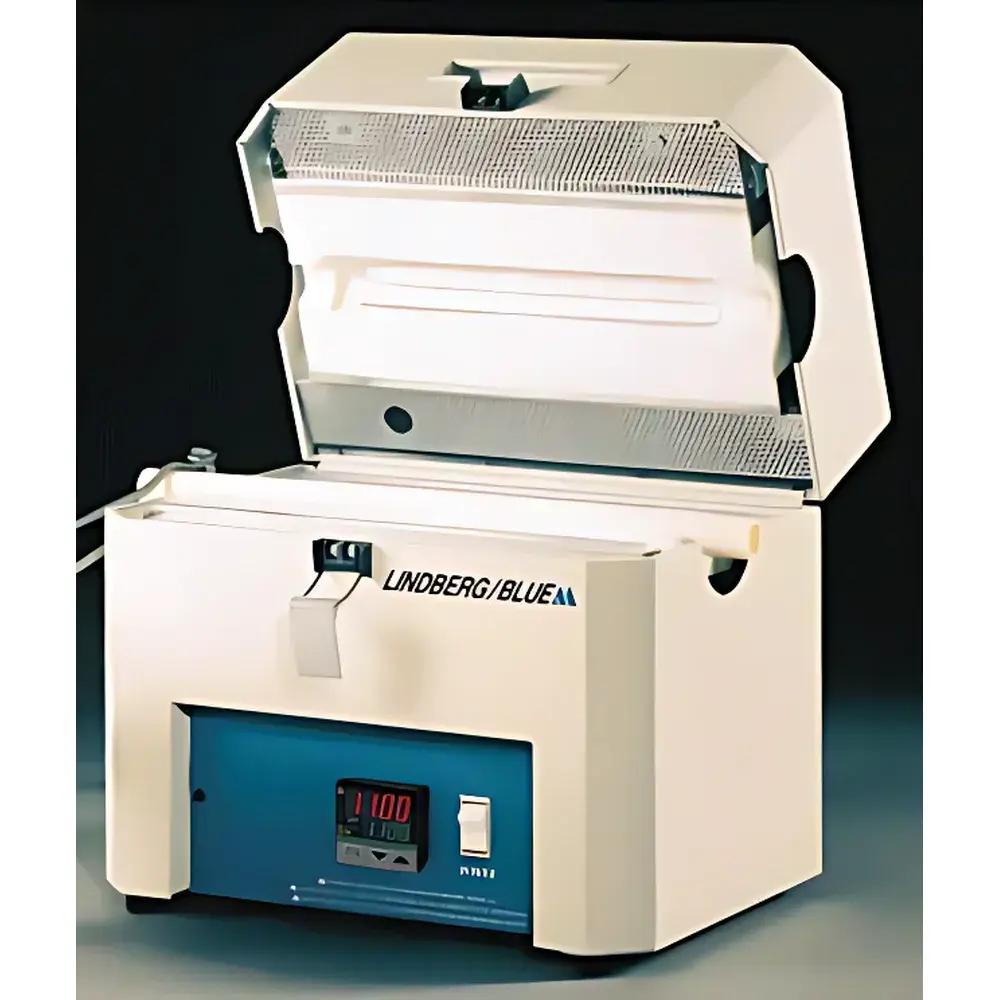
Thermo Fisher Lindberg/Blue M TF55030C-1 1100°C Single-Zone Horizontal Tube Furnace
| Brand | Thermo Fisher |
|---|---|
| Origin | USA |
| Manufacturer | Thermo Fisher Scientific |
| Product Type | Tube Furnace |
| Max Temperature | 1100°C |
| Temperature Control Accuracy | ±2–4°C |
| Max Power | 800 W |
| Heating Rate (to Max Temp) | 6–12°C/min |
| Heating Method | Resistive Wire (Kanthal A1) |
| Internal Chamber Dimensions | 381 × 279.4 × 406.4 mm |
| External Dimensions (H×D×W) | 381 × 279.4 × 406.4 mm |
| Voltage/Frequency | 208–240 V, 50/60 Hz |
| Net Weight | 16 kg |
| Thermocouple Type | K-type |
| Controller Options | Single-Setpoint or Multi-Step Programmable Controller |
| Operating Tube ID | 25.4 mm |
| Heated Zone Length | 304.8 mm |
Overview
The Thermo Fisher Lindberg/Blue M TF55030C-1 is a compact, single-zone horizontal tube furnace engineered for precise thermal processing in research laboratories, materials science labs, and quality control environments. Designed around a robust resistive heating architecture using high-purity Kanthal A1 resistance wire, the furnace delivers stable, repeatable temperature profiles up to 1100°C within its insulated chamber. Its horizontal configuration accommodates standard quartz or ceramic process tubes (25.4 mm ID, 304.8 mm heated length), enabling controlled atmosphere experiments—including inert gas purging, vacuum-compatible operation (with optional fittings), and low-oxygen annealing. The unit features a front-loading design with an upward-swinging door, minimizing heat loss during sample insertion and removal while maintaining operator safety through integrated interlock logic.
Key Features
- Compact footprint (381 × 279.4 × 406.4 mm) and lightweight construction (16 kg) facilitate benchtop deployment and repositioning across shared lab spaces.
- Moldatherm® high-efficiency insulation reduces external surface temperature rise and improves energy efficiency—typical external skin temperature remains below 60°C at 1100°C internal setpoint.
- Front-mounted control panel includes dual-function toggle switch, LED temperature display, and manual power cutoff—designed for intuitive, glove-compatible operation.
- Integrated door safety interlock instantly de-energizes heating elements upon door opening, protecting both thermocouple integrity and user safety per IEC 61010-1 requirements.
- K-type thermocouple with extended service life provides reliable temperature feedback; calibrated traceability supports ISO/IEC 17025-compliant validation protocols.
- Two controller options available: basic single-setpoint analog controller (TF55030C-1) or digital multi-step programmable controller (TF55035C-1) supporting up to 16 ramp-hold segments and soak profiles.
Sample Compatibility & Compliance
The TF55030C-1 accommodates standard 1-inch (25.4 mm) OD quartz, alumina, or fused silica tubes with lengths up to 610 mm. Its horizontal orientation ensures uniform axial temperature distribution across the 304.8 mm heated zone (±5°C uniformity at 1000°C). The furnace meets UL 61010-1 and CSA C22.2 No. 61010-1 safety standards for laboratory electrical equipment. When operated with certified inert gas manifolds and validated tube seals, it supports ASTM E29-23-compliant thermal treatment procedures for ceramic sintering, catalyst calcination, and thin-film precursor decomposition. Optional accessories include gas inlet/outlet ports, water-cooled flanges, and PID-tuned controllers compliant with FDA 21 CFR Part 11 audit trail requirements when paired with Thermo Fisher’s optional data logging software.
Software & Data Management
While the base TF55030C-1 operates via standalone analog or digital front-panel controls, integration with Thermo Fisher’s optional LabManager™ Thermal Suite enables remote monitoring, real-time profile logging, and electronic record generation. The suite supports CSV export, time-stamped event tagging (e.g., door open/close, power cycle), and configurable alarm thresholds—facilitating GLP/GMP documentation workflows. All logged data retain NIST-traceable timestamps and are stored with immutable metadata, satisfying internal audit and regulatory review expectations for thermal process validation.
Applications
- Low-volume annealing of semiconductor substrates and metal foils under nitrogen or argon atmospheres.
- Controlled pyrolysis of polymer precursors for carbon nanomaterial synthesis.
- Thermal gravimetric analysis (TGA) pre-conditioning of reference standards per ASTM E1131.
- Heat treatment of dental alloys and biomedical ceramics per ISO 6872 and ISO 13356 specifications.
- Pre-baking and post-deposition thermal cycling of thin-film photovoltaic layers (e.g., CIGS, perovskites).
- Calibration verification of secondary temperature sensors using fixed-point reference materials (e.g., Al, Zn, Sn ITS-90 points).
FAQ
What tube materials are compatible with the TF55030C-1?
Quartz, high-purity alumina, and fused silica tubes with outer diameters ≤25.4 mm and total lengths ≤610 mm are recommended. Avoid borosilicate glass above 800°C due to creep deformation risk.
Can this furnace be used under vacuum conditions?
Yes—when fitted with vacuum-rated end caps and O-rings (sold separately), the furnace supports rough vacuum (≤10⁻² mbar) operation. For high vacuum, consult Thermo Fisher Application Support for flange compatibility and outgassing mitigation guidelines.
Is the temperature uniformity specified across the entire chamber?
Uniformity is characterized over the 304.8 mm heated zone only: ±5°C at 1000°C, measured per ASTM E220 calibration methodology using five-point traversing thermocouples.
Does the furnace support ramp-and-soak programming without upgrading the controller?
No—the base TF55030C-1 includes only single-setpoint control. Ramp-and-soak functionality requires the TF55035C-1 multi-step controller or external programmable power supply interfaced via 4–20 mA analog input.
What maintenance intervals are recommended for long-term reliability?
Inspect heating element continuity and thermocouple output annually; replace Kanthal A1 wire elements every 2,000–3,000 operating hours at ≥900°C. Clean interior insulation surfaces quarterly to prevent dust accumulation affecting thermal response.



