
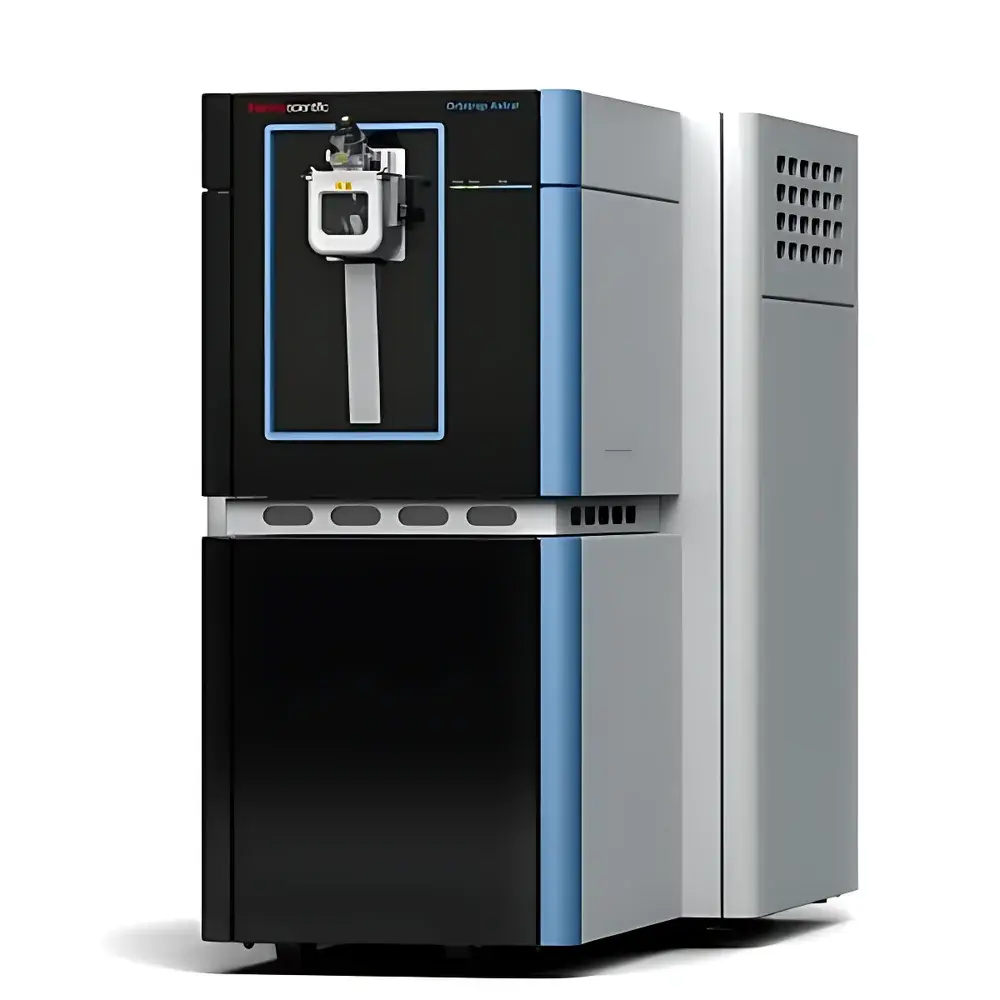
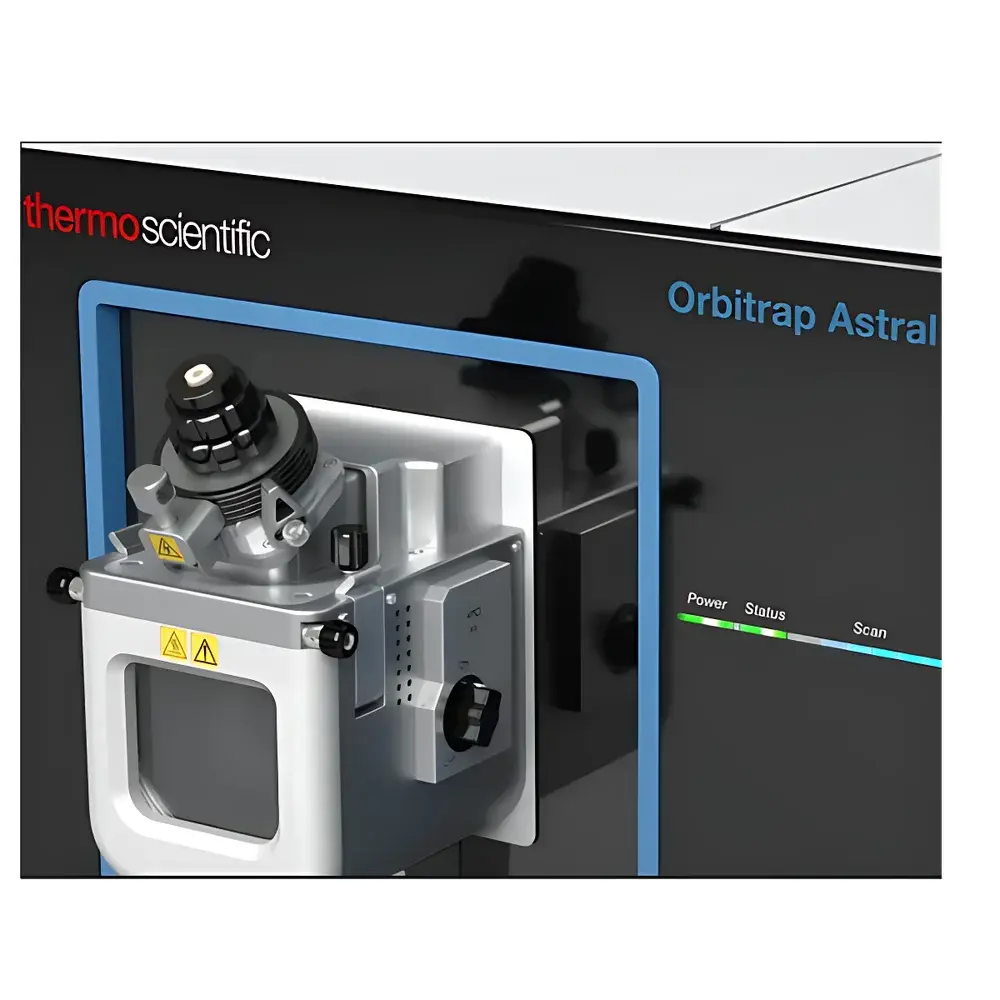
Thermo Fisher Orbitrap Astral Mass Spectrometer
| Brand | Thermo Fisher |
|---|---|
| Origin | Shanghai, China |
| Manufacturer Type | Authorized Distributor |
| Origin Category | Domestically Manufactured (China) |
| Model | Orbitrap Astral |
| Instrument Type | Orbitrap Mass Spectrometer |
| Application Field | Universal Proteomics & Small Molecule Analysis |
| Resolution | 480,000 at m/z 200 |
| Mass Accuracy | < 3 ppm RMS (external calibration) |
| Mass Range | 40–6,000 m/z |
| Dynamic Range per Spectrum | > 5,000 |
| Scan Rate | up to 200 Hz |
| Dimensions (D × W × H) | 185 × 96 × 140 cm |
| Weight | 680 kg |
Overview
The Thermo Fisher Orbitrap Astral Mass Spectrometer represents a paradigm shift in high-throughput, high-fidelity mass spectrometry for large-scale proteomics and multi-omic applications. Engineered around an enhanced Orbitrap mass analyzer architecture coupled with advanced ion transmission optics and real-time intelligent acquisition algorithms, the system delivers unprecedented depth, speed, and quantitative precision in bottom-up and top-down proteomics workflows. Unlike conventional Orbitrap platforms, the Astral design integrates a novel dual-pressure ion path, optimized C-trap pulsing, and synchronized parallel detection to achieve sub-second duty cycles without compromising spectral quality. Its core measurement principle relies on electrostatic trapping of ions within a modified Orbitrap analyzer, where image current detection enables Fourier-transform-based mass analysis with exceptional mass accuracy and resolving power—critical for distinguishing isobaric peptides, post-translational modifications (PTMs), and co-eluting species in complex biological matrices.
Key Features
- Ultra-high resolution of 480,000 at m/z 200, enabling confident identification of near-isobaric species across broad mass ranges (40–6,000 m/z)
- Mass accuracy of < 1 ppm RMS using internal calibration standards—meeting stringent requirements for regulatory-compliant biomarker discovery and clinical assay development
- Scan rates up to 200 Hz, supporting ultra-fast LC gradients and achieving full proteome coverage in ≤8 minutes per injection
- Dynamic range exceeding 5,000-fold within a single transient, facilitating simultaneous quantification of low-abundance signaling proteins and high-abundance structural proteins
- Robust architecture optimized for 24/7 operation in core facilities, with integrated vacuum management, thermal stabilization, and automated diagnostic routines
- Native compatibility with Thermo Scientific™ Vanquish™ UHPLC systems and EASY-nLC™ platforms for seamless method transfer and reproducible chromatographic coupling
Sample Compatibility & Compliance
The Orbitrap Astral platform supports diverse sample types including tryptic digests, intact proteins, native complexes, metabolite extracts, and synthetic oligonucleotides. It is routinely deployed in GLP- and GMP-aligned environments for target engagement studies, biopharmaceutical characterization, and translational biomarker validation. The instrument complies with ISO/IEC 17025 requirements for analytical testing laboratories and supports audit trails, electronic signatures, and instrument qualification protocols aligned with FDA 21 CFR Part 11 and EU Annex 11. All calibration, tuning, and performance verification procedures are traceable to NIST-traceable standards and documented per ICH Q2(R2) guidelines.
Software & Data Management
Controlled via Thermo Scientific™ Compound Discoverer™ 3.3 and Thermo Scientific™ Proteome Discoverer™ 2.5 software suites, the Astral system provides end-to-end workflow automation—from raw data acquisition through spectral library matching, PTM localization, and statistical inference. Integrated support for DIA (Data-Independent Acquisition) and TMT (Tandem Mass Tag) multiplexing enables label-free and isobaric quantification across hundreds of samples with built-in batch correction and missing value imputation. Raw files are stored in open-format Thermo RAW format, fully compatible with open-source tools such as MaxQuant, FragPipe, and Skyline. Data integrity is ensured through SHA-256 checksum logging, version-controlled processing methods, and export-ready reports compliant with MIAME and MIAPE metadata standards.
Applications
- Deep proteome profiling: Identification and quantification of >12,000 proteins per hour in human cell lysates, approaching near-complete proteome coverage
- Single-cell proteomics: Reliable quantification of ~3,000 proteins per HeLa cell from 80 individually processed samples in a single day
- Time-resolved phosphoproteomics: Monitoring dynamic kinase-substrate relationships across 10+ timepoints with <2 ppm mass error
- Structural proteomics: Intact protein mass measurement and top-down sequencing of monoclonal antibodies and viral capsid proteins
- Multi-omic integration: Correlative analysis of proteome, phosphoproteome, acetylome, and metabolome datasets using shared retention time alignment and cross-platform normalization
- Clinical cohort studies: Reproducible quantification across >1,000 plasma samples in longitudinal disease progression studies
FAQ
What distinguishes the Orbitrap Astral from previous-generation Orbitrap instruments?
The Astral introduces a redesigned ion optical pathway, higher-frequency detection electronics, and real-time adaptive scanning algorithms—enabling faster scan speeds while maintaining or improving resolution and mass accuracy.
Is the Orbitrap Astral compatible with existing Thermo LC systems?
Yes—it is natively interoperable with Vanquish Flex, Vanquish Horizon, and EASY-nLC 1200 systems via standard Thermo Scientific™ Chromeleon™ CDS and instrument control drivers.
Does the system support both DDA and DIA acquisition modes?
Yes—full support for data-dependent acquisition (DDA), data-independent acquisition (DIA), and targeted SIM/MRM modes is included out-of-the-box.
Can the Astral be qualified for regulated environments?
Yes—comprehensive IQ/OQ/PQ documentation packages, 21 CFR Part 11 compliance modules, and vendor-supported validation services are available upon request.
What is the recommended maintenance schedule?
Routine maintenance includes quarterly ion source cleaning, semi-annual mass calibration verification, and annual vacuum system inspection—aligned with Thermo Scientific™ Service Level Agreements.






