
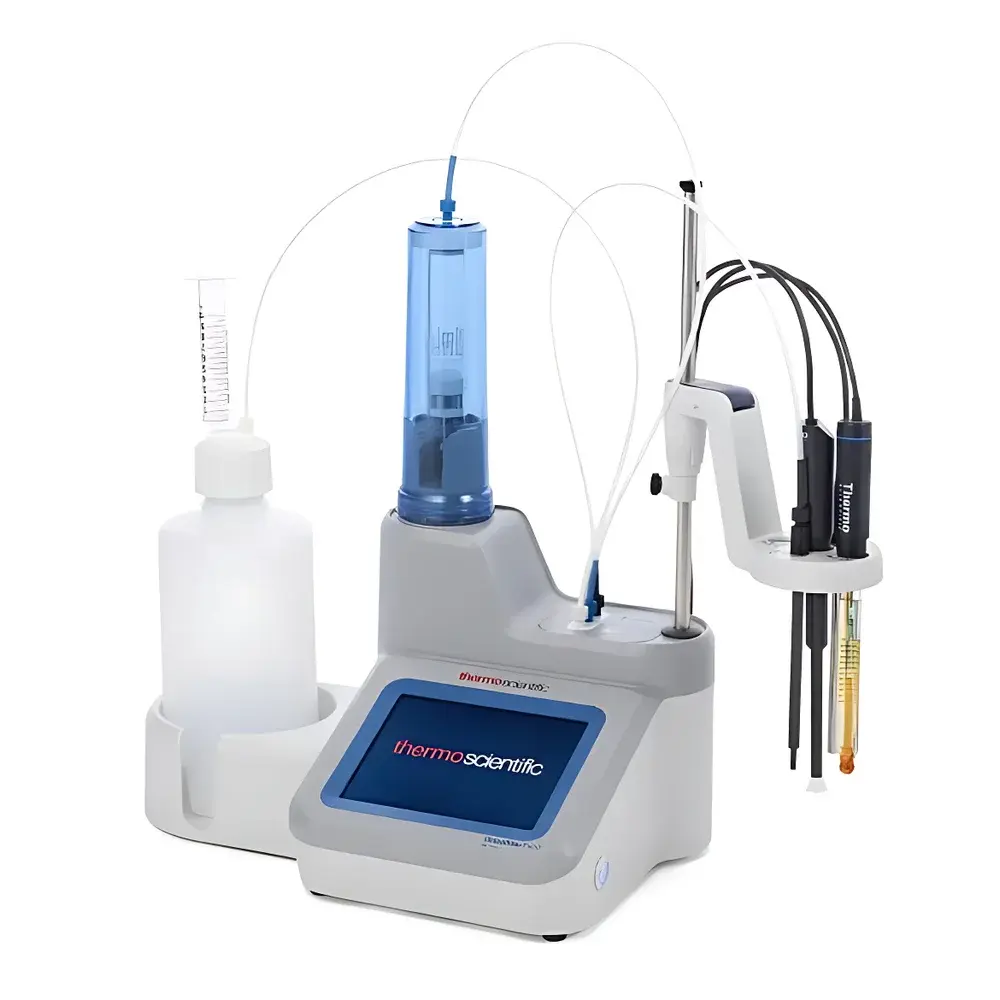
Thermo Fisher Orion Star T910 Automatic Potentiometric Titrator
| Brand | Thermo Fisher |
|---|---|
| Origin | USA |
| Manufacturer | Thermo Fisher Scientific |
| Type | Orion Star T910 |
| Instrument Category | General-purpose Potentiometric Titrator |
| Measurement Range | pH: −2.000 to 20.000 |
| mV | −2000 to +2000 mV |
| Temperature | −5 to 100 °C |
| Meter Accuracy | ±0.2% of full scale |
| Meter Resolution | pH: 0.001 |
| mV | 0.1 mV |
| Temperature | 0.1 °C |
| Titration Accuracy | (±0.3 mV ±1 digit) over 3 h |
Overview
The Thermo Fisher Orion Star T910 Automatic Potentiometric Titrator is an integrated electrochemical analysis platform engineered for precision, reproducibility, and operational simplicity in routine and research-grade titrimetric applications. Based on potentiometric endpoint detection—measuring the potential difference between a reference electrode and an indicator electrode as a function of titrant volume—the Star T910 delivers high-fidelity quantification of acid-base, redox, precipitation, and complexometric reactions. Its architecture conforms to fundamental electrochemical measurement principles defined in ASTM E2087 and ISO 8655-6, ensuring traceable compliance in regulated environments. Designed for laboratories requiring robust, out-of-the-box functionality without software dependency, the instrument operates autonomously via its embedded firmware, eliminating external PC requirements for core titration execution. The system’s dual-channel input supports simultaneous pH/mV and temperature monitoring, enabling real-time compensation and thermally stabilized endpoint determination across diverse sample matrices.
Key Features
- Integrated 20 mL precision burette with glass piston and PTFE stopcock, calibrated per ISO 8655-3 and certified for volumetric accuracy ≤ ±0.1% (v/v)
- Large 7-inch capacitive color touchscreen with intuitive icon-driven navigation, supporting multi-language UI (English, Spanish, French, German, Chinese)
- Onboard method storage for up to 10 user-defined titration protocols—including preset endpoint, dynamic equivalence point (first derivative), and Gran plot methods—with step-by-step on-screen guidance
- Automatic result calculation engine with configurable units (e.g., % acidity, mg/L alkalinity, mmol/L concentration), error propagation handling, and statistical summary (mean, SD, RSD)
- Internal non-volatile memory retaining ≥10,000 complete titration records, each timestamped with date, time, operator ID (optional), and full audit trail metadata
- Dual-electrode support with automatic recognition of Thermo Scientific™ Orion™ ROSS™ pH electrodes (e.g., 8102BNUWP, 8172BNWP) and ATC temperature probes (e.g., 927007MD)
- Comprehensive connectivity: USB host (for printer, flash drive, keyboard), USB device (PC data export), RS-232 (legacy peripherals), and optional Ethernet module for networked data logging
Sample Compatibility & Compliance
The Star T910 accommodates liquid, semi-solid, and suspended-phase samples typical in food & beverage (e.g., titratable acidity in wine, juice, dairy), environmental testing (carbonate/bicarbonate alkalinity in drinking water and wastewater per APHA 2320 B), industrial QA/QC (free fatty acids in oils, chloride in plating baths), and academic instruction. Its modular fluid path—comprising chemically resistant PTFE/PFA tubing, ceramic stirrer tips, and optional inert gas purging—minimizes contamination and oxidation artifacts. All hardware and firmware comply with IEC 61010-1 (safety) and IEC 61326-1 (EMC). Data integrity meets GLP/GMP expectations through built-in electronic signatures (user login), immutable record timestamps, and export-ready CSV/Excel formats compatible with LIMS integration. While not inherently 21 CFR Part 11 compliant, the system supports validated operation when deployed with controlled access, documented SOPs, and external audit-trail archiving.
Software & Data Management
No proprietary software installation is required for basic operation; all titration control, calibration, and reporting occur natively on the instrument. For advanced data review and regulatory submission, Thermo Fisher provides optional Orion Titrator Connect desktop software (Windows only), enabling method synchronization, batch report generation, PDF certificate export, and trend analysis across historical datasets. Raw data exports include full titration curves (mV vs. volume), derivative plots, calibration logs, and electrode diagnostics—each embedded with ISO/IEC 17025–aligned metadata (instrument ID, calibration dates, environmental conditions). Internal memory supports direct printing to ESC/POS-compatible thermal printers or export to FAT32-formatted USB drives without intermediate PC transfer.
Applications
- Food & Beverage: Titratable acidity (TA) in fruit juices, wines, and fermented products per AOAC 942.05; lactic acid in yogurt; citric acid in soft drinks
- Environmental: Total alkalinity and hardness in surface water per EPA Method 310.1; free chlorine residual in distribution systems
- Industrial Chemistry: Saponification value of fats/oils; hydroxide and carbonate content in caustic soda; amine value in epoxy resins
- Pharmaceutical Excipients: Assay of sodium bicarbonate, citric acid monohydrate, and tartaric acid per USP & Ph. Eur. monographs
- Academic Teaching: Student-led acid–base titrations with real-time curve visualization; comparative studies of electrode response kinetics and junction potential effects
FAQ
Does the Star T910 support non-aqueous titrations?
Yes—when paired with compatible non-aqueous electrodes (e.g., Orion 910000 series) and appropriate solvents (e.g., glacial acetic acid, methanol), the instrument performs perchloric acid titrations per USP & Ph. Eur. guidelines.
Can I perform back-titrations or multi-step titrations?
The firmware supports sequential addition steps and conditional logic (e.g., “add 5 mL HCl, wait 30 s, then titrate with NaOH”), enabling standardized back-titration workflows such as chloride determination by Volhard method.
Is electrode calibration automated?
Calibration is semi-automated: users initiate 2- or 3-point pH/mV calibration via touchscreen; the system validates slope (% recovery), offset, and asymmetry potential, flagging electrodes outside Thermo Fisher’s acceptance criteria (e.g., slope 95–105%, offset ±30 mV).
What maintenance is required for long-term reliability?
Routine maintenance includes monthly cleaning of the burette piston and tip with isopropanol, quarterly verification of burette delivery accuracy using certified weights, and annual verification of temperature probe drift against NIST-traceable reference baths.
How is data security handled during USB export?
Data exported to USB devices is stored in plain-text CSV format with no encryption; however, file naming conventions and directory structure follow ISO/IEC 27001-aligned lab practices (e.g., “T910_20240522_1430_SampleID.csv”) to support chain-of-custody documentation.
Related Products





