
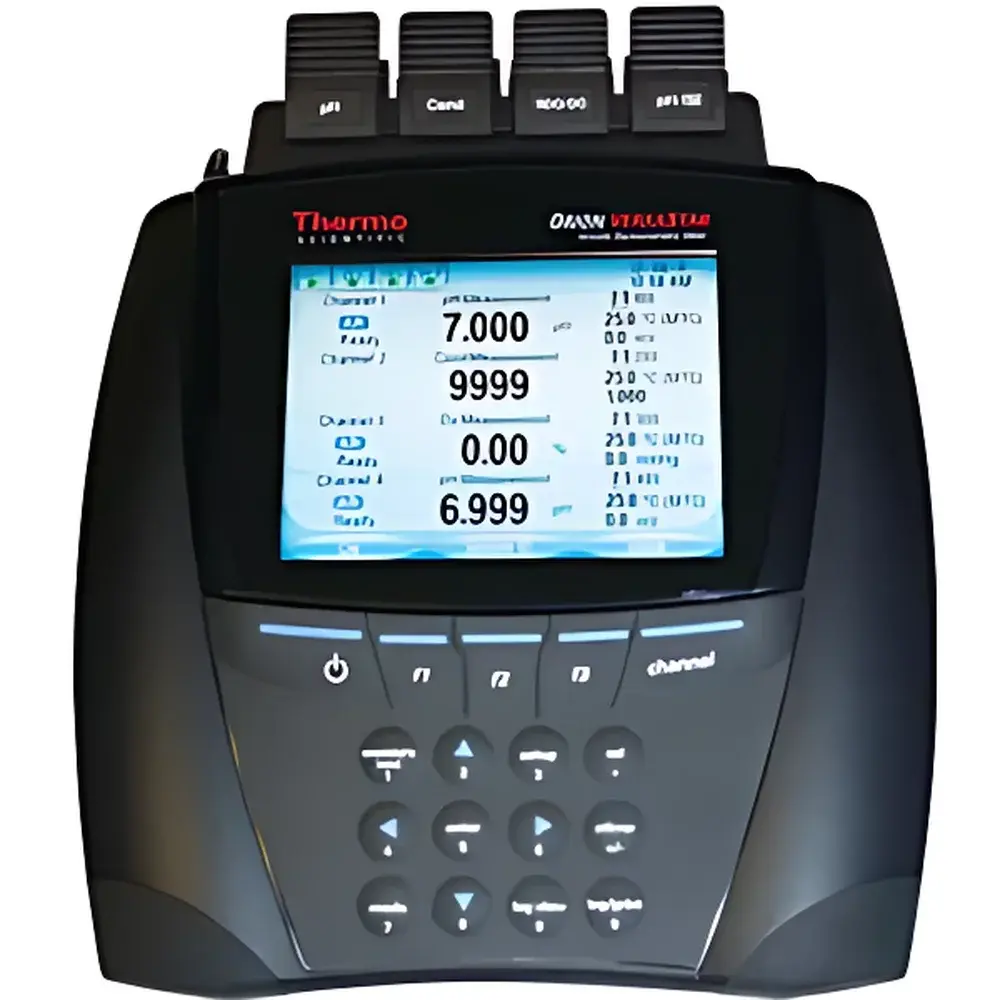
Thermo Fisher Orion VERSA STAR Desktop Multiparameter Meter
| Brand | Thermo Fisher |
|---|---|
| Origin | USA |
| Model | VERSA STAR (VM-01 refers to base configuration) |
| Compliance | GLP, USP <645>, ASTM D1125, ISO 7888, ISO 5814, ISO 10523, FDA 21 CFR Part 11 (with optional audit trail software) |
| Data Storage | 2000 GLP-compliant entries |
| Connectivity | Dual USB + RS232 |
| Module Capacity | Up to 4 simultaneous modules |
| IP Rating | IP54 |
| Power | 90–260 V AC, 50–60 Hz |
Overview
The Thermo Fisher Orion VERSA STAR Desktop Multiparameter Meter is a modular, laboratory-grade analytical platform engineered for precision measurement of pH, ion concentration (ISE), conductivity, dissolved oxygen (DO), and temperature across diverse aqueous sample matrices. Built upon a robust, microprocessor-controlled architecture, the system operates on proven electrochemical principles—including potentiometric pH/ISE detection, four-electrode conductivity measurement with selectable cell constants, Clark-type polarographic and luminescent RDO (Ruthenium-based optical) DO sensing, and integrated ATC (Automatic Temperature Compensation) algorithms that correct for thermal effects on electrode slope and solution conductivity. Designed for regulated environments, its hardware and firmware comply with core requirements of GLP (Good Laboratory Practice) and support traceable data integrity under FDA 21 CFR Part 11 when paired with validated PC software and user access controls. The instrument serves as a central hub in QC labs, environmental testing facilities, pharmaceutical water systems, and academic research settings where reproducibility, multi-analyte flexibility, and audit-ready documentation are non-negotiable.
Key Features
- Modular architecture supporting up to four independent measurement modules simultaneously—pH/Temp, ISE/Temp, Conductivity/Temp, DO/Temp, or pH/LogR/Temp—enabling rapid reconfiguration without hardware replacement.
- GLP-compliant data management: stores 2000 measurement records with timestamp, operator ID, electrode serial number, calibration history, and environmental metadata (e.g., atmospheric pressure, salinity).
- Intelligent calibration tools: editable calibration curves, endpoint detection (timed or stable-slope), linear/nonlinear fitting, automatic blank subtraction, and incremental/spiking methods for ISE quantification.
- Dual stirring control: two dedicated 8-pin mini-DIN ports for Orion Star-compatible magnetic stirrers, ensuring consistent hydrodynamic conditions during titration or low-conductivity measurements.
- Multi-standard buffer recognition: auto-detection of USA, NIST, and DIN pH buffer sets; built-in seawater salinity curve per ASTM D1125 and ISO 9467; configurable TDS factors and resistivity conversion models.
- Advanced diagnostics: LogR module provides real-time electrode resistance monitoring (0–6000 MΩ) and predictive failure alerts; RDO probe self-checks luminescence decay kinetics prior to measurement.
Sample Compatibility & Compliance
The VERSA STAR accommodates standard laboratory electrodes—including combination pH, double-junction reference, solid-state ISE, toroidal/conductivity cells (K = 0.001–199.9 cm⁻¹), and both polarographic and optical DO probes—across sample types ranging from ultrapure water (≥18.2 MΩ·cm) to concentrated brines (up to 80 ppt NaCl). Its conductivity module implements non-linear temperature compensation per USP <645> for purified water systems and supports pharmacopeial resistivity pass/fail criteria. Dissolved oxygen measurements meet ISO 5814 (optical) and ISO 10523 (electrochemical) validation protocols. All modules adhere to IEC 61010-1 safety standards and operate within an IP54-rated enclosure suitable for general lab use. Regulatory alignment includes ASTM D1125 (conductivity), ISO 7888 (pH), and EPA Method 360.1 (DO), with full traceability to NIST-traceable reference standards.
Software & Data Management
Data export and instrument control are facilitated via native USB mass-storage mode (no driver required) or RS232 serial communication. Stored datasets transfer directly to spreadsheet or LIMS platforms as CSV files containing raw values, units, calibration coefficients, and metadata fields required for 21 CFR Part 11 compliance. Optional Orion Star Com software enables real-time graphing, statistical analysis (mean, SD, RSD, confidence intervals), BOD/DOUR/SOUR kinetic modeling, and generation of PDF reports with digital signatures. Audit trail functionality—when enabled—logs all user actions (calibrations, edits, deletions) with timestamps and operator IDs, satisfying GLP audit requirements and internal QA reviews.
Applications
- Pharmaceutical water quality: USP <645> resistivity and conductivity verification in Purified Water (PW) and Water for Injection (WFI) loops.
- Environmental monitoring: Field-deployable calibration and multi-parameter profiling of surface water, wastewater effluents, and groundwater (pH, NH₄⁺, NO₃⁻, Cl⁻, EC, DO).
- Food & beverage QC: Titratable acidity (pH), salt content (Na⁺ ISE), total dissolved solids (TDS), and shelf-life oxygen ingress testing (RDO).
- Academic research: Electrode characterization (LogR), kinetic studies of redox reactions (mV vs. time), and temperature-dependent ion activity modeling.
- Industrial process control: Continuous calibration verification of inline sensors using grab-sample correlation against VERSA STAR reference measurements.
FAQ
Does the VERSA STAR support FDA 21 CFR Part 11 compliance?
Yes—when used with validated Orion Star Com software, configured user roles, electronic signatures, and enabled audit trail logging, it meets Part 11 requirements for electronic records and signatures.
Can I measure both polarographic and optical DO probes on the same instrument?
Yes—the VSTAR-RD module automatically detects and configures either Clark-type or RDO probes via plug-and-play 9-pin mini-DIN connectivity.
Is temperature compensation applied automatically during ISE measurements?
Yes—ATC is active across all modules; for ISE, temperature correction is applied to the Nernst slope calculation in real time.
How many calibration points can be stored per parameter?
Up to six calibration points per method (e.g., pH, conductivity, DO), with editable coefficients and residual error reporting.
What happens if power is interrupted during data logging?
All measurements are written to non-volatile memory immediately upon acquisition; no data loss occurs during unexpected shutdown.







