
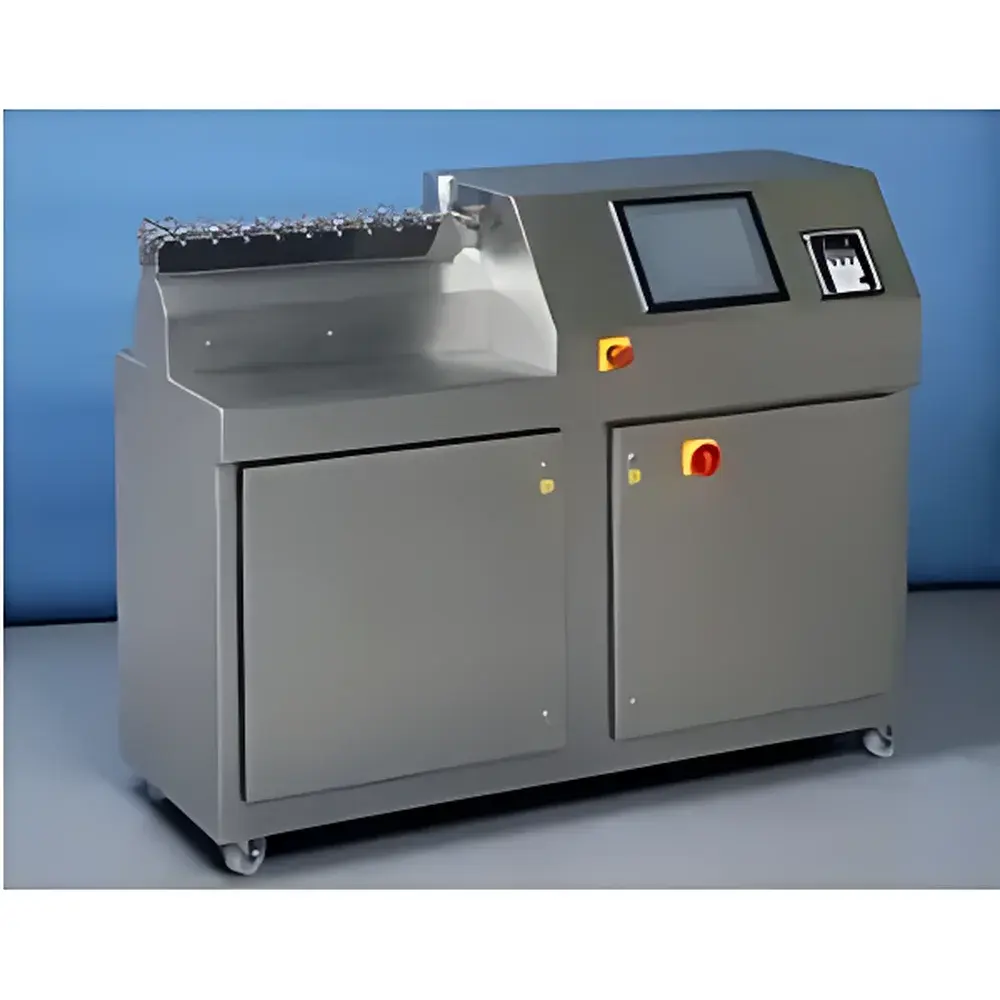
Thermo Fisher Pharma 16 HME Hot Melt Extruder
| Brand | Thermo Fisher |
|---|---|
| Origin | Germany |
| Manufacturer Type | Original Equipment Manufacturer (OEM) |
| Origin Category | Imported |
| Model | Pharma 16 |
| Price | Upon Request |
| Screw Diameter | 15.6 mm |
| Barrel Diameter | 16 mm |
| L/D Ratio | 25:1 to 40:1 (modular) |
| Motor Power | 2.5 kW |
| Max Screw Speed | 1000 rpm |
| Free Volume | 6–109 cm³ |
| Voltage/Phase/Current | 400 V / 3-phase / 20 A |
| Throughput | 1–5 kg/h |
| Barrel Material | Pharmaceutical-grade stainless steel (e.g., AISI 316L) |
| Drive | Brushless AC inverter motor |
| Control System | Touchscreen HMI with PLC-based data acquisition |
| Compliance | Designed per EU GMP Annex 1 & ICH Q5A/Q5C principles |
Overview
The Thermo Fisher Pharma 16 HME is a laboratory-scale, twin-screw hot melt extruder engineered for pharmaceutical process development, formulation screening, and clinical batch manufacturing. It operates on the principle of co-rotating intermeshing twin-screw extrusion—utilizing precise thermal control, screw geometry modulation, and residence time distribution management to achieve homogeneous melt blending, amorphous solid dispersion (ASD) formation, and polymer-based drug delivery system fabrication. With a nominal barrel diameter of 16 mm and an adjustable L/D ratio spanning 25:1 to 40:1 via modular barrel sections, the system supports scalable parameter mapping from lab to pilot scale. Its horizontal split-barrel design enables rapid access to screw elements and internal surfaces—critical for cleaning validation, cross-contamination control, and flexible configuration changes between API-excipient systems. The unit is purpose-built for integration into continuous manufacturing lines compliant with FDA’s Guidance for Industry on Continuous Manufacturing of Drug Substances and Products (2019) and aligned with ICH Q8(R2), Q9, and Q10 frameworks.
Key Features
- Horizontal split-barrel architecture with quick-release clamps—enabling full exposure of screws and barrel interior within <90 seconds for cleaning, inspection, or screw reconfiguration.
- Modular barrel segments featuring interchangeable feed, melting, mixing, devolatilization, and die zones—each equipped with standardized thermocouple ports and optional vacuum venting (≤1 mbar).
- Pharmaceutical-grade stainless-steel construction (AISI 316L) throughout all product-contact surfaces—certified to meet USP Class VI and EP 3.1.9 requirements for extractables and leachables.
- Brushless AC servo motor with closed-loop speed control—delivering stable torque across 10–1000 rpm with ≤±0.5% speed deviation under load.
- Integrated touchscreen HMI running embedded PLC firmware—supporting recipe storage (≥100 user-defined protocols), real-time torque/temperature/pressure trending, and audit-trail-enabled parameter logging per 21 CFR Part 11 requirements.
- GMP-aligned mechanical design including sloped surfaces, zero-dead-leg geometry, and IP54-rated enclosures—validated for use in ISO Class 7 (Grade B) cleanroom environments.
Sample Compatibility & Compliance
The Pharma 16 HME accommodates a broad spectrum of thermoplastic carriers—including polyvinylpyrrolidone (PVP), hydroxypropyl methylcellulose acetate succinate (HPMCAS), Eudragit® grades, and polyethylene oxide (PEO)—as well as low-melting-point APIs (<150°C), waxy excipients, and solvent-free formulations. It supports direct coupling with PAT tools such as inline Raman spectroscopy (via fiber-optic probe ports), melt temperature sensors (ASTM E2847-compliant), and gravimetric feeders meeting USP <1059> accuracy thresholds. All mechanical and software components conform to EN 61000-6-2 (EMC immunity) and EN 61000-6-4 (EMC emission) standards. Design documentation includes DQ/IQ/OQ templates traceable to ISO 9001:2015 and ISO 13485:2016 quality management systems.
Software & Data Management
The embedded control system provides native CSV export functionality and OPC UA server capability for seamless integration into MES/SCADA platforms (e.g., Siemens SIMATIC IT, Rockwell FactoryTalk). Process data—including screw speed, barrel zone temperatures (±0.3°C accuracy), motor torque (% full scale), and melt pressure (0–100 bar range)—are timestamped and stored with user ID, session ID, and electronic signature fields. Optional Thermo Fisher Extrusion Analytics Suite enables multivariate analysis (MVA) of residence time distribution (RTD), thermal history profiling, and correlation of rheological output with dissolution performance. All data archives comply with ALCOA+ principles (Attributable, Legible, Contemporaneous, Original, Accurate, Complete, Consistent, Enduring, Available) for regulatory submissions.
Applications
- Development of amorphous solid dispersions to enhance solubility and bioavailability of BCS Class II/IV compounds.
- Hot-melt coating of pellets or mini-tablets using thermoplastic film-forming polymers.
- Continuous production of implantable or transdermal polymeric matrices without organic solvents.
- Rheological characterization of molten polymer-API blends under shear conditions representative of commercial extrusion.
- Stability assessment of thermally sensitive actives via controlled residence time experiments at defined melt temperatures.
- Process validation support for QbD-based regulatory filings—including identification of proven acceptable ranges (PARs) and design space boundaries.
FAQ
What is the maximum allowable processing temperature for the Pharma 16 HME?
Standard barrel zones are rated to 300°C; optional high-temp configurations support up to 350°C with upgraded heater cartridges and thermocouples.
Can the system be validated for GMP manufacturing?
Yes—the platform includes FAT/SAT documentation packages, IQ/OQ protocol templates, and 21 CFR Part 11-compliant electronic records functionality.
Is it possible to retrofit existing units with PAT interfaces?
All Pharma 16 systems ship with pre-drilled and sealed ports for Raman, NIR, and pressure probes; retrofit kits are available through Thermo Fisher Service Engineering.
What maintenance intervals are recommended for the gearmotor and barrel seals?
Gearmotor lubrication is specified at 5,000 operating hours; dynamic barrel seal replacement is recommended every 12 months or after 200 cleaning cycles—whichever occurs first.
Does the system support remote monitoring and diagnostics?
Via optional Ethernet/IP or Modbus TCP connectivity, authorized users can access live process variables, alarm logs, and predictive maintenance alerts through Thermo Fisher’s CloudLink™ portal.




