
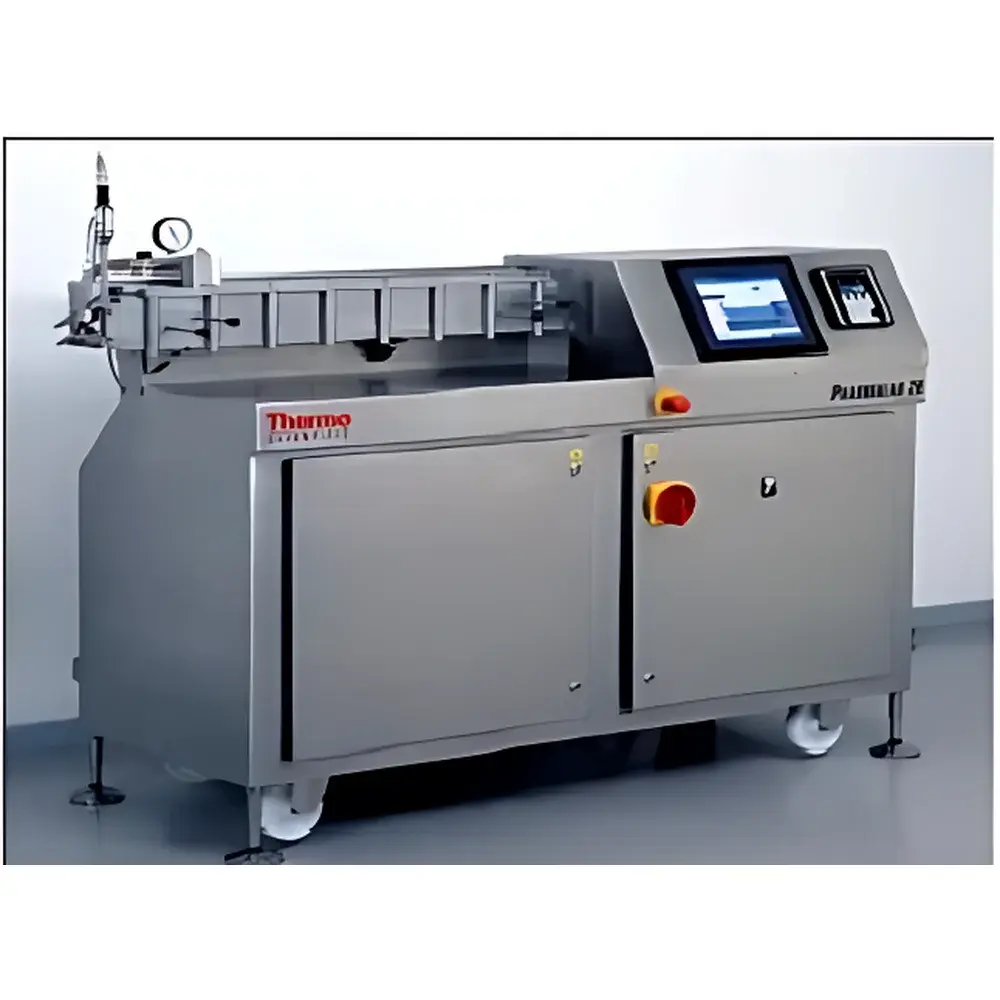
Thermo Fisher Pharma 24 HME Hot Melt Extruder
| Brand | Thermo Fisher |
|---|---|
| Origin | Germany |
| Manufacturer Type | Original Equipment Manufacturer (OEM) |
| Origin Category | Imported |
| Model | Pharma 24 |
| Pricing | Upon Request |
Overview
The Thermo Fisher Pharma 24 HME is a bench-scale, horizontal-split, twin-screw hot melt extruder engineered for pharmaceutical process development, formulation screening, and clinical-scale continuous manufacturing. Based on the proven architecture of the Pharma 16 HME platform, the Pharma 24 features an extended L/D ratio of 40:1—enabling enhanced residence time distribution control, improved mixing homogeneity, and greater flexibility in thermal and shear history modulation. Its operation relies on co-rotating intermeshing twin screws housed within a modular barrel system, where material undergoes simultaneous conveying, melting, kneading, devolatilization, and dispersive mixing under precisely controlled temperature, torque, and screw speed profiles. Designed explicitly for compliance with current Good Manufacturing Practice (cGMP) requirements, the system supports Quality-by-Design (QbD) workflows and seamless integration with Process Analytical Technology (PAT) tools—including inline Raman spectroscopy, NIR probes, and gravimetric feeders—for real-time monitoring and feedback control.
Key Features
- Horizontal split-barrel design with quick-release clamps for rapid access to screws and barrel internals—reducing downtime during cleaning, maintenance, or configuration changes.
- Modular barrel segments (solid feeding, melting, mixing, venting, and die zones) allow customizable thermal and mechanical processing zones; all segments are interchangeable and independently heated/cooled.
- GMP-compliant construction: stainless steel (AISI 316L) wetted parts, electropolished surfaces (Ra ≤ 0.4 µm), and fully traceable material certifications per EN 10204 3.1.
- Brushless AC servo motor with closed-loop speed control (0.1–600 rpm, ±0.2% repeatability) and integrated torque measurement (0–150 N·m, resolution < 0.1 N·m).
- Touchscreen HMI (10.4″ color display) with intuitive navigation, recipe management, and audit-trail-enabled operation logs compliant with FDA 21 CFR Part 11 requirements.
- Programmable Logic Controller (PLC)-based control system with embedded data acquisition (sample rate ≥ 10 Hz), real-time trending, and configurable alarm thresholds for temperature, pressure, torque, and feed rate.
Sample Compatibility & Compliance
The Pharma 24 HME accommodates a broad range of thermoplastic pharmaceutical excipients—including polyvinyl caprolactam–polyvinyl acetate–polyethylene glycol graft copolymer (Soluplus®), hydroxypropyl methylcellulose acetate succinate (HPMCAS), Eudragit® grades, and polyethylene oxide (PEO)—as well as active pharmaceutical ingredients (APIs) with thermal stability up to 220 °C. It supports both powder and granule feeding, with optional gravimetric loss-in-weight feeders meeting USP performance criteria. All operational parameters adhere to ISO 22000, ASTM F2971 (standard guide for hot-melt extrusion process validation), and ICH Q5A–Q5E biopharmaceutical quality guidelines. The system is validated per GAMP 5 principles and supports full lifecycle documentation for regulatory submissions (e.g., CMC sections of IND/NDAs).
Software & Data Management
Control and data handling are managed via Thermo Fisher’s proprietary ExtrusionSuite™ software (v3.2+), which provides secure user role management (admin/operator/auditor), electronic signatures, and automated report generation (PDF/CSV). Raw process data—including screw speed, barrel zone temperatures (±0.5 °C accuracy), melt pressure (0–100 bar, ±0.25% FS), torque, and feeder mass flow—is timestamped and stored with SHA-256 hash integrity verification. Data export supports OPC UA connectivity for integration into MES (Manufacturing Execution Systems) and LIMS platforms. Optional cloud-based analytics modules enable multivariate statistical process control (MSPC), batch trajectory comparison, and root-cause correlation across multiple extrusion campaigns.
Applications
- Amorphous solid dispersion (ASD) development for bioavailability enhancement of BCS Class II/IV compounds.
- Continuous manufacturing of directly extruded tablets, mini-tablets, and implantable dosage forms.
- Hot-melt coating of particles and beads for modified release profiling.
- Development of thermoplastic elastomer-based medical device components (e.g., catheter tubing, drug-eluting stent coatings).
- Stability-indicating studies involving thermal degradation kinetics and polymer–API interaction mapping.
- Scale-down modeling for tech transfer from lab to pilot (Pharma 24 → Pharma 40 → Pharma 60) using dimensionless number correlations (e.g., Reynolds, Froude, and Peclet numbers).
FAQ
What is the maximum operating temperature of the Pharma 24 HME barrel zones?
Standard configuration supports up to 220 °C per zone; high-temp option extends to 300 °C with upgraded heater cartridges and thermocouples.
Can the Pharma 24 be integrated with third-party PAT sensors?
Yes—via open analog/digital I/O (4–20 mA, 0–10 V, RS485 Modbus RTU) and Ethernet/IP; certified compatibility exists with Malvern Panalytical, Kaiser Optical, and Mettler Toledo PAT solutions.
Is cleaning validation support provided?
Thermo Fisher supplies a comprehensive Cleaning Validation Package including swab recovery studies, residue limit calculations per ICH Q5C, and reusable cleaning log templates aligned with EU Annex 15.
Does the system meet FDA 21 CFR Part 11 requirements out-of-the-box?
Yes—the HMI and ExtrusionSuite™ software include electronic signature workflows, audit trails with immutable storage, and role-based access controls pre-validated per GAMP 5.
What throughput range is typical for API-containing formulations?
Depending on formulation viscosity and screw configuration, typical throughputs range from 0.5 to 8 kg/h, with residence time adjustable between 30 s and 5 min.






