
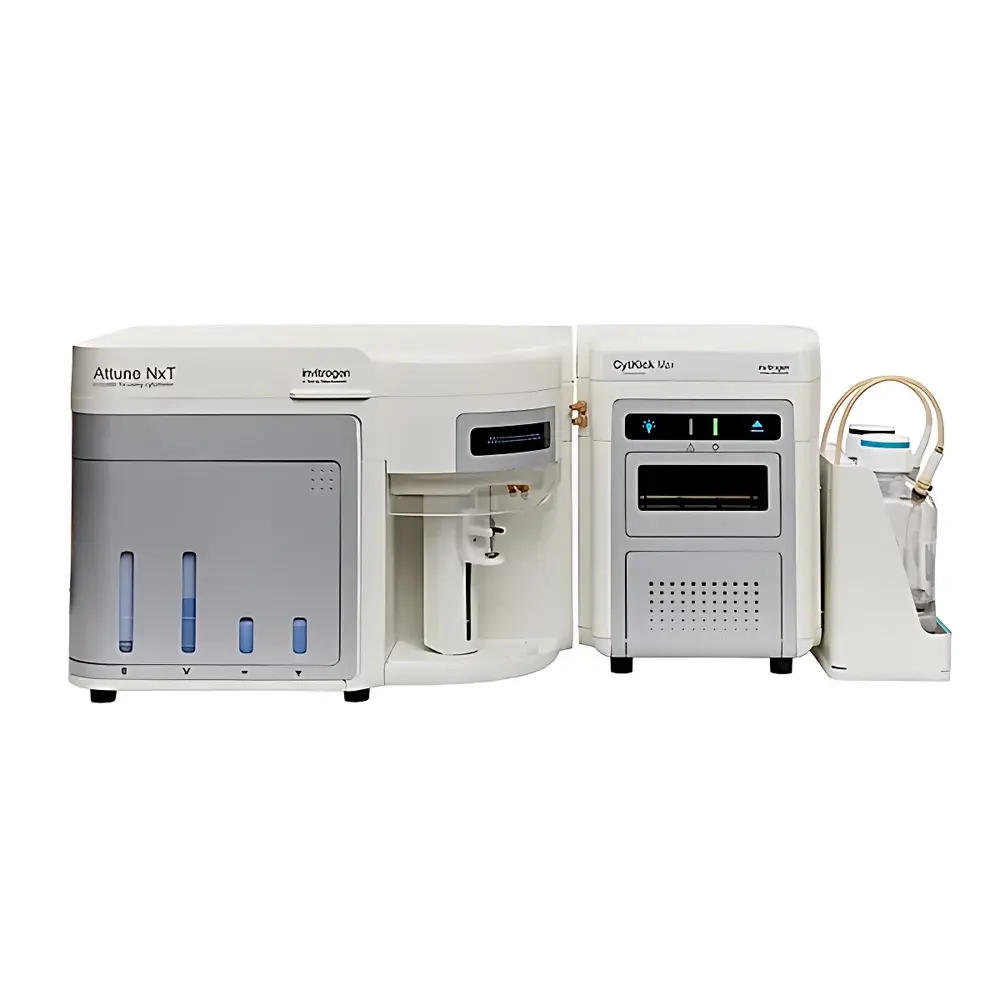
Thermo Fisher Scientific Attune NxT Flow Cytometer
| Brand | Invitrogen |
|---|---|
| Origin | Singapore |
| Manufacturer Type | Original Equipment Manufacturer (OEM) |
| Import Status | Imported Instrument |
| Model | Attune NxT |
| Product Category | Flow Cytometry Analyzer |
| Application Domain | Research-Grade Cell Analysis |
| Laser Configuration | Up to 4 Lasers, 16 Parameters |
| Coefficient of Variation (CV) | <3% |
| Sample Flow Rate | 12.5–1000 µL/min |
| Maximum Acquisition Speed | 65,000 events/sec |
| Fluorescence Sensitivity | ≤30 MESF (Molecules of Equivalent Soluble Fluorochrome) |
Overview
The Thermo Fisher Scientific Attune NxT Flow Cytometer is a benchtop, research-grade flow cytometry platform engineered for precision, reproducibility, and operational robustness in demanding life science laboratories. Unlike conventional hydrodynamic focusing systems constrained by fluidic trade-offs between speed and resolution, the Attune NxT integrates patented acoustic-assisted hydrodynamic focusing—a dual-mode alignment mechanism combining ultrasonic standing waves (>2 MHz) with laminar sheath flow. This architecture forces cells into a narrow, stable single-file stream centered precisely at the laser interrogation point—regardless of sample concentration, viscosity, or flow rate. As a result, the system achieves consistent optical excitation geometry and minimal signal variation across its full dynamic range (12.5–1000 µL/min), enabling high-fidelity multicolor immunophenotyping, rare-event detection, and kinetic studies without compromising analytical integrity.
Key Features
- Acoustic Focusing Technology: Eliminates dependence on sample-to-sheath ratio; maintains sub-3% CV across all acquisition speeds and sample types—including viscous, clumpy, or low-concentration suspensions (e.g., CSF, marine plankton, bone marrow aspirates).
- High-Throughput Acquisition: Sustains up to 65,000 events/sec at 1000 µL/min—10× faster than conventional cytometers—while preserving resolution and fluorescence sensitivity (≤30 MESF for FITC).
- No-Wash, No-Lyse Capability: Enables direct analysis of whole blood and other complex matrices without RBC lysis or centrifugation, minimizing cell loss, activation artifacts, and protocol-induced variability.
- Modular Laser & Detector Architecture: Supports up to four solid-state lasers (violet, blue, yellow, red) and 16-parameter detection via interchangeable filter sets and PMT configurations—field-upgradable without instrument downtime.
- Integrated Absolute Counting: Uses precision syringe-pump-based volumetric sampling; eliminates reliance on counting beads while maintaining traceable, ISO/IEC 17025-aligned quantification protocols.
- Optimized Optical Design: Flat-top laser beam profiles ensure uniform illumination intensity across the entire interrogation volume—removing need for daily optical alignment or real-time beam steering calibration.
Sample Compatibility & Compliance
The Attune NxT demonstrates broad compatibility with primary human and murine samples (whole blood, PBMCs, bone marrow, fine-needle aspirates), microbial cultures, phytoplankton isolates, and plant protoplasts. Its acoustic focusing enables reliable analysis of fragile or aggregation-prone populations—including stem cells, circulating tumor cells (CTCs), and side population (SP) cells—without clogging or nozzle shear damage. The platform supports GLP/GMP-aligned workflows through audit-trail-enabled software logging, user-access controls, and electronic signature compliance per FDA 21 CFR Part 11. Data files adhere to standard FCS 3.1 format and are compatible with third-party analysis platforms (FlowJo, Cytobank, R/Bioconductor). Instrument validation documentation meets ASTM E2877-22 (Standard Guide for Validation of Flow Cytometric Assays) and ISO 13845:2021 (Clinical laboratory testing and in vitro diagnostic test systems).
Software & Data Management
Attune NxT Software v4.x provides a validated, intuitive interface for experimental design, real-time acquisition monitoring, and post-acquisition analysis. Key capabilities include automated spectral compensation using built-in titration-guided algorithms, batch processing of multi-sample panels, and dynamic gating with live histogram updates at >20 million events/sec refresh rate. The Reagent Selector tool cross-references fluorochrome emission spectra against installed optical filters and recommends optimal antibody conjugates from curated databases (including Invitrogen™ eBioscience™ and BD Horizon™ reagents). All instrument settings, compensation matrices, and gate hierarchies are saved as version-controlled experiment templates. Raw data export supports both native .fcs and open HDF5 formats, facilitating integration with LIMS and ELN systems. Remote monitoring and scheduled run initiation are enabled via secure HTTPS API endpoints.
Applications
- Cancer biology: Detection and phenotyping of circulating tumor cells (CTCs), minimal residual disease (MRD), and immune checkpoint marker expression.
- Immunology: High-dimensional immune profiling (e.g., 14-color T-cell subset analysis), phospho-flow for intracellular signaling kinetics, and cytokine capture assays.
- Stem cell research: Human mesenchymal stromal cell (hMSC) characterization, side population (SP) isolation, and differentiation trajectory mapping.
- Microbiology & marine science: Enumeration and functional assessment of heterotrophic bacteria, cyanobacteria, and eukaryotic phytoplankton without fixation or staining artifacts.
- Cell cycle & proliferation: Precise DNA content quantification using DAPI or Hoechst dyes, coupled with Ki-67 or EdU incorporation readouts.
- Translational research: Bridging preclinical models (e.g., murine tumor grafts) to clinical sample analysis under harmonized SOPs compliant with ISAC guidelines.
FAQ
How does acoustic focusing differ from traditional hydrodynamic focusing?
Acoustic focusing uses ultrasonic pressure nodes to laterally confine cells within the core stream—decoupling stream width from flow rate. Hydrodynamic focusing relies solely on sheath pressure gradients, causing core stream widening and increased event coincidence at higher speeds.
Can the Attune NxT perform absolute cell counts without counting beads?
Yes—the integrated syringe pump delivers precise volumetric aspiration, enabling bead-free absolute quantification traceable to NIST-certified standards.
Is the system compatible with regulatory-compliant workflows?
Yes—software includes 21 CFR Part 11 features (electronic signatures, audit trails, role-based access), and hardware meets IEC 61010-1 safety requirements for laboratory equipment.
What sample types require no preprocessing before analysis?
Whole blood, cerebrospinal fluid (CSF), bronchoalveolar lavage (BAL) fluid, and marine water samples can be analyzed directly—without lysis, washing, or filtration.
How is laser alignment maintained over time?
The flat-top beam profile and fixed-optics design eliminate routine alignment; only annual verification using NIST-traceable reference beads is recommended per manufacturer service protocols.




